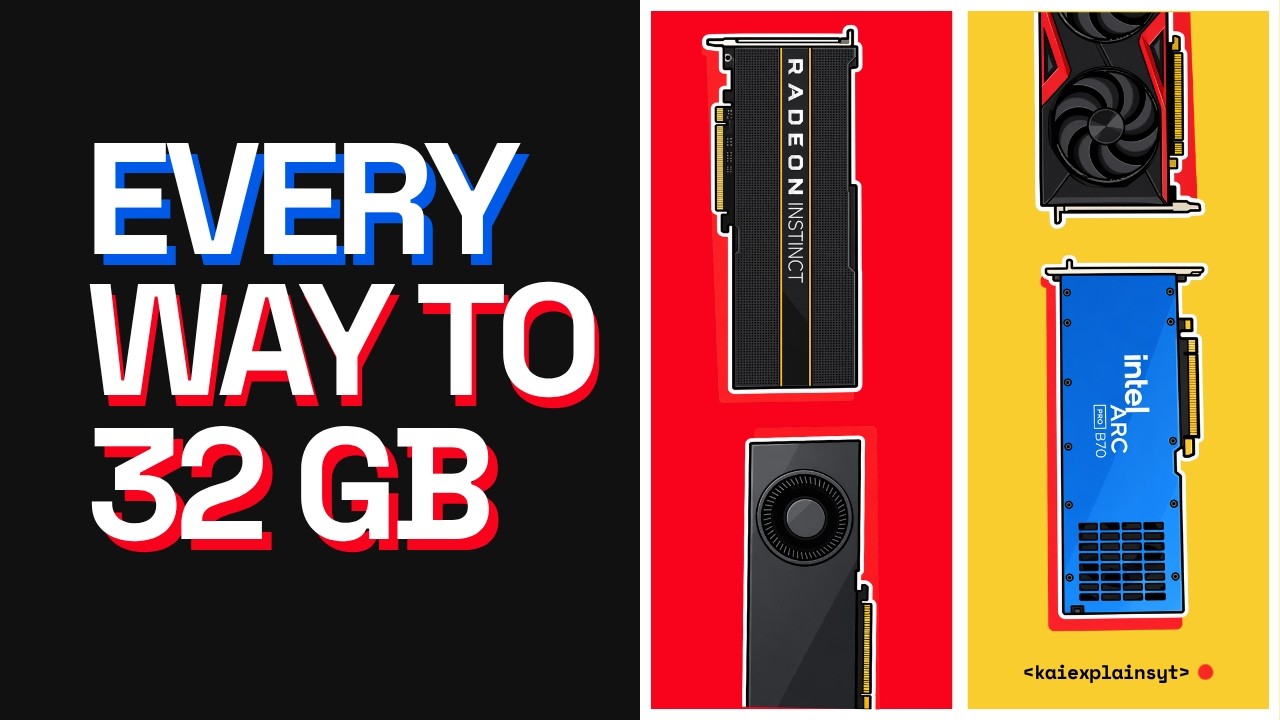
Every Ways to Get 32GB VRAM for Local AI at Full Context
Title history
- Every Ways to Get 32GB VRAM for Local AI at Full Context — observed on 20261031-2319 UTC (YouTube)
Keywords
Summary
206 words
Critical Evaluation
Value of the Information & Strength of the Argument
The video’s value lies in its rare synthesis of scattered community data into a single, decision-oriented framework. It goes beyond sticker prices by factoring in usable memory, software ecosystem, prompt processing speed, idle power draw, and total cost of ownership. The argumentation is solid: the author systematically builds the case for each option using specific benchmarks and price points from multiple sources, acknowledges limitations (e.g., V100’s cooling needs, MI50’s software challenges), and provides balanced recommendations. The logic is persuasive, particularly the comparison of renting versus owning, where he calculates hours of rental against purchase price. However, some numbers are anecdotal (e.g., specific Reddit measurements) and may not be universally reproducible, but the overall reasoning remains sound.
Scientific Rigor, Source Quality, Title Accuracy
The video demonstrates high scientific rigor in its use of sources. It references official documentation (CUDA release notes, ROCm compatibility matrix, llama.cpp multi-GPU docs), direct product pages (Newegg, Apple), and reproducible community reports (Reddit threads, YouTube benchmarks). The author explicitly mentions the volatility of prices and software support, showing awareness of the fast-moving landscape. The title is slightly ungrammatical but accurately describes the comprehensive scope; the content matches the promise of covering ’every way’ to get 32GB VRAM. The video’s structure with chapters enhances clarity, and the author’s transparency about his own experiences (buying a V100, using two 5060 Tis) adds credibility. There are no obvious logical fallacies or unsupported major claims; while some specifics may become outdated, the methodology and warning about ‘advertised vs usable’ memory remain broadly applicable.
261 words
Title / Content Match
The title accurately reflects the content, which exhaustively covers the main routes to 32GB VRAM for local AI inference, despite the minor grammatical irregularity.
Quality & Reliability
8/10
The video provides a well-structured, practical overview of 32GB VRAM options for local AI, backed by numerous community references and real-world benchmarks. However, some prices and software details are time-sensitive and based on anecdotal reports from Reddit and YouTube, not peer-reviewed sources.
Chapters
- $19 a gig, and no driver
- Why price per gig looks right
- Advertised gigs vs usable gigs
- Three 32GB names that hold 24
- Same card, three different speeds
- V100 and MI50: cheap until you read the prompt
- Two 16GB cards: the default split
- R9700 vs B70: $400 of software
- The 32GB Mac and the $4,400 5090
- The buyer who should rent instead
- What to buy this week
Cited Sources
- Fine-tune VRAM size of Mac for LLM — Referenced when explaining macOS GPU memory cap on 32GB Mac.
- CUDA 13.0 Release Notes — Referenced noting CUDA 13 drops Volta (V100).
- llama.cpp multi-GPU split modes — Referenced for layer split vs tensor split.
- RTX 3090 used pricing — As part of price comparison.
- Tesla V100 used pricing — For V100 price reference.
- Qwen3.8-27B GGUF sizes — For quantization sizes.
- AMD MI50 32GB for local LLM — For MI50 discussion.
- Qwen 3.8 27B on OpenRouter — For hosted model pricing.
- ROCm 10.0.0 supported GPUs — For MI50 not supported.
- Mac mini specs — For Mac mini memory details.
- Intel Arc Pro B70 32GB at Newegg — For B70 price.
- Radeon AI PRO R9700 32GB at Newegg — For R9700 price.
- Reddit: Arc Pro B70 at 84.65 tok/s — Referenced for B70 performance with patched vLLM.
- Reddit: R9700 on vLLM-Radiance — Referenced for R9700 high tok/s.
- Reddit: Two 5060 Ti layer vs tensor split — Referenced for tensor split speedup.
- RunPod pricing — For RTX 5090 rental cost.
- Lon.TV Tesla V100 build — Referenced for V100 build and performance.
- Best Local AI Models For Every VRAM Tier — From channel's related videos.
- Don't Buy a Mac Mini For Local AI (Do This) — From channel's related videos.
- Don't Buy a Local AI Hardware Until You See This — From channel's related videos.
Concurring Sources
- Fine-tune VRAM size of Mac for LLM — Confirms the macOS memory cap on 32GB Macs, supporting the video's claim.
- Reddit: R9700 on vLLM-Radiance — User measurements of high token rates on R9700 with a custom fork, correlating with the video's performance claims.
- Reddit: Two 5060 Ti layer vs tensor split — Real-world test showing significant speedup with tensor split, aligning with the video's recommendation.
External References
Contribution & Novelties
The video’s main contribution is a holistic, decision-ready analysis of 32GB VRAM options, highlighting often-overlooked factors such as usable memory after OS caps, software fork performance differences, idle power draw, and total cost of ownership. It consolidates fragmented community knowledge into a single resource, with a clear action plan. The author’s personal experience and candid advice (e.g., about the V100’s cooling needs and the MI50’s slow prefill) add practical depth.
Pour aller plus loin :
- Tensor splitting in llama.cpp multi-GPU — Explains the layer vs tensor split modes that are critical for multi-GPU setups.
- Multi-token prediction in LLMs (see llama.cpp docs) — An optimization technique that speeds up generation by predicting multiple tokens per pass; the video shows its impact on AMD cards.
- ROCm 10.0.0 compatibility matrix — Details which AMD GPUs are officially supported, illustrating the MI50’s lack of support.
141 words
Radar Profile
The radar profile shows high scores in information quantity and reliability, with moderate technical level and slightly lower quality (due to reliance on community data). This suggests a comprehensive, well-referenced guide that assumes some technical familiarity from the viewer, while presenting the information in an accessible manner.
💬 Très positif – Sur les 30 commentaires analysés, la grande majorité exprime une très forte approbation, louant la clarté, la profondeur et l'utilité pratique de la vidéo, avec plusieurs partages d'expériences personnelles et des remerciements pour avoir clarifié des choix complexes.