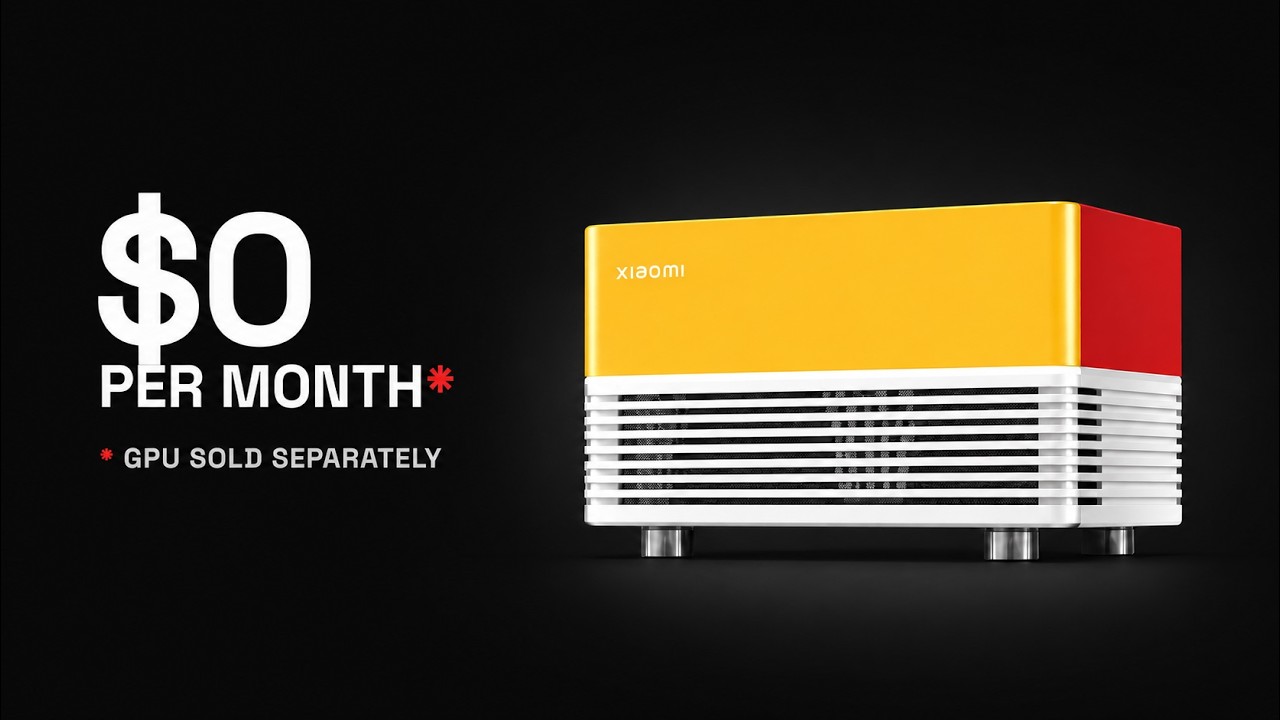
China Is Coming for Your Local AI Box (XIAOMI AI Cube)
Title history
- China Is Coming for Your Local AI Box (XIAOMI AI Cube) — observed on 20261101-0046 UTC (YouTube)
Keywords
Summary
163 words
Critical Evaluation
Value of the Information & Strength of the Argument
The video offers valuable practical insights by clarifying the critical role of memory bandwidth in local LLM performance, correcting common misconceptions about compute-centric marketing claims. The argumentation is coherent and well-illustrated with concrete benchmarks and examples, such as the comparison between DGX Spark and RTX 5090. The presenter’s personal anecdote adds credibility and makes the technical points relatable. The discussion of Chinese hardware entrants is balanced, distinguishing demonstrated facts from mere claims. The buying guide is actionable and based on real-world considerations.
Scientific Rigor, Source Quality, Title Accuracy
The video demonstrates moderate scientific rigor: it references multiple sources (reviewers, forums, press coverage) but does not provide direct citations with URLs, relying instead on anecdotal evidence and unnamed testers. The quality of sources varies, with some like LMSYS and NVIDIA official info being reliable, while others are community discussions. The title accurately reflects the content, covering Xiaomi’s AI Cube and the broader competitive landscape. The presenter shows critical thinking by questioning official numbers and highlighting the difference between marketing and reality.
179 words
Title / Content Match
The title accurately reflects the content: it compares Chinese companies' entry into local AI hardware with existing Western options.
Quality & Reliability
8/10
The video provides a well-structured technical analysis, distinguishes claims from verified facts, and offers practical buying advice. However, it relies on anecdotal evidence and some unnamed sources, and does not provide direct citations.
Key Moments
Markers derived by PSI from the transcript: the creator did not define chapters.
- Introduction: The wrong AI machine - presenter's personal mistake.
- What is a local AI box? Explanation of shared memory and bandwidth.
- DGX Spark problem: petaflop claim vs. real token generation speed.
- Xiaomi AI Cube explained: claims vs. demonstrated capabilities.
- DGX Spark cluster: real-world performance and memory constraints.
- Why AI boxes are getting cheaper: memory shortage and pricing.
Cited Sources
- Devsplainers Takeouts — Newsletter for deeper tech analysis mentioned in description.
- LMSYS, DGX Spark In-Depth Review — Mentioned as a source for performance benchmarks.
- NVIDIA DGX Spark product information — Official product specs and pricing.
- AMD Ryzen AI Max / Strix Halo product information — Product details for AMD's competing chip.
- Xiaomi AI Cube and Xring presentation coverage — Coverage of Xiaomi's launch event.
Contribution & Novelties
The video provides a clear mental model for evaluating local AI hardware, emphasizing memory bandwidth as the critical bottleneck—often overlooked in marketing. It critiques the misleading petaflop numbers and offers a practical checklist for buyers. The discussion of Chinese entrants (Xiaomi, Alibaba) is nuanced, separating hype from reality and situating their moves within the broader AI stack ownership race.
Pour aller plus loin :
- Mixture of experts — Relevant to understanding why capacity matters more than compute in modern LLMs.
- Memory bandwidth — Key spec determining token generation speed; central to the video’s argument.
- CUDA — NVIDIA’s software moat, as highlighted in the video.
104 words
Radar Profile
The radar shows a strong profile with high scores in information quantity and quality, moderate technical depth, and good reliability. The content is well-researched but relies on anecdotal evidence in places, which slightly lowers the reliability score.
💬 Positive overall. The audience engaged critically, with several commenters correcting pricing details and sharing technical experience, while many praised the clarity and value of the content.