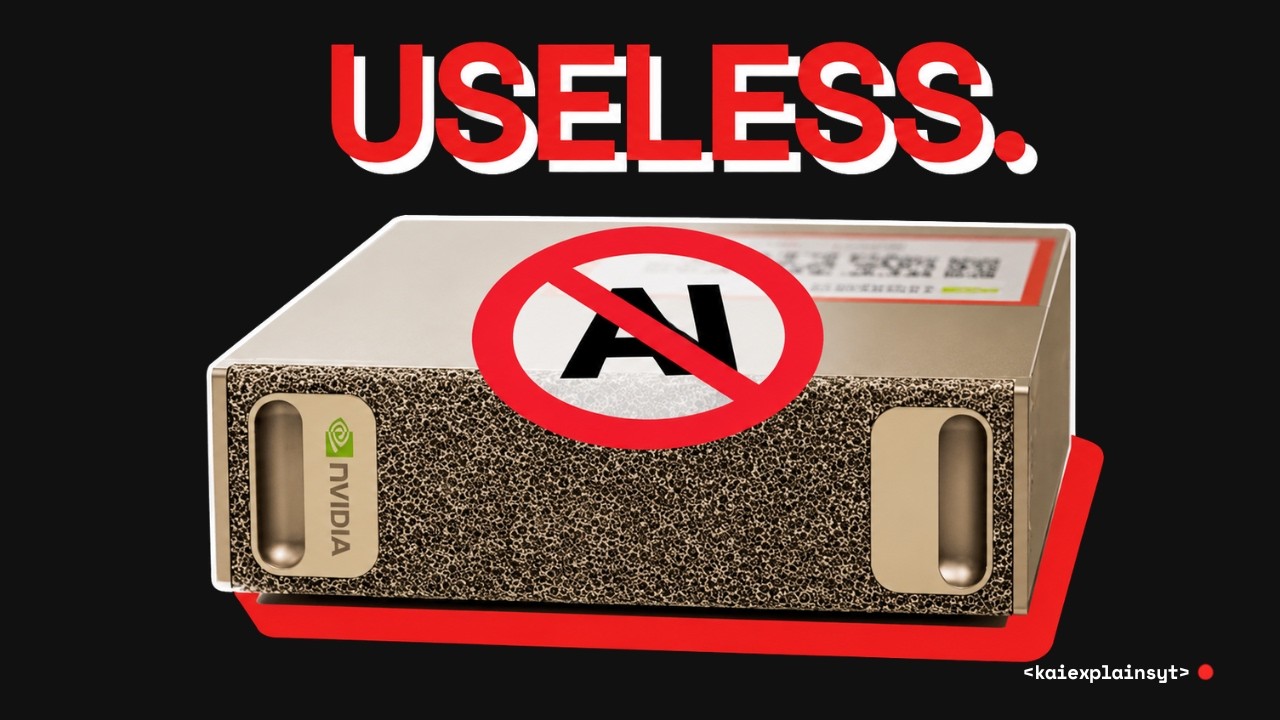
Can 9 year old GPU beats today's latest GPUs?
Title history
- Can 9 year old GPU beats today's latest GPUs? — observed on 20261031-2310 UTC (YouTube)
Keywords
Summary
162 words
Critical Evaluation
Value of the Information & Strength of the Argument
The video delivers high value by debunking the assumption that newer hardware always wins. Its argumentation is solid: it clearly separates compute-bound prefill from memory-bound decode, using real benchmarks and explaining why memory bandwidth dominates token generation. It also demonstrates that software optimization can dramatically alter performance, as evidenced by the 1Cat-vLLM improvements. The inclusion of multiple comparisons (DGX Spark, RTX 5090, 8x RTX Pro 6000) strengthens the case. The reasoning is logical and backed by data, with transparent acknowledgment of limitations such as high power draw and dependency on community support.
Scientific Rigor, Source Quality, Title Accuracy
The video maintains high scientific rigor by citing specific sources: the original benchmark by Jun Yamog, the llama.cpp CUDA scoreboard, NVIDIA’s support schedule, PyTorch’s Volta deprecation notice, and community projects on GitHub. It also references third-party pricing and API costs. The title is perfectly matched to the content, as it directly addresses the question and answers it with concrete evidence. The video’s reliance on verifiable data and clear methodology enhances its credibility.
179 words
Title / Content Match
The title poses a provocative question and the video directly answers it with concrete data, showing a specific case where a 2017 GPU outperforms 2025 hardware in token generation. The content is perfectly aligned with the title.
Quality & Reliability
8/10
The video provides a rigorous, well-referenced analysis of GPU performance for LLM inference, clearly explaining technical concepts and citing multiple independent sources, benchmarks, and community projects. It transparently discusses limitations and costs, strengthening its reliability.
Chapters
Cited Sources
- 1Cat-vLLM (V100/SM70 fork of vLLM) — The community fork of vLLM that enabled significant performance gains on V100.
- v100-skinny — A project combining 4x V100 16GB to compete with RTX 5090.
- llama.cpp CUDA scoreboard — Benchmarks showing V100 and DGX Spark token generation rates.
- DGX Spark hardware specs — Official NVIDIA documentation for DGX Spark specifications.
- DGX Spark 64GB pricing — Reports on DGX Spark pricing and 128GB clustering option.
- NVIDIA on CUDA 13 and driver 580 — Official blog detailing CUDA 13 architecture support and driver longevity.
- PyTorch Volta wheel notice — PyTorch announcement about ending pre-built binaries for Volta from version 2.15.
- Qwen 3.8 Flash API pricing — Pricing for hosted Qwen 3.8 Flash model on OpenRouter.
- v100-skinny on r/LocalLLaMA — Reddit discussion of v100-skinny project and user benchmarks.
- Jun Yamog's video: '9 year old GPU beats today's latest?' — Original benchmark video that inspired this analysis.
- Alex Ziskind's video: 8x RTX Pro 6000 benchmark — Benchmark of a high-end Blackwell server that the video compares against.
Concurring Sources
- llama.cpp CUDA scoreboard — Confirms the V100's advantage in token generation over the DGX Spark.
- Jun Yamog's benchmark video — Original source of the 155 tok/s vs 60 tok/s comparison.
Contribution & Novelties
The video’s original contribution lies in demystifying why a 2017 GPU can outperform 2025 hardware for LLM inference, centering on the critical role of memory bandwidth and the impact of community software optimization. It provides a clear, practical analysis of the trade-offs, including cost, power, and support lifecycle, offering guidance for hobbyists. The video also highlights the growing ecosystem of community-maintained forks (1Cat-vLLM, v100-skinny) that extract unexpected performance from legacy hardware.
Pour aller plus loin :
- High Bandwidth Memory (HBM) — Explains the technology behind V100’s 900 GB/s advantage.
- vLLM (official project) — The base framework that 1Cat-vLLM forks, representing the state-of-the-art in LLM serving.
- CUDA hardware support lifecycle — Official NVIDIA guide explaining why old architectures are deprecated, relevant to the V100’s future.
124 words
Radar Profile
The radar profile shows high scores in quantity and technical depth, with slightly lower scores for reliability due to occasional speculative points. The video is dense with information but remains accessible, balancing technical rigor with practical insights.
💬 Positive sentiment overall, with viewers appreciating the technical depth and clear explanation. Some comments speculate about AI-generated content, while several share personal experiences with V100 setups, validating the video's claims. The tone is engaged and informative.