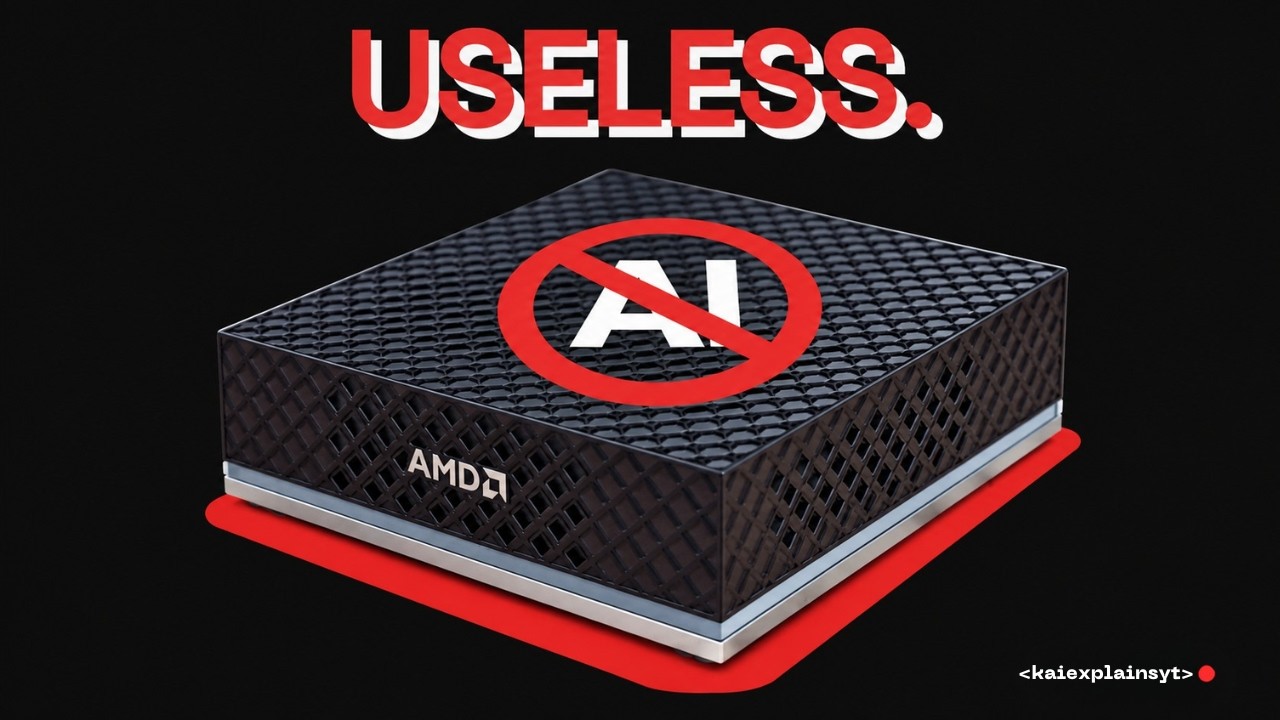
Mac Studio vs AMD AI PC: Don't Buy Before Watching This
Title history
- Mac Studio vs AMD AI PC: Don't Buy Before Watching This — observed on 20261031-2331 UTC (YouTube)
Keywords
Summary
153 words
Critical Evaluation
Value of the Information & Strength of the Argument
The video provides valuable insights into the overlooked prefill/decode distinction and the impact of model architecture on hardware advantages. The argumentation is well-structured, presenting evidence from community benchmarks and personal experience. However, the creator makes some unsupported claims (like power consumption later corrected) and the graphics errors undermine credibility. The reasoning is logical, and the conclusion is balanced, acknowledging both platforms’ strengths.
Scientific Rigor, Source Quality, Title Accuracy
The video references community benchmarks and open-source projects but doesn’t provide direct links (only a Notion page as a catch-all). The title is engaging but somewhat clickbait. The content adequately matches the title, as it offers comprehensive buying advice. The scientific rigor is moderate: numbers are cited from anonymous testers but not independently verified. The graphic errors are a notable flaw.
138 words
Title / Content Match
The title accurately reflects the content, which is a comprehensive comparison of Mac Studio and AMD AI PCs for local inference, with strong buying advice. It is slightly clickbait but appropriately sets expectations.
Quality & Reliability
7/10
The video provides well-researched information with specific benchmarks and community references, but several graphical errors and a power consumption claim (480W vs actual 145W) undermine its reliability. The core technical arguments are sound but not independently verified.
Chapters
Cited Sources
- All Links (Notion) — The creator's Notion page with all sources and links referenced in the video.
Contribution & Novelties
The video’s main contribution is the clear breakdown of prefill vs decode and its practical implications for hardware choices, especially the effect of MoE models on bandwidth advantage. It also highlights the significant role of software optimization on AMD platforms. The analysis of cheap mini PC pitfalls is valuable for buyers.
Pour aller plus loin :
- Mixture of experts (Wikipedia) — Overview of MoE models, central to the video’s argument.
- llama.cpp (GitHub) — The inference engine discussed, where AMD optimizations such as flash attention were implemented.
- AMD ROCm official site — The software stack for AMD GPUs, crucial for configuring the Ryzen AI Max.
- FlashAttention paper (arXiv) — The attention mechanism that inspired the open-source optimizations mentioned for AMD iGPU.
120 words
Radar Profile
The scores show a technically dense video with high information quantity but moderate reliability and quality. The strong technical level is balanced by presentation errors, making it useful for informed viewers but requiring caution on specific numbers.
💬 Sur les 30 commentaires analysés, l'ambiance est mitigée : une part notable critique les erreurs graphiques nombreuses, tandis que d'autres saluent l'analyse technique détaillée. Le ton général est plutôt négatif en raison des problèmes de présentation, malgré la valeur du contenu.