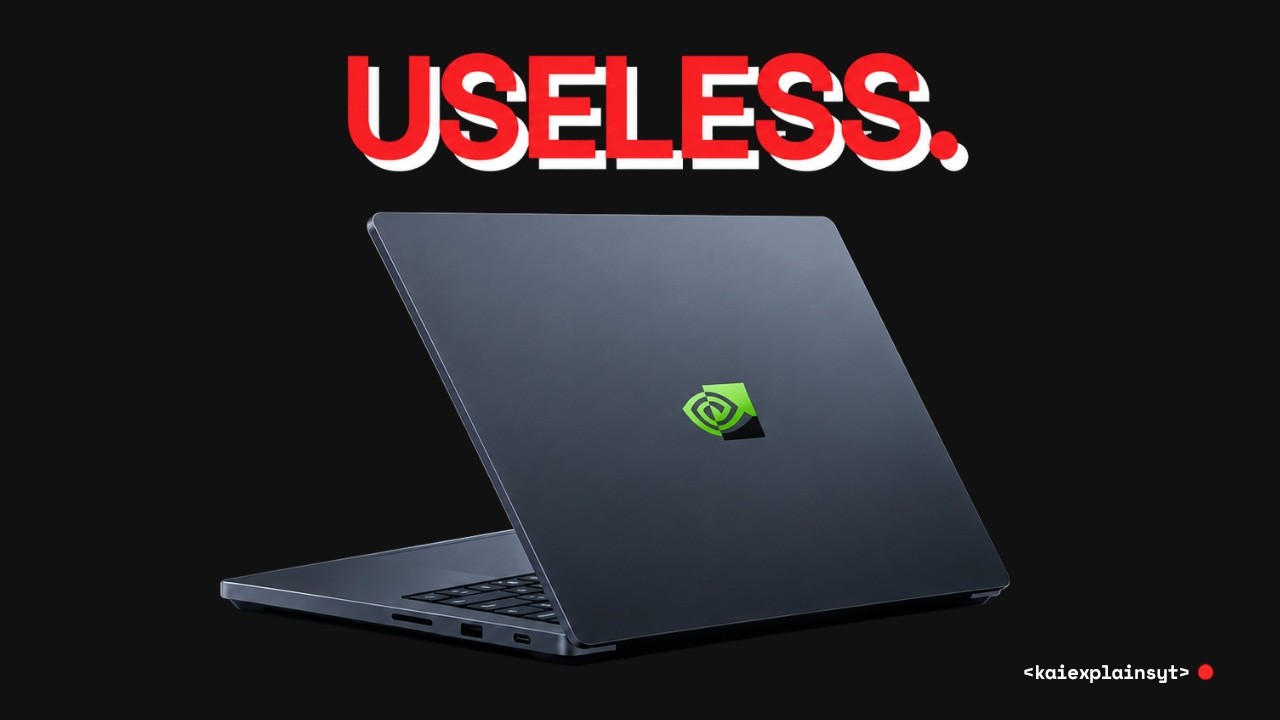
Don't Buy a RTX Spark Laptop For Local AI Until You See This
Title history
- Don't Buy a RTX Spark Laptop For Local AI Until You See This — observed on 20261031-2310 UTC (YouTube)
Keywords
Summary
153 words
Critical Evaluation
Value of the Information & Strength of the Argument
The video provides valuable insight by clarifying the often-overlooked prefill bottleneck in local AI hardware, using concrete numbers from Microsoft and NVIDIA forums. The argumentation is solid: it logically connects power consumption to compute capability, demonstrates with cited benchmarks, and acknowledges counterpoints (e.g., caching, warm turns). It avoids hype and gives balanced advice, although some extrapolations (like comparing different models/engines) are noted as directional, not definitive.
Scientific Rigor, Source Quality, Title Accuracy
The video relies on primary sources: Microsoft’s developer blog, NVIDIA’s forum, Tom’s Hardware, and manufacturer specs. It transparently states that all speeds are third-party published numbers. The title matches the content, which is a cautionary review. The video does not overstate claims; it explicitly notes when comparisons are not apples-to-apples. The inclusion of six sources from the description strengthens credibility, and the creator’s willingness to correct prior assumptions (e.g., 110 W figure) indicates rigor.
155 words
Title / Content Match
The title accurately reflects the video's focus on prefill performance concerns before purchasing an RTX Spark laptop, aligning with the content presented.
Quality & Reliability
8/10
The video bases its analysis on official benchmarks (Microsoft's developer blog, NVIDIA forums) and clearly explains the technical distinction between prefill and decode. It acknowledges uncertainties (e.g., final wattage) and provides sourced figures. The argumentation is structured and transparent, though some extrapolations are made from limited data.
Chapters
- 170 seconds before the first word
- The case for the RTX Spark laptop
- Prefill vs decode: the two jobs
- Same chip, 80 watts instead of 140
- Microsoft’s own benchmark
- Why coding agents live on prefill
- The DGX Spark price flipped
- 128GB that shows up as 110
- Who should buy one anyway
- The AMD alternative
- Four things to check in the reviews
- Verdict
Cited Sources
- Microsoft's local model benchmark — Primary source for prefill and decode performance numbers on Surface Laptop Ultra.
- RTX Spark N1X TDP by SKU (StorageReview) — Provides TDP and memory bandwidth specifications for RTX Spark N1X.
- NVIDIA RTX Spark official page — Official product information.
- Tom's Hardware article on 110 W statement — Background on Microsoft's TDP statements and correction.
- NVIDIA developer forum thread on DGX Spark prefill — User-reported prefill speeds on DGX Spark for comparison.
- The Register article on DGX Spark price increase — Reports DGX Spark price raise to $6,950.
- Microsoft Store page for Surface Laptop Ultra — Price, stock, and return policy information.
- Surface Laptop Ultra footnote 5 — Notes GPU memory accessible is less than total.
- Surface RTX Spark Dev Box — Alternative with 100 W thermal envelope.
- MacBook Pro M5 Max specs — Provides memory bandwidth for comparison.
- Gizmodo article on Surface Laptop Ultra battery claim — Claims 99% GPU performance on battery.
- Bosgame M5 product page — AMD alternative with Ryzen AI Max+ 395.
- Strata v0.1.40 release — Engine used in prefill comparisons.
- MacRumors article on upcoming MacBook Pros — Reuters report on Apple launch timing.
Concurring Sources
- NVIDIA developer forum thread 385316 — DGX Spark user reports higher prefill speeds, supporting the power-vs-performance argument.
- StorageReview TDP data — Confirms laptop TDP range and memory bandwidth specifications.
Dissenting Sources
- Top comment on video — A commenter claims underclocked DGX Spark units at under 100 W lose only single-digit percentage prefill performance, contradicting the simple TDP arithmetic. However, this is not a published source but an anecdotal claim.
External References
Contribution & Novelties
The video breaks new ground by shifting the local AI laptop debate from memory bandwidth to power-limited prefill, using Microsoft’s own published data to illustrate a 170-second cold prompt latency. It also highlights the DGX Spark’s price hike and provides a pragmatic four-point checklist for evaluating reviews. This is rare in the tech review space, where prefill is often overlooked.
Pour aller plus loin :
- Prefill and decode in LLMs — Background on transformer inference phases.
- NVIDIA DGX Spark — Desktop alternative with higher TDP.
- Mixture of Experts — Architecture behind MAI Code 1.1 Flash.
- Speculative decoding — Technique used in Microsoft’s benchmark.
- Apple M5 Max memory bandwidth — Comparison point for decode speed.
114 words
Radar Profile
The profile shows high reliability and technical depth with slightly lower information quantity, reflecting a focused analysis rather than a broad overview. The balance between qualitative and quantitative metrics suggests a well-researched but targeted video.
💬 Balanced. The 30 comments show a mix of agreement, technical disagreements, and practical advice. Many appreciate the detailed breakdown, while some challenge the power-draw assumptions or suggest alternatives. Overall, viewers engage constructively with the technical content.