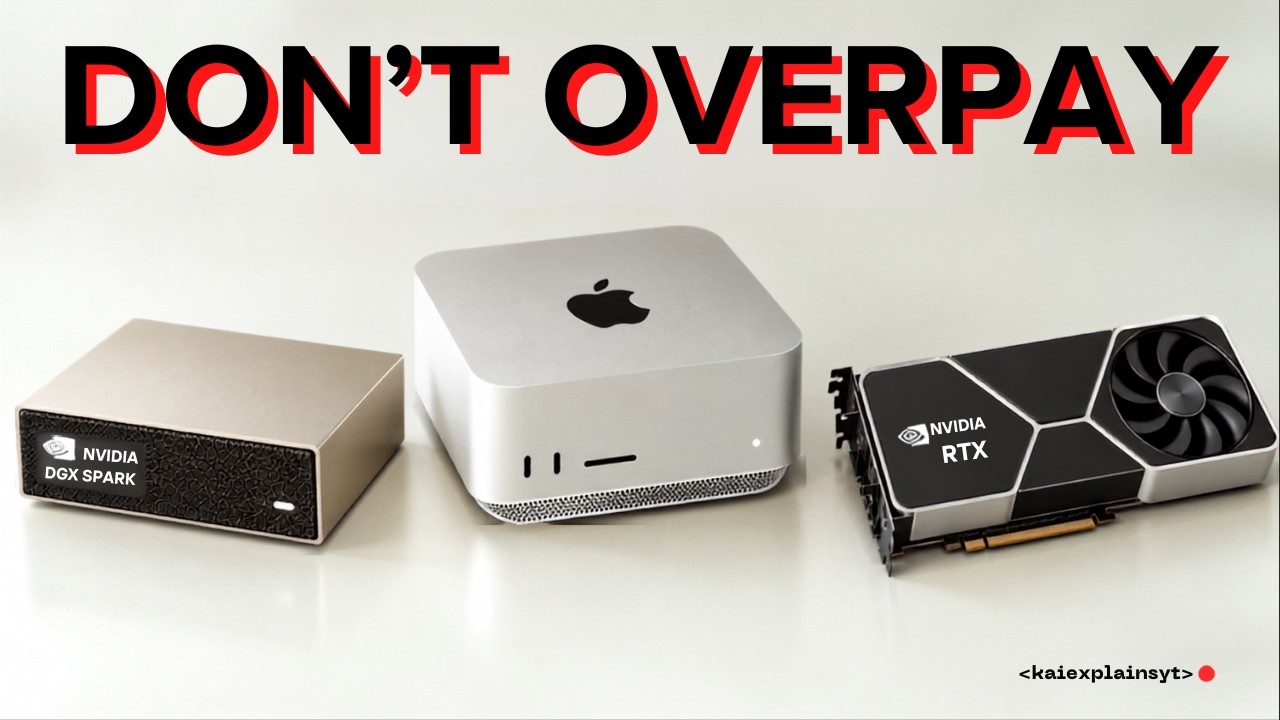
Every Ways to Get 128GB VRAM for Local AI at Full Context
Title history
- Every Ways to Get 128GB VRAM for Local AI at Full Context — observed on 20261031-2313 UTC (YouTube)
Keywords
Summary
145 words
Critical Evaluation
Value of the Information & Strength of the Argument
The video’s value is high: it aggregates scattered community data and pricing into a coherent decision framework. The argumentation is logical, progressing from the technical basis (model architecture, quantization, offloading) to concrete price/performance comparisons. The presenter clearly distinguishes between unified memory and discrete VRAM, and introduces the concept of ‘buying the fourth bit’ as a quantified upgrade cost. However, some performance figures are drawn from unverified community posts, and the claim that Strata works only on Flash-Next is a limitation. The reasoning remains balanced, acknowledging trade-offs like power consumption and context window constraints.
Scientific Rigor, Source Quality, Title Accuracy
The video cites multiple sources: ServeTheHome for DGX Spark pricing, Reddit threads for specific builds, Prismix for MLX benchmarks, and the Strata GitHub repository. The sources are relevant and current (October 2026). The title perfectly matches the scope, and the content is well-structured with clear chapters. The creator distinguishes between speculation and measured data, but some numbers (e.g., RTX Spark claims) are flagged as not independently verified. The overall rigor is commendable, though the reliance on community data introduces moderate uncertainty.
189 words
Title / Content Match
The title accurately reflects the content: the video systematically covers all major routes to 128GB of memory for local AI, including unified memory systems, multi-GPU builds, and hybrid RAM/VRAM setups, with a focus on full-context performance.
Quality & Reliability
8/10
The video provides detailed, up-to-date pricing and benchmark data, citing specific community reports and tool documentation. While some figures rely on user-submitted measurements rather than controlled testing, the methodology is transparent and sources are clearly listed. The analysis distinguishes between expert offloading and unified memory, offering practical, well-reasoned conclusions.
Chapters
Cited Sources
- DGX Spark 64GB launched and 128GB price increase — Source for DGX Spark pricing and launch info.
- Strata engine GitHub repository — Official repository for the Strata inference engine.
- Flash-Next on M5 Max (MLX) — MLX benchmarks for Flash-Next on Mac Studio M5 Max.
- 4x V620 build — Reddit thread detailing the four Radeon Pro V620 build.
- Strix Halo, llama.cpp vs Gufo — Reddit thread comparing inference engines on Strix Halo.
- Qwen 3.8 Flash-Next explained — Video explaining the model architecture.
Concurring Sources
- ServeTheHome DGX Spark pricing — Confirms the DGX Spark price increase and specs.
- Reddit 4x V620 build — Corroborates the multi-GPU build performance and cost.
External References
Contribution & Novelties
The video’s originality lies in systematically pricing the ‘fourth bit’ of precision across all hardware routes, and in highlighting the expert offloading technique (Strata) that allows running large models on modest hardware. It also corrects common misconceptions about memory caps (e.g., 96GB limit on Windows/macOS) and provides a clear decision framework.
Pour aller plus loin :
- Strata engine — Core tool enabling expert offloading; essential for understanding the budget route.
- Qwen 3.8 Flash-Next model — Video explaining the model’s architecture and parameter efficiency.
- Expert offloading (concept) — No stable URL provided, but can be researched via academic papers on mixture-of-experts and weight offloading.
103 words
Radar Profile
The radar exhibits strong performance in quantity of information and technical depth, with slightly lower scores in reliability due to reliance on community-sourced data. The global score reflects a well-structured, expert-led comparison.
💬 Très positif. Sur les 30 commentaires analysés, la grande majorité exprime une gratitude et une admiration pour la clarté et l'exhaustivité de l'analyse, certains partageant leurs propres configurations et résultats, avec seulement quelques corrections mineures ou préoccupations sur les prix.