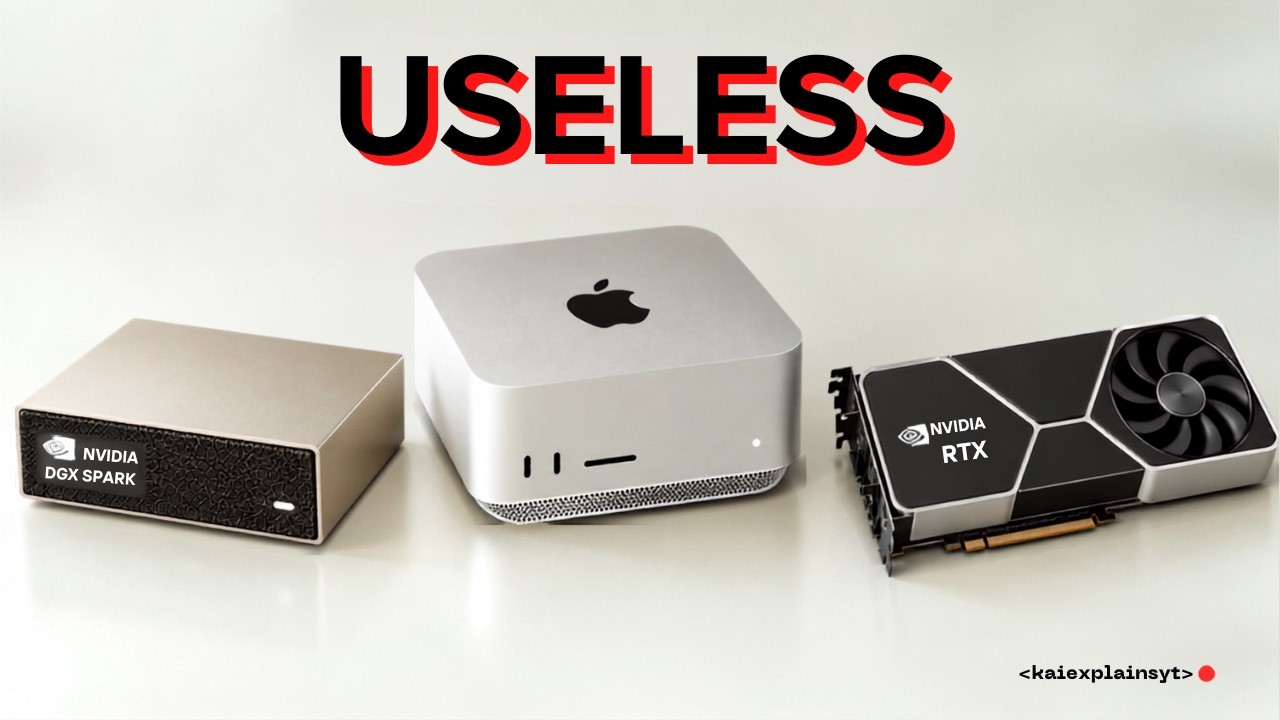
Don't Buy a Local AI Hardware Until You See This
Title history
- Don't Buy a Local AI Hardware Until You See This — observed on 20261031-2332 UTC (YouTube)
Keywords
Summary
187 words
Critical Evaluation
Value of the Information & Strength of the Argument
The video’s value lies in its unconventional focus on resale value and bandwidth per dollar, which are typically absent from hardware reviews. The argumentation is logical and well-structured, using concrete examples like the 3090 price surge, soldered memory illiquidity, and a detailed break-even calculation. The author also nuances his own advice, acknowledging scenarios where local hardware is indispensable (privacy, data residency) and where it’s already owned. The reasoning is persuasive, though some comparisons (e.g., Apple trade-in vs. eBay) could be viewed as unflattering, but the core logic is sound.
Scientific Rigor, Source Quality, Title Accuracy
The video demonstrates strong internal rigor, with careful reasoning and a clear thesis. However, it cites unnamed price trackers and token indices without direct links, relying on the author’s credibility. The title is catchy but accurately summarizes the message. The content matches the title well. Related videos in the description offer additional context but do not serve as primary sources. Overall, the video’s rigor is good for an opinion piece, but independent verification of the cited data would enhance its reliability.
185 words
Title / Content Match
The title accurately reflects the content: a cautionary economic analysis of buying local AI hardware, with a strong focus on resale value and bandwidth efficiency.
Quality & Reliability
8/10
The video offers a well-reasoned and detailed analysis of local AI hardware purchasing economics, using concrete market data and practical examples. However, it lacks direct citations to primary sources for its key data points, relying on the author's own research, which slightly reduces its verifiability.
Chapters
Cited Sources
- Is Frontier Class Local AI Possible? — Related video from the same channel, providing additional context on local AI capabilities.
- Your AI Coding Plan is Worth Less — Related video from the same channel, discussing the economics of AI coding tools.
Contribution & Novelties
This video brings a fresh perspective to local AI hardware reviews by emphasizing long-term ownership costs, particularly resale value and bandwidth per dollar, rather than just capacity or peak performance. It introduces novel concepts like the ‘memory commodity’ nature of certain GPUs and the impact of prefill speed on real-world workloads. For further exploration, consider these resources:
Pour aller plus loin :
- Memory bandwidth — Directly relevant to the core argument about bandwidth per dollar.
- High Bandwidth Memory (HBM) — Explains the technology behind the memory shortage and its impact on GPU prices.
- Total cost of ownership — A framework for evaluating the full economic picture of hardware purchases, central to the video’s methodology.
114 words
Radar Profile
The radar profile shows a well-balanced analysis with high quantity and quality of information, a solid technical level, but a slightly lower reliability score due to the absence of primary source citations. This indicates a valuable and informative yet not fully verifiable presentation.
💬 Based on the 30 comments analyzed, the response was largely positive, with many praising the depth of analysis and practical advice, though a few criticized the comparison between Apple trade-in and used GPU resale values.