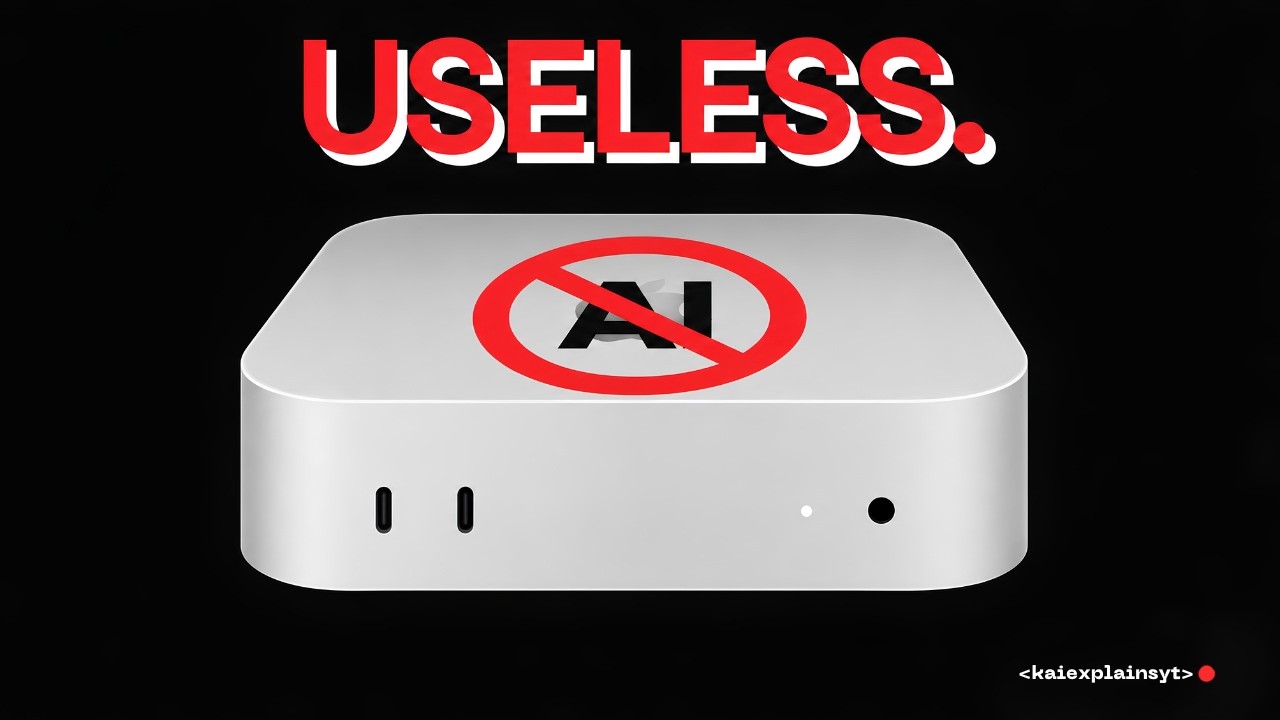
Don't Buy a Mac Mini For Local AI (Do This)
Title history
- Don't Buy a Mac Mini For Local AI (Do This) — observed on 20261031-2327 UTC (YouTube)
Keywords
Summary
202 words
Critical Evaluation
Value of the Information & Strength of the Argument
The value of this video lies in its clear articulation of hidden costs and technical trade-offs, going beyond superficial benchmarks. It debunks the marketing focus on peak token rates by highlighting pre-fill delays and the impact of context length. The argument is well-structured: it starts with a personal near-mistake, builds a cost analysis, explains bandwidth, demonstrates hard ceiling, attributes price rises to market shortages, then offers actionable solutions (server change, sparse models) and a final purchase recommendation. The reasoning is logical and supported by specific numbers (e.g., $25/GB, 57→3 t/s, 94% pre-fill). The author consistently ties back to the user’s real needs rather than specs, strengthening the persuasive power.
Scientific Rigor, Source Quality, Title Accuracy
The scientific rigor is moderate: the author cites Apple’s ML research and community benchmarks, but no direct links are provided. The claims about memory bandwidth and sparse models are well-established, but some anecdotal data (e.g., exact token rates from user posts) lack verification. The title is apt and not misleading; it directly signals the counter-intuitive advice. The discussion of DRAM shortage and price increases is factual. Adequacy: the title matches the content, and the video delivers on its promise. Weaknesses: no explicit citations, and the ‘halucinated’ correction from a commenter indicates a minor factual error about Mac Mini configurations (the 24GB base vs 16GB upgrade bandwidth). Overall, the approach is honest and data-informed, but more rigorous sourcing would elevate confidence.
244 words
Title / Content Match
The title accurately reflects the content: a critical evaluation of Mac Mini purchases for local AI, with alternatives and recommendations. The 'Do This' is fulfilled by concrete advice on server changes and model choice.
Quality & Reliability
8/10
The video provides a balanced, data-driven analysis of Mac Mini options for local AI, correctly identifying technical bottlenecks like memory bandwidth and pre-fill costs. It cites specific benchmarks and price structures, though some claims (e.g., exact token rates) are anecdotal. The author acknowledges market externalities and avoids hype, but the lack of direct source links slightly reduces verifiability.
Chapters
Contribution & Novelties
The video’s original contribution is reframing local AI hardware purchases around memory bandwidth and pre-fill latency rather than raw token counts, and introducing sparse Mixture-of-Experts models as a game-changer that lowers hardware requirements. It also contextualizes Apple’s pricing within the global DRAM shortage, showing the broader market dynamics.
Pour aller plus loin :
- Mixture of experts — Architectures that activate only a subset of parameters per token, reducing inference cost and memory requirements.
- KV cache in large language models — The key-value cache stores attention history; its size grows with context and can become a memory bottleneck.
- DRAM price surge due to AI demand — Background on why DRAM prices have skyrocketed, tied to high-bandwidth for AI data centers.
119 words
Radar Profile
The profile shows high scores in quantity and quality of information, with a strong technical depth; the lowest is reliability, reflecting the lack of explicit sourcing. The overall shape suggests an informative, technically competent video with room for better verifiability.
💬 The comment section is predominantly positive, with many viewers expressing gratitude for the honest and nuanced breakdown, and a few technical critiques about specific model age and configuration details. The overall tone is appreciative, valuing the no-hype approach.