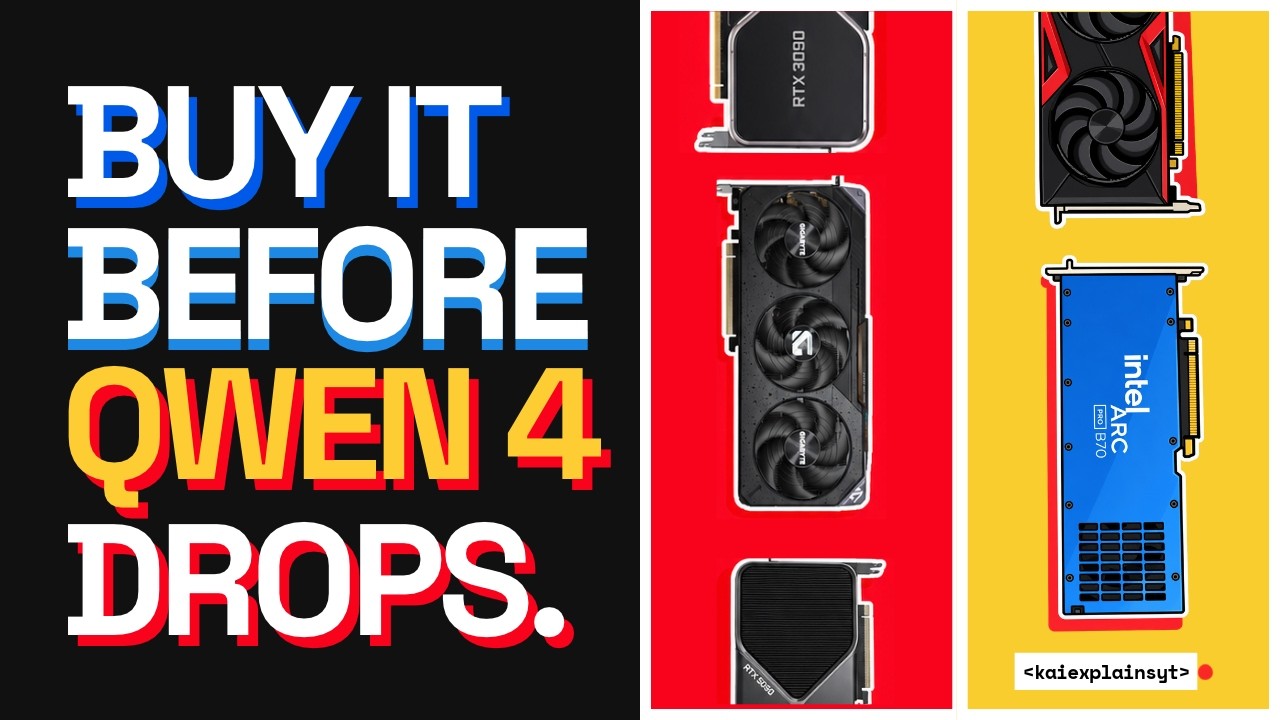
10 GPUs You Should Get for Local AI Before Qwen 4's Release!
Keywords
Summary
326 words
Critical Evaluation
Value of the Information & Strength of the Argument
The informational value lies less in the ten numbers than in the frame built around them: the explicit separation of decode from prefill, the demonstration that a theoretical bandwidth ceiling can be exceeded only by a decoding trick, and the insistence that a benchmark run on Qwen 3.8 does not transfer automatically to an architecture nobody can download yet. That reasoning chain is coherent and self-consistent. The ceiling computation is transparent and reproducible by hand, and the explanation of why the Qwen 4 MTP head is stuck — several parallel residual streams, each requiring its own prediction head, with averaging tanking the acceptance rate — is specific enough to be checked against the linked pull requests. The argument is also honest about the cost of its own metric: the author repeatedly flags that the cheapest cards per token are the ones with the worst prefill, the least certain software support or the oldest silicon, and that a low $/tok figure can hide a workflow problem. Where the argument thins is in its single-axis optimisation. Price divided by plain decode ignores VRAM headroom, power, cooling, motherboard and PSU costs, resale and noise, so a pair of cards that needs two PCIe x8 slots and 600 W is compared on the same axis as a single card. Several load-bearing data points are single tests with unreported methodology, and the 84.56 tok/s figure for the B70, presented as the widest column spread in the whole video, rests on one patched community setup that the author himself says can crash under two concurrent requests. The speculative element — that Qwen 4 will resemble Qwen 3.8 closely enough in size and context regime for these extrapolations to hold — is stated as an assumption but never stress-tested against alternative scenarios. The overall argument is stronger on mechanism and on incentives (why benchmark lists converge on one column, why prices moved) than on empirical breadth.
Scientific Rigor, Source Quality, Title Accuracy
Sourcing discipline is above average for the genre. Every price carries a date and a stated method, the price aggregator is named and linked, and the technical claims are tied to specific artefacts: GitHub pull request numbers with their status and last-update dates, Hugging Face model cards for the benchmarked model, and a serving-framework recipe showing that MTP for the new architecture already works on one path and not another. Third-party testing is attributed by name to identifiable individuals and sites rather than to ‘people are saying’, and the video openly declares its data gaps — no clean prefill benchmark for the 7900 XTX, no Qwen 3.8 numbers at all for the Arc Pro B65 — which is the single most reliable signal of good faith in this format. The weak flank is the provenance of the throughput figures: most come from individual owners posting on forums, with no repeated trials, no reported batch size, quantization, context length or build hash, so a 41.3 tok/s and a 38.3 tok/s on different cards are not strictly comparable. The internal estimate of Qwen 4’s residual-stream count is sourced to kernel code that was only briefly public and has since been deleted, which the author states but which the viewer cannot verify. The title-to-content match is solid: ten cards, ten price-per-token figures, and a stated purchasing conclusion for each, with the caveat that a title framed around ‘should get’ undersells how many of the ten the video effectively argues against.
581 words
Title / Content Match
The title promises ten GPUs to buy ahead of Qwen 4 and the video delivers exactly ten, each with price, measured speed and a stated caveat; the ranking is honest enough to tell viewers that several of the ten are poor buys on the recommended metric, which is a nuance the click-oriented title does not convey.
Quality & Reliability
7/10
The video is unusually explicit about its own methodology: it names the community table it re-analyses, links the llama.cpp pull requests, gives the exact pricing method (average of the three cheapest listings, dated 25 November 2026), and states where data is missing (no clean prefill benchmark for the RX 7900 XTX, a single self-measured run for the dual RTX 5070 Ti, a single-user number for the Arc Pro B70 with MTP). The bandwidth-ceiling reasoning is checkable arithmetic. The main reservations are that many throughput figures come from anonymous forum owners whose test conditions are not reported, that the central premise (Qwen 4's release date, size and weights) is unverifiable by the viewer at the time of publication, and that the single ranking metric deliberately ignores VRAM capacity, power draw, platform cost and noise, which the video acknowledges only partially.
Chapters
- Every GPU list quotes the wrong column
- Decode, prefill and the MTP trick
- RTX 3090: the $35 yardstick
- Dual GPUs: 2x RTX 3060, 2x 5060 Ti, 2x 5070 Ti
- AMD and Intel: RX 7900 XTX, R9700, Arc Pro B70
- Data center cards: Tesla V100 and P100
- RTX 5090: slower than a 3090 at 64K
- All 10 ranked: what to buy before Qwen 4
Cited Sources
- Community MTP table (sudoingX/qwen38-mtp) — The two-column community table from which the widely quoted figures (63 tok/s on an RTX 3090, 76 on 2× RTX 5060 Ti, 155 on an RTX 5090) originate; the video's whole thesis is that lists quote the fast column only.
- llama.cpp PR #27742 (qwen4exp) — Basic support for Qwen 4's preview architecture, reportedly added about three days after the model was previewed.
- llama.cpp PR #27836 (qwen4exp MTP head, draft) — The unmerged MTP head for the new architecture, cited as a draft roughly 90 days old with a last update on 2 October — the reason the video ranks on the plain column.
- llama.cpp PR #28243 (closed) — A second attempt at the same MTP support, closed without merging, cited as evidence that the blocker is technical rather than a matter of neglect.
- Qwen3.8-Flash-Next model card — The preview of Qwen 4's architecture that the video uses to date the ecosystem timeline and to argue that small Qwen 4 models still have no weights, size or release date.
- vLLM Flash-Next recipe — Used to support the claim that MTP for the new architecture already works in a serving framework on Nvidia cards — i.e. the trick is not dead, it is unevenly available.
- Qwen3.8-27B model card — The model every quoted benchmark was actually measured on, since Qwen 4 small models are not available.
- Unsloth Qwen3.8-27B GGUF — Source for the quantized file sizes (about 16.5 GB at four bits) used in the bandwidth-ceiling calculation.
- Hardware Corner — Qwen3.8 27B hardware tests — Provides the context-length measurements behind the RTX 5090's degradation: 74.83 tok/s at 4K, 26.22 at 64K and 22.79 at 128K, versus 41.3 tok/s for an RTX 3090 at 64K.
- Jonathan Mann — Qwen3.8-27B on Arc Pro B70 — Source for both the plain figures (21.41 tok/s with SYCL, 16.02 with Vulkan) and the patched vLLM + MTP result of 84.56 tok/s, described as a single carefully configured setup.
- GPU Poet — November 2026 GPU market report — The pricing method used throughout: the average of the three cheapest listings, dated 25 November 2026.
- GPUDojo — RTX 3090 asks rise — Cited for the observation that the median eBay asking price for an RTX 3090 approached $2,000 on 11 November while sold prices climbed quickly.
- ComputingForGeeks — Black Friday GPU deals (23 Nov) — Used for specific new-retail listings, including an ASUS TUF RTX 5090 at $7,280 on 23 November.
- Kmic llama.cpp fork (P100 kernels) — A fork with kernels hand-optimised for the Tesla P100, reaching 32.6 tok/s plain (about 54 with MTP) against 17.5 stock, and expected to be updated for Qwen 4.
- Oliver Sulzer — R9700 Radiance test — The 18 November test cited for the Radeon AI Pro R9700's cold-prompt speed-up of 3× to 4.2× on the Radiance engine versus the standard Vulkan path, with both paths tied on cached prompts.
Concurring Sources
- Hardware Corner — Qwen3.8 27B hardware tests — Independently supports the video's most counter-intuitive claim that a 32 GB flagship loses most of its advantage at long context, by testing the same model at 4K, 64K and 128K rather than at a single short prompt.
- vLLM Flash-Next recipe — Corroborates the video's framing that MTP support exists on some paths and not others: the feature is available in a serving framework on Nvidia hardware while the llama.cpp implementation remains an unmerged draft.
- Unsloth Qwen3.8-27B GGUF — Allows the bandwidth-ceiling arithmetic to be checked directly, since the quantized file sizes quoted in the video are listed on the model repository.
Dissenting Sources
- Community MTP table (sudoingX/qwen38-mtp) — The same table the video re-analyses is the source of the fast-column figures that circulate without their precondition: 63 tok/s on an RTX 3090, 76 on 2× RTX 5060 Ti, 155 on an RTX 5090. Those numbers are not contradicted so much as decontextualised — they require a working MTP head for the architecture being run, which is exactly what is missing for Qwen 4, so any list quoting them as day-one performance is in tension with the draft pull request cited alongside them.
Contribution & Novelties
The original contribution is not new hardware data but a reframing that most of the widely circulated local-AI GPU numbers are conditional on a decoding feature that may not exist for the next model generation. By separating the fast column from the plain column and then publishing the price-per-plain-token ranking, the video makes a falsifiable, checkable claim about buyer remorse: the card that looks best on a Qwen 3.8 table is not necessarily the card that performs on day one of a new architecture. The secondary contribution is the observation that the market itself appears to be pricing the fast column — the P100 doubling, the V100 up 48%, the 7900 XTX up 39% while the dual 3060 barely moves — which turns a benchmark critique into a claim about where the used market is mispriced. The tensor-split versus layer-split flag is treated as an under-discussed 40% performance loss, which for a viewer with a multi-GPU rig is arguably the most actionable single item in the video.
Further reading:
- Memory bandwidth — Background for the ceiling argument: tokens per second for a single-stream decode is bounded by how fast weights move from VRAM into the compute cores.
- Large language model — Context for the distinction the video draws between prefill (prompt processing) and decode (token generation), and for quantization effects on file size.
- llama.cpp repository — The engine whose split-mode defaults, SYCL/Vulkan backends and third-party patches determine most of the numbers discussed; the pull requests cited all live here.
- Multi-token prediction / speculative decoding as a decoding-time technique, and tensor split versus layer split in llama.cpp — worth reading up on by name, as no single canonical reference page is reliably available.
- Nvidia Tesla — Background on the data-center V100 and P100 lineage and why Volta support ends with a specific driver branch.
303 words
Radar Profile
The profile is lopsided toward information density and technical depth, with reliability held back mainly by the provenance of the individual throughput measurements rather than by any obvious bias. Quality sits just below quantity because the video is transparent about its data gaps and its metric's blind spots, but the underlying numbers are single unreplicated runs from unnamed configurations. This is a dense, method-conscious buying analysis whose confidence should be recalibrated rather than dismissed.