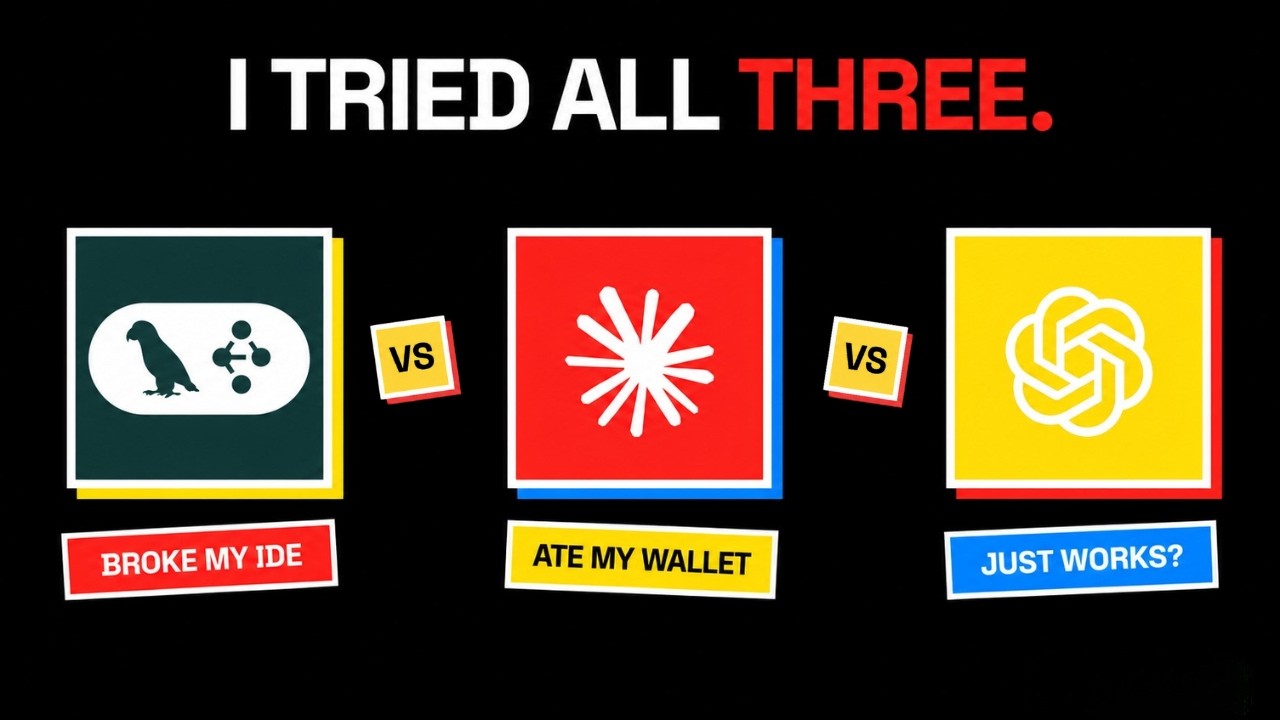
LangGraph vs OpenAI Agents SDK vs Claude Agent SDK
Title history
- LangGraph vs OpenAI Agents SDK vs Claude Agent SDK — observed on 20261101-0040 UTC (YouTube)
Keywords
Summary
205 words
Critical Evaluation
Value of the Information & Strength of the Argument
The video’s value lies in its nuanced, practical insights beyond typical feature checklists. It provides a clear mental model of agent harnesses and critiques common evaluation criteria like star counts. The argumentation is solid: it supports claims with concrete evidence (e.g., version numbers, checkpointing updates, specific documentation clauses) and transparently acknowledges when sources have commercial interests. The decision rule based on in-distribution vs out-of-distribution tasks is a useful heuristic, and the emphasis on contractual and billing constraints is a distinctive contribution. The reasoning is coherent, and the creator openly admits to personal experience and potential biases, strengthening credibility.
Scientific Rigor, Source Quality, Title Accuracy
The video demonstrates strong scientific rigor by grounding claims in official documentation and release notes, and by clearly separating personal measurements from structured benchmarks. It critically evaluates sources, including pointing out inaccuracies in comparison articles. The title accurately reflects the content, and the video does not overpromise. It also addresses the quality of sources by mentioning independent breakdowns and acknowledging their vendor status. The balance between technical depth and business considerations is maintained throughout. Overall, the rigor is high, and the title-topic alignment is excellent.
198 words
Title / Content Match
The title exactly matches the content, which systematically compares the three named frameworks in depth.
Quality & Reliability
8/10
The video demonstrates high reliability through critical analysis, explicit acknowledgment of vendor biases, and grounding in official documentation. It avoids hype, provides balanced caveats, and addresses technical and business constraints often overlooked.
Chapters
- Three frameworks, one confusing decision
- What an agent harness actually does
- LangGraph vs OpenAI vs Claude: three workshops
- Why GitHub stars are almost meaningless
- The frameworks are converging
- Version stability and checkpointing
- Language support and latency
- Why Claude Agent SDK is still incredible
- The clause nobody talks about
- Claude billing and managed agents
- Which framework should you actually use?
- The primitives converged, but the leases didn't
Cited Sources
- Claude Agent SDK Overview — Official documentation for Claude Agent SDK, including usage terms and authentication restrictions.
- LangGraph Documentation — Official LangGraph docs covering architecture and components.
- LangGraph Persistence — Official documentation for checkpointing and persistence in LangGraph.
- LangGraph GitHub Repository — Source code repository for LangGraph, showing current version and activity.
- OpenAI Agents SDK Documentation — Official documentation for the OpenAI Agents SDK, including features and updates.
- Anthropic Compliance: Covered Models under BAA — Documentation on compliance guarantees, including data retention and HIPAA/BAA eligibility for managed agents.
Contribution & Novelties
The video’s unique contribution is its focus on the ’lease’ rather than the ‘primitives’: it highlights that while AI agent frameworks have converged architecturally, their business terms, billing models, and compliance constraints remain distinct and often decisive. It uncovers an under-discussed clause in Anthropic’s documentation that restricts how developers can integrate Claude.ai authentication, and it provides a practical decision rule based on distribution alignment. It also offers a nuanced evaluation of checkpointing, language support, and latency that goes beyond typical marketing comparisons.
Pour aller plus loin :
- AI agent — Background on autonomous agents and their architectures.
- LangChain — Framework context for LangGraph.
- Anthropic — Company behind Claude Agent SDK, useful for understanding business constraints.
- OpenAI Agents SDK — Official documentation, deeper dive into features.
- Claude Code — Documentation for Claude Code, the basis of Claude Agent SDK.
138 words
Radar Profile
The profile is well-balanced with high scores across all dimensions, slightly lower on technical depth due to the non-benchmarked latency measurement. The strength lies in information quantity and reliability, while the technical level remains accessible.