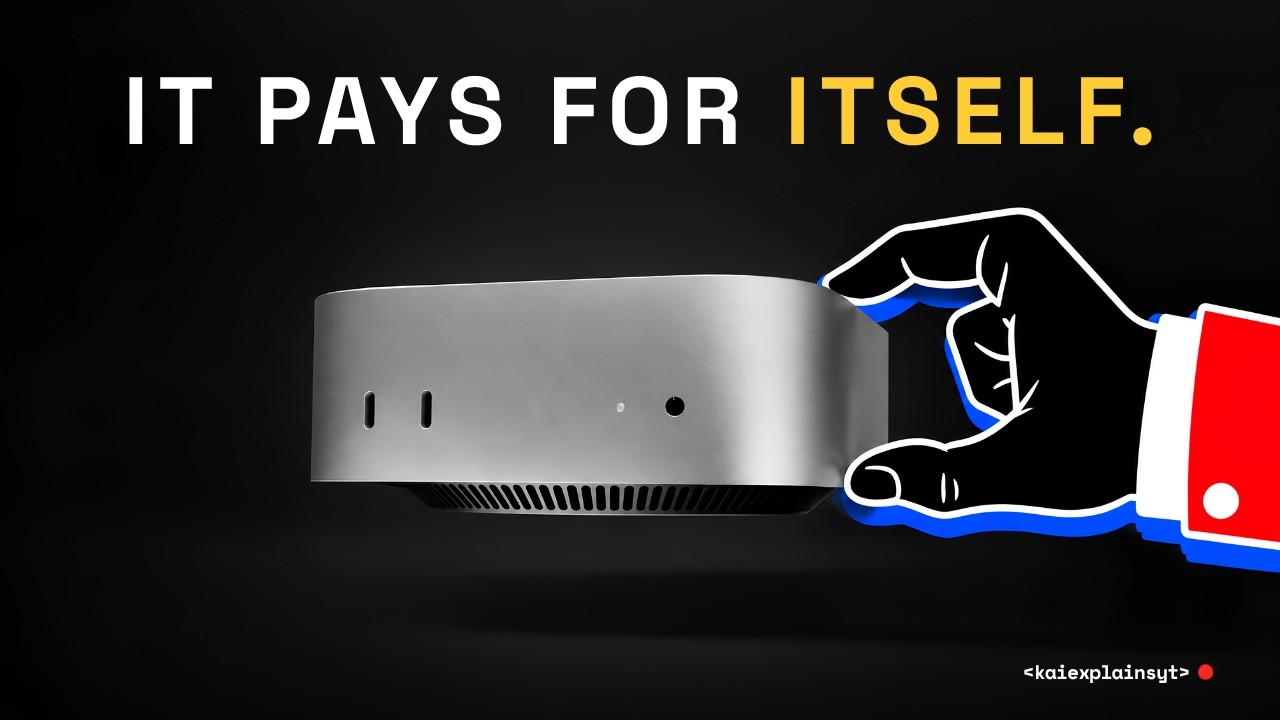
Can a Mac Mini Replace your $200 AI Subscription?
Title history
- Can a Mac Mini Replace your $200 AI Subscription? — observed on 20261031-2320 UTC (YouTube)
Keywords
Summary
213 words
Critical Evaluation
Value of the Information & Strength of the Argument
The video excels in deconstructing the ‘payback period’ fallacy by separating the subscription into three distinct components: the model, the compute for reading context, and the volume cap. The argumentation is solid, using specific hardware bandwidth math, benchmark scores, and API pricing to demonstrate that a Mac Mini cannot match the frontier model quality or the reading speed of cloud GPUs. The $79 figure is derived transparently from token output and OpenRouter pricing, and the comparison to a $19 hosted alternative is a powerful reframe. The creator acknowledges valid use cases (data sovereignty, overnight tasks) and provides a structured decision path, making the argument both balanced and convincing.
Scientific Rigor, Source Quality, Title Accuracy
The video cites multiple official sources: Apple’s specs, Anthropic’s cost documentation, OpenRouter pricing, and community reports (r/LocalLLM, r/ClaudeCode). The claims are cross-referenced with dates and specific numbers, and the creator distinguishes between measured and headline figures. The title accurately reflects the core question and the conclusion, though the title might imply a simple yes/no answer, the video provides a nuanced response. The adéquation titre/contenu is strong, and the use of sources is rigorous, though some data points (e.g., user-reported token speeds) are anecdotal and not independently verified.
210 words
Title / Content Match
The title poses a direct question and the video answers it comprehensively with a nuanced 'no, but it replaces the cheaper hosted version', making the title fully aligned with the content.
Quality & Reliability
9/10
The video provides a detailed cost-benefit analysis with specific hardware specs, benchmark figures, and API pricing, citing sources like Apple, OpenRouter, and user reports. The reasoning is transparent and logical, though some figures are from anecdotal sources, balancing thoroughness with occasional uncertainty.
Chapters
Cited Sources
- Don't Buy a MAC MINI - — Related video referenced in the description as a contrast to this analysis.
Contribution & Novelties
The video’s main contribution is replacing the simplistic $1,299 / $200 = 6.5-month payback calculation with a nuanced, model-aware cost analysis. It highlights the hidden cost of reading long prompts (pre-fill) and the difference between the $200 plan and the $19 hosted price of the same open-source model. The creator provides a concrete ‘downgrade first’ strategy and a practical testing protocol via OpenRouter, which is a valuable addition to the local AI buying discussion.
Pour aller plus loin :
- Speculative decoding — Explains the technique behind the headline token speeds, showing how they differ from realistic write rates.
- Memory bandwidth — The fundamental constraint limiting token generation speed on Apple Silicon, central to the video’s reasoning.
- OpenRouter — The aggregator used to price hosted models, enabling direct cost comparison with local inference.
132 words
Radar Profile
Le profil radar montre une excellente qualité d'information et de fiabilité, avec une quantité d'information élevée (9/10) et un niveau technique modéré-élevé (8/10), reflétant un contenu détaillé mais accessible. La fiabilité globale (9/10) est soutenue par de nombreuses références et un raisonnement transparent.
💬 Orientation: positif. Sur les 30 commentaires analysés, le climat est largement positif, les spectateurs saluent la clarté et le réalisme de l'analyse, certains partageant leurs propres expériences complémentaires.