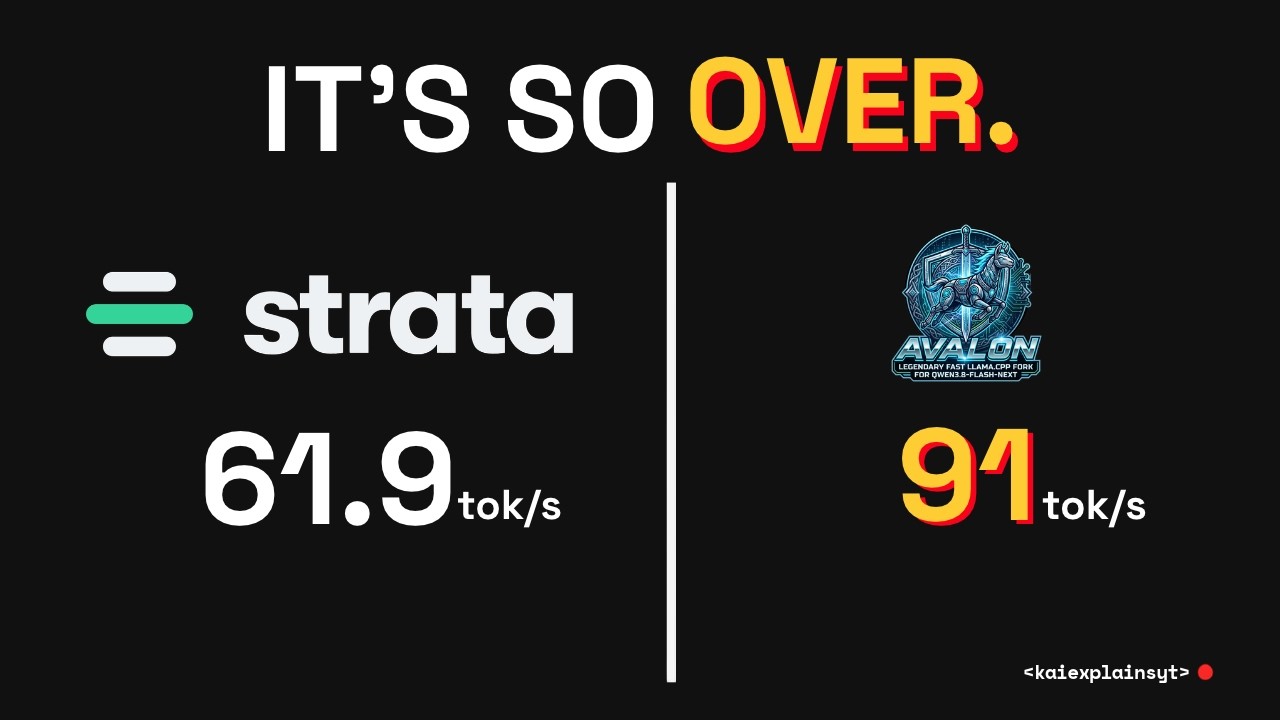
Avalon Just Beat Strata by 47% on AMD (9x Faster)
Title history
- Avalon Just Beat Strata by 47% on AMD (9x Faster) — observed on 20261031-2302 UTC (YouTube)
Keywords
Summary
This video analyzes a benchmark where Avalon, a fork of llama.cpp, achieved 91 tokens per second on an AMD RX 7900 XT, beating Strata’s 61.9 tokens per second by 47%. The author breaks down the 47% into a 27% engine improvement (due to expert caching and parallel CPU/GPU work) and a 15% gain from more efficient speculative drafting. The video explains the hardware context: a 2020 desktop with Ryzen 7 3800XT, B450 board, DDR4-3200 RAM, and a used RX 7900 XT. It details the model Qwen3.8-Flash-Next (125B parameters, mixture of experts) and how memory bandwidth limits inference speed. The analysis covers why Strata’s own AMD optimizations since the benchmark landed on newer RDNA 4 cards, not the RX 7000 series. The video also discusses the model file size difference (Avalon’s file is 13% larger but lower perplexity), the 32GB RAM scenario, and gives practical recommendations: Avalon suits RX 7900 XT/X
TX users on Linux, while Strata remains better for NVIDIA, RDNA 4, Windows, and full-featured usage. The author emphasizes that benchmarks are hardware-specific and encourages viewers to ask four questions about version, model files, hardware, and hardware ownership.
188 words
Critical Evaluation
Value of the Information & Strength of the Argument
The value of the information is high: the video provides a thorough decomposition of the benchmark results, explaining the underlying technical reasons (expert cache, speculative decoding on MoE) with clear calculations. The argumentation is solid and transparent: the author acknowledges the limitation of comparing two different model files, notes that the Strata version used is outdated, and cites community benchmarks to verify representative performance. The video avoids hype and gives balanced advice on when to use each engine, supported by data from release notes and user reports. The reasoning is methodical, progressing from hardware specs to memory bandwidth limits to specific optimization techniques, making complex concepts accessible without oversimplification.
Scientific Rigor, Source Quality, Title Accuracy
The scientific rigor is high: all claims are backed by references to the Avalon README, Strata release notes, and community benchmark tables. The author verifies the hardware specifications and clarifies a minor date error (3800XT is 2020, not 2019). The sources are primary and verifiable. The title is accurate and attention-grabbing but not misleading; the video indeed explains how Avalon beat Strata by 47%. The analysis of sources is critical: the author notes the Strata version was 14 releases old, that AMD improvements since then apply to RDNA 4, and that the comparison involves both engine and model file differences. No comments are provided, so public reaction trends are not analyzed.
235 words
Title / Content Match
The title accurately reflects the content, which is a deep comparison of Avalon vs Strata on AMD hardware, explaining the 47% performance gap.
Quality & Reliability
9/10
The video provides a detailed, technically accurate analysis of benchmark results, citing specific versions, hardware specs, and community data. It clearly separates facts from interpretations and acknowledges uncertainties. The author checks the source reliability by cross-referencing release notes and community reports.
Chapters
- 61.9 to 91 on a 2020 desktop
- Why it reads as revenge
- A fork built for one model
- A €500 card in a 2020 box
- 125B counted, 177B stored
- The RAM floor and the cache
- Every byte of VRAM is cache
- 47% is two numbers
- Drafting on a mixture of experts
- Faster on a bigger file
- The Strata build from that night
- The card Strata never ran
- 61.9 is what owners get
- Off the home card, it shrinks
- 32 gigs and the prompt bill
- The owner this is wrong for
- Run what your card's author runs
Cited Sources
- Avalon README — Contains the benchmark table, Avalon's documentation, the RTX 4090 run, and 32GB RAM test.
- Avalon model files and quantization recipe — Provides the model files and details on quantization used by Avalon.
- Avalon issue #1 — Describes the two Radeon Pro W7800 tests and performance findings.
- Avalon launch thread on r/ROCm — The author's Reddit post discussing the benchmark and software philosophy.
- Strata repository — Main Strata inference engine repository.
- Strata releases — Includes version 0.1.43 and later 0.2.7/0.2.8 with R9700 numbers and the note about RX 7000 packages not being tested.
- Strata AMD support table — Lists maintainer-tested hardware and HIP backend history.
- Strata community benchmarks — Contains user-reported results for RX 7900 XTX, GRE, and 4x 7900 XT.
- Strata vs llama.cpp head-to-head on RTX 3060 — Earlier benchmark showing Strata's advantage over llama.cpp.
- llama.cpp PR #30971 — Adaptive single-graph MoE offload (draft) from Piotr Wilken.
- llama.cpp PR #30966 — Missed experts on CPU parallel execution.
- RX 7900 XT used price history — Shows EU used prices around €590 at the time of the test.
Concurring Sources
- Strata community benchmarks — Confirms that RDNA 3 owners report 59-62 tok/s with Strata, matching the 61.9 in the benchmark.
- Strata release notes 0.2.0-beta — Explicitly state that RX 7000 packages were not tested on RX 7000 hardware, aligning with the video's claim.
Dissenting Sources
- Strata vs llama.cpp head-to-head on RTX 3060 — This earlier benchmark showed Strata being 4.5x faster than llama.cpp, which seems to contradict Avalon's dominance, but the difference is explained by hardware and version specifics.
Contribution & Novelties
The video’s original contribution is a clear breakdown of the 47% performance gap into component factors, explaining the technical mechanisms behind expert caching and speculative decoding in MoE models. It contextualizes the benchmark by examining the hardware and software versions, showing that the results are specific to the RX 7900 XT configuration. The video also highlights the significance of who owns the hardware, as each engine is optimized for the creator’s own system.
Pour aller plus loin :
- Mixture of experts — Core architecture of Qwen3.8-Flash-Next, essential for understanding the memory bottlenecks.
- Speculative decoding — Technique used by both engines to accelerate generation; explanation of verification overhead.
- llama.cpp — The base project from which Avalon is forked; relevant for comparison.
- ROCm — AMD’s GPU compute stack; explains the software ecosystem challenges for AMD cards.
134 words
Radar Profile
The radar profile shows high scores in quantity and quality of information, reflecting the video's depth and accuracy. Technical level is high, while overall reliability is also strong, indicating a trustworthy analysis. The balance suggests a well-researched technical review.