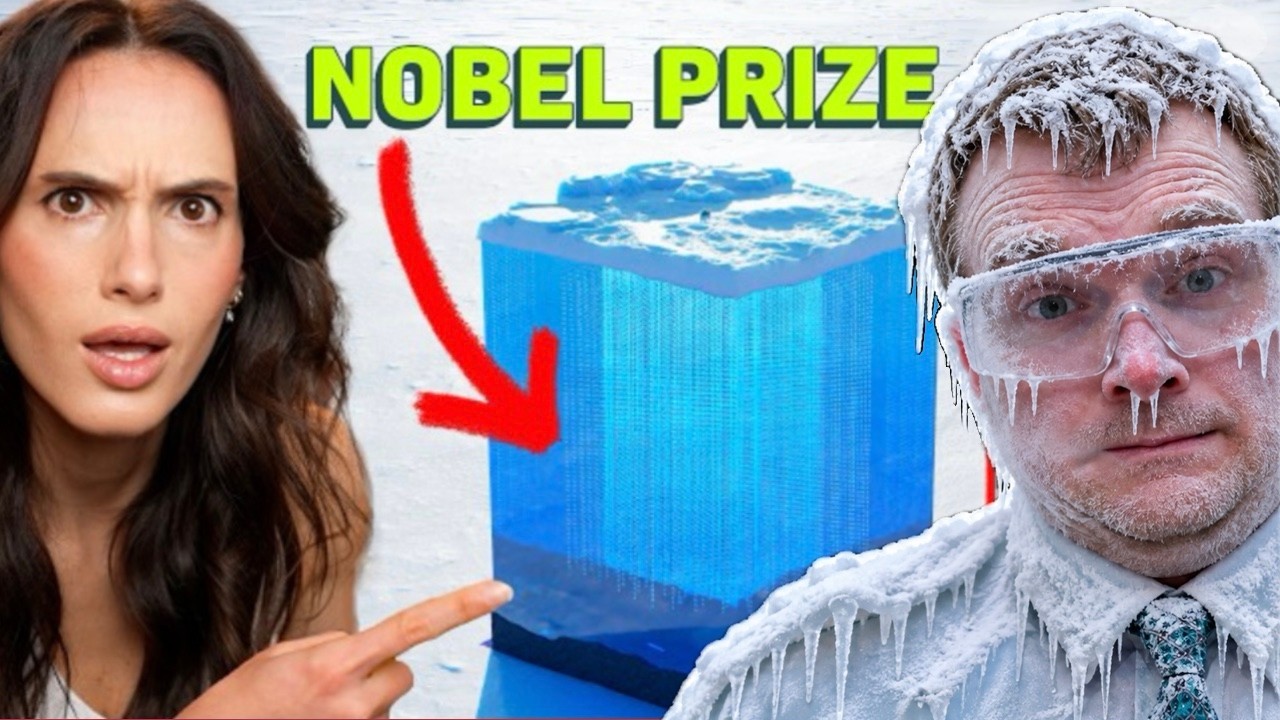
This Crazy Ice Experiment Just Won a Nobel Prize - Nuclear Engineer Reacts to Cleo Abram
Keywords
Summary
168 words
Critical Evaluation
Value of the Information & Strength of the Argument
The value of the information is high because the nuclear engineer provides a unique technical perspective that enriches the original narrative. His explanations are clear and logically structured, using analogies to nuclear engineering to make complex physics accessible. He demonstrates solid argumentation by systematically deconstructing the IceCube design, its operational principles, and the engineering tradeoffs, all while maintaining scientific accuracy. He also corrects minor inaccuracies in the original video, adding credibility. The argumentation is sound, grounded in professional experience, and effectively bridges particle physics and practical engineering.
Scientific Rigor, Source Quality, Title Accuracy
The scientist demonstrates strong rigor by accurately explaining the physics and engineering of IceCube. He references the original video as the primary source, but also brings his own expertise, mentioning concepts like the ‘barn’ unit and diverse indications in nuclear power. The title faithfully reflects the content, and the reaction format allows for both exposition and critical analysis. The discussion is well-informed, though it relies heavily on personal expertise rather than external citations. Overall, the scientific quality is high, and the title accurately represents the video’s focus.
189 words
Title / Content Match
The title accurately describes the content: a nuclear engineer reacts to a video about the Nobel Prize-winning ice experiment (IceCube).
Quality & Reliability
8/10
The nuclear engineer provides accurate explanations of neutrino detection, Cherenkov radiation, and cross sections, with appropriate technical depth. He correctly highlights the engineering tradeoffs and the significance of the IceCube detector. Minor inaccuracies in the original video are corrected.
Key Moments
Markers derived by PSI from the transcript: the creator did not define chapters.
- Introduction to the reaction and the IceCube detector, with the engineer's initial thoughts on radiation detection.
- Discussion of the detector's scale and the use of ice as both target and optical medium, with analogies to nuclear power plant water systems.
- Explanation of neutrino interactions, Cherenkov radiation, and the concept of cross section, including the 'barn' unit.
- Comparison to diverse indications in reactor monitoring, and the value of neutrinos as messengers to observe the universe.
- Discussion of the development history, including the AMANDA prototype and the three major hurdles overcome.
Cited Sources
- Cleo Abram's original video — The original video being reacted to, which explains the IceCube experiment and Nobel Prize.
Contribution & Novelties
The engineer adds unique value by framing IceCube through the lens of nuclear engineering, offering insights into cross-section physics, detector design tradeoffs, and analogies to reactor safety and monitoring. He corrects a simplification in the original video (the ‘million-to-one’ odds) and provides a deeper technical background. This perspective helps bridge the gap between casual science communication and professional engineering knowledge.
Pour aller plus loin :
- IceCube Neutrino Observatory — Detailed background on the detector and its science.
- Neutrino — Overview of neutrino properties and types.
- Cherenkov radiation — Explanation of the light emission mechanism used in IceCube.
97 words
Radar Profile
The radar profile shows a well-rounded score with high values in all four dimensions, indicating a balanced and thorough presentation. The technical level is notably high, yet the information is effectively communicated and substantiated by professional experience, resulting in a reliable and insightful analysis.