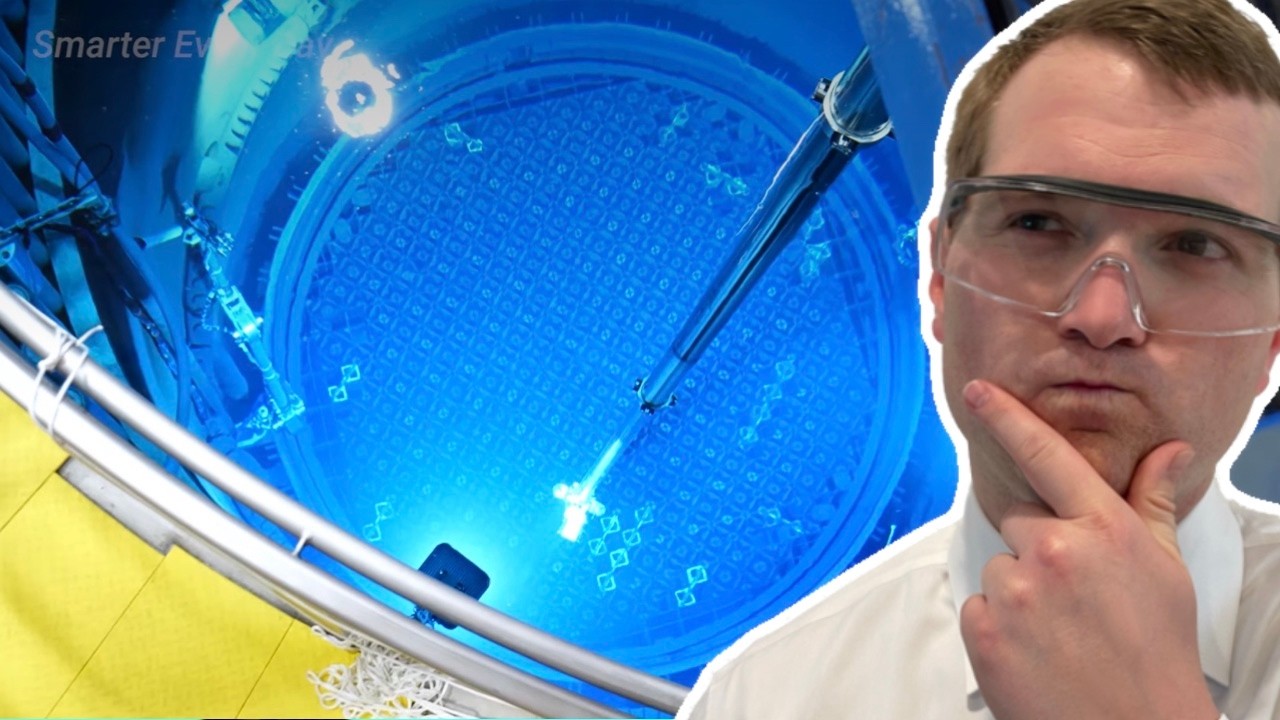
Inside Nuclear Reactor Fuel - Nuclear Engineer Reacts to Smarter Every Day
Keywords
Summary
183 words
Critical Evaluation
Value of the Information & Strength of the Argument
The video adds substantial value by translating the original Smarter Every Day content into a deeper technical tutorial. Folse consistently anchors his explanations in physical principles, distinguishing between fast and thermal neutrons, and painstakingly clarifies the meaning of cross-section and barn. His argumentation is solid: he walks through each feedback coefficient (Doppler, moderator, void) systematically and ties them to reactor design and safety. The discussion of decay heat and loss-of-coolant accidents is especially rigorous, correcting potential overconfidence in negative reactivity feedback. He also provides practical context, such as how moderator temperature is monitored and reflected in reactivity coefficients, illustrating real-world reactor operations. The reasoning is coherent, audience-aware, and demonstrates mastery of nuclear engineering concepts without oversimplifying.
Scientific Rigor, Source Quality, Title Accuracy
The rigor is high: Folse is a practicing nuclear engineer and his explanations align with established reactor physics literature. He explicitly references the original Smarter Every Day video, providing a transparent link for cross-checking. The technical details, such as the boron carbide control rods, the role of boron isotopes, and the different boiling regimes, are accurate and well-presented. The title mirrors the content precisely, as the video is indeed a reaction with additional expert commentary. The neutral tone and careful distinction between personal experience and general knowledge bolster credibility. No external sources are cited beyond the original video, but the depth of technical knowledge serves as its own validation.
240 words
Title / Content Match
The title accurately describes the content: a nuclear engineer reacts to a Smarter Every Day video about nuclear reactor fuel, offering expert commentary and clarification.
Quality & Reliability
9/10
The content is presented by a nuclear engineer with extensive operational knowledge, providing technically accurate explanations that align with established reactor physics principles and engineering practices.
Key Moments
Markers derived by PSI from the transcript: the creator did not define chapters.
- Introduction and recap of part 1, setting context for the reaction.
- Explanation of control rod shape (cross design) and its function in BWR assemblies.
- Clarification of neutron cross-section and the unit 'barn' as a measure of interaction probability.
- Discussion of moderator temperature coefficient and Doppler broadening as built-in safety features.
- Explanation of void coefficient and how boiling reduces moderation and reactivity in BWRs.
- Emphasis on decay heat and the critical safety function of core cooling after scram.
- Comparison of a nuclear fuel pellet's energy content to one ton of coal, highlighting energy density.
Cited Sources
- Smarter Every Day - Inside Nuclear Reactor Fuel — Original video that Tyler Folse reacts to and adds technical commentary on.
Contribution & Novelties
This video contributes original value by serving as a supplementary technical layer to the Smarter Every Day production. The engineer’s commentary clarifies up-to-date concepts such as the role of the moderator temperature coefficient, void coefficient, and decay heat, and corrects common misconceptions about control rod geometry and reactor safety. It offers viewers a deeper understanding of reactor physics principles without requiring a formal background. The discussed topics are further explored in the following resources.
Pour aller plus loin :
- Neutron cross section — Provides formal definition and the barn unit.
- Thermalization (physics) — Explains the slowing down of neutrons by a moderator.
- Doppler broadening — Relates to the fuel temperature coefficient in reactors.
- Boiling water reactor — Details the design and void coefficient behavior.
124 words
Radar Profile
The radar profile shows high scores across all axes (information quantity, quality, technical level, and reliability), forming a near-square profile typical of a highly informative and credible expert analysis. The video is technically dense but well-explained, making it a valuable resource for enthusiasts and professionals alike.
💬 Sur les 30 commentaires analysés, l'orientation est très positive, avec des éloges pour la qualité éducative et la précision technique de la réaction. Plusieurs spectateurs soulignent que l'ajout de détails techniques enrichit le contenu original et expriment une forte appréciation pour le niveau d'expertise de l'auteur.