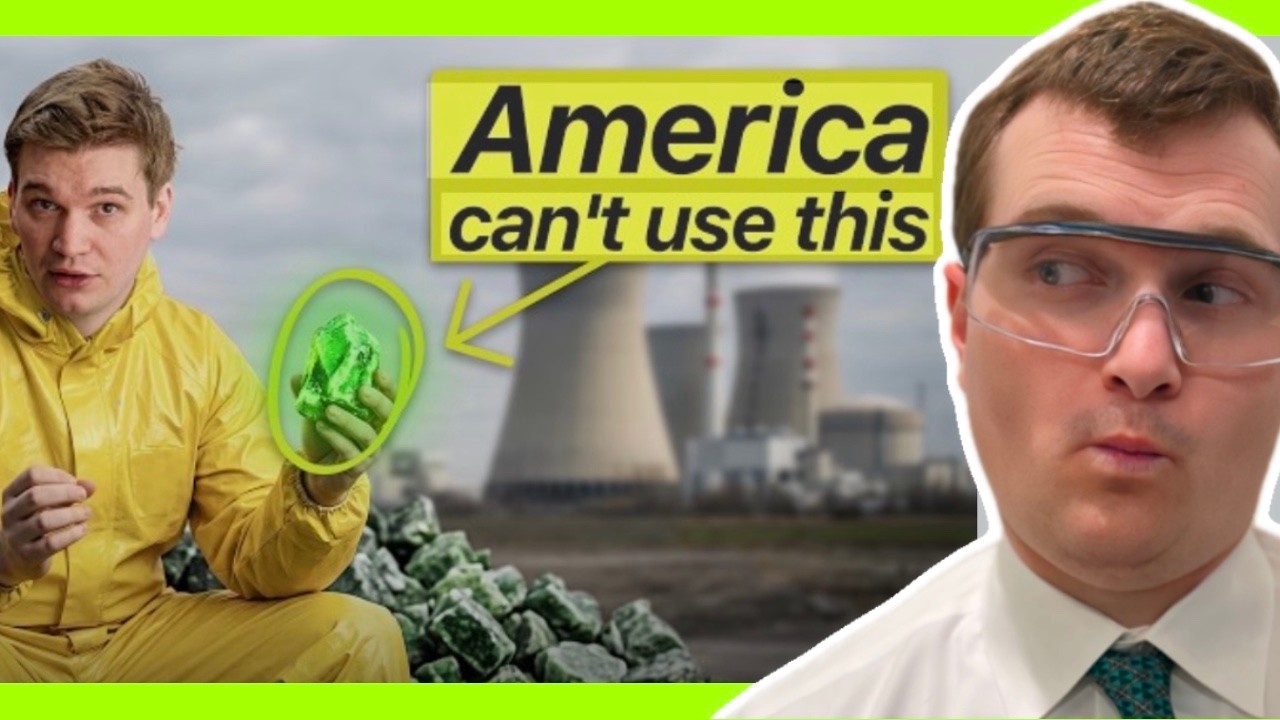
The US Can't Process its Own Uranium? - Nuclear Engineer Reacts to Business Explains the World
Keywords
Summary
138 words
Critical Evaluation
Value of the Information & Strength of the Argument
The value of this video lies in its expert correction of oversimplified claims. The engineer provides a detailed explanation of the nuclear fuel cycle, clarifying that having uranium resources is not enough; processing capacity is key. He effectively argues that the US’s problem is not raw material but the industrial infrastructure for enrichment and conversion. The argumentation is solid, based on technical knowledge and historical context, though it could benefit from more explicit sources. He carefully separates facts from hyperbole, such as clarifying that US production has recently increased, and acknowledges multiple factors for the decline rather than a single cause.
Scientific Rigor, Source Quality, Title Accuracy
The engineer demonstrates high technical rigor by explaining concepts like isotopic separation and the differences between resources and reserves. However, he relies primarily on his own knowledge and the original video, providing limited external references. The title accurately reflects the content: a reactor’s response to a claim about US uranium processing. The analysis is thorough but could be strengthened by citing authoritative sources for specific data points. The reaction format is appropriate for the correction, and the engineer remains objective throughout.
197 words
Title / Content Match
The title accurately describes the content: a nuclear engineer reacting to a video about the US uranium supply chain.
Quality & Reliability
8/10
The analysis is technically sound, corrects inaccuracies, and provides detailed context on the nuclear fuel cycle. The engineer demonstrates deep expertise, but the reaction format lacks systematic sourcing and relies on personal knowledge.
Key Moments
Markers derived by PSI from the transcript: the creator did not define chapters.
- Introduction: Reactor sets up the original video's claim and explains the supply chain framework.
- Detailed breakdown of the nuclear fuel cycle steps: mining, milling, conversion, enrichment, and fuel fabrication.
- Historical discussion of enrichment technologies: gaseous diffusion vs. centrifuges, and the US's loss of commercial capability.
- Analysis of the Megatons to Megawatts program and its impact on the US uranium industry.
- Discussion of the decline in US mining and enrichment, and the current state with limited domestic production.
Cited Sources
- Why the US Can't Use Its Own Uranium — Original video being reacted to by T. Folse Nuclear
External References
Contribution & Novelties
93 words
Radar Profile
The profile shows high scores in information quantity and quality, moderate technical level, and good overall reliability, indicating a well-informed expert analysis with a focus on educational correction.