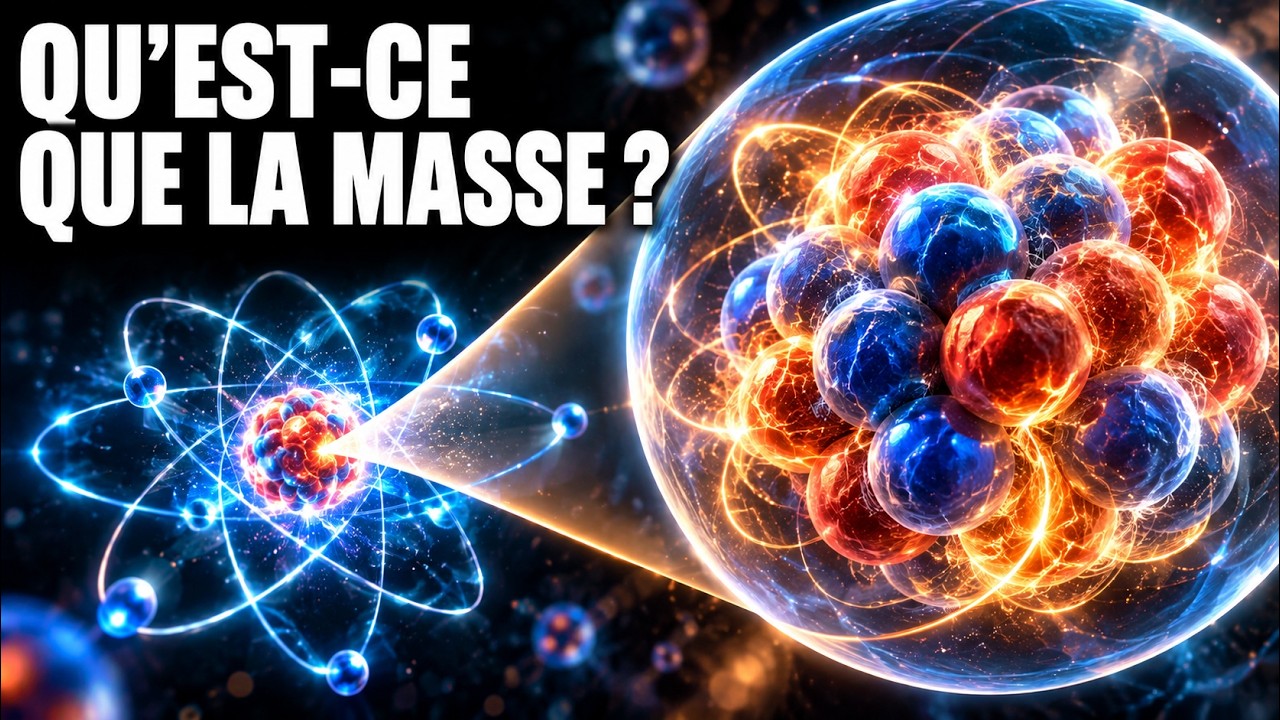
De quoi est faite la masse selon la physique quantique ?
What is mass made of according to quantum physics?
Keywords
Summary
200 words
Critical Evaluation
Value of the Information & Strength of the Argument
The video delivers solid scientific value by tackling a genuinely deep question—the origin of mass—with remarkable pedagogical clarity. It draws a rigorous distinction between the two principal contributions: approximately 99% of mass arising from gluon binding energy and quark kinetic energy within nucleons, and the remaining ~1% intrinsic mass of elementary particles from the Higgs mechanism. The explanation of quantum chromodynamics, including color charge, asymptotic freedom, and quark confinement, is conceptually accurate despite the simplified metaphors (rubber band, spring). The argumentation follows a logical structure: from the paradox of missing mass to its resolution via the Einstein equation, then to the necessity of the Higgs field for the residual fraction. The reasoning is sound overall, with a few notable simplifications—such as presenting the mass difference between electron and photon as a binary while neglecting neutron-proton mass splitting—but no substantive scientific errors. The dramatic crescendo style, while engaging, occasionally sacrifices sobriety (repeated use of ‘vertiginous’ and ’terrifying’) without harming factual accuracy. The thought experiment of a massless universe is a particularly effective didactic instrument.
Scientific Rigor, Source Quality, Title Accuracy
The scientific content is broadly accurate and reflects a correct understanding of the standard model of particle physics. All cited numerical values (quark masses, proton mass, electron mass) are consistent with established data from the Particle Data Group, and the Higgs mechanism narrative aligns with the Nobel Prize-winning framework of Englert, Higgs, and Brout. However, the video does not cite or reference any specific scientific papers, textbooks, or publicly accessible sources, significantly limiting its scholarly value and traceability. The description contains no external links that could serve as verification references—only a self-promotional call for likes and subscriptions. The title is an accurate reflection of the content, matching the central topic without exaggeration or clickbait tactics. For a science-communication piece, the absence of any source citation is a notable weakness, especially given the video’s ambition to explain a concept as subtle as the Higgs field.
332 words
Title / Content Match
The title perfectly matches the content: the video thoroughly explores what mass is made of at the quantum level, covering quark/gluon binding energy and the Higgs mechanism as the two main contributions.
Quality & Reliability
7/10
The video delivers a scientifically accurate, well-structured explanation of the origin of mass in quantum physics. Quark masses (up ~2.2 MeV/c², down ~4.7 MeV/c²), proton mass (938 MeV/c²), and electron mass (0.511 MeV/c²) match standard textbook values. The strong-nuclear-force account, including color confinement and asymptotic freedom, and the Higgs mechanism description are conceptually sound. Minor simplifications for a general audience—e.g., the rubber-band analogy for confinement—are acceptable in a popularization context. However, the dramatic, sensationalist tone and the absence of any citation to primary sources or research references lower the score.
Chapters
Contribution & Novelties
This video’s original contribution lies in its pedagogical framing: it takes a single central question—‘what is mass?’—and traces the answer from everyday experience down to the deepest layers of quantum field theory. It illustrates a key conceptual insight often missed in science communication: that most mass is not ‘stuff’ but bound energy, as reflected in the famous result that 99% of a proton’s mass comes from gluon field energy rather than quark rest mass. The video also clearly separates the two regimes (binding energy vs. Higgs mechanism) and uses the massless-photon comparison as a powerful contrast to explain why intrinsic mass is crucial for the existence of complex matter. This framing is neither original in content nor radically new in approach, but it successfully combines textbook facts into a coherent and memorable narrative for a general audience.
Pour aller plus loin :
- Higgs boson — Overview of the particle that confirms the Higgs mechanism and its role in generating mass.
- Quantum chromodynamics — The theory of the strong force, governing quarks and gluons; essential for understanding binding energy mass.
- Mass-energy equivalence — Einstein’s E=mc², the mathematical basis for explaining mass as confined energy.
- Standard Model — The overarching quantum field theory framework in which these mechanisms are embedded.
208 words
Radar Profile
The radar profile shows a well-rounded science-communication piece: information quantity is high (8), reflecting a dense 54-minute discussion covering multiple facets of the mass question. Quality (7) and reliability (7) are strong for a popularization video, though limited by the absence of explicit source citations. The technical level (6) is appropriately pitched for a motivated lay audience, balancing accessibility with genuine physics depth.