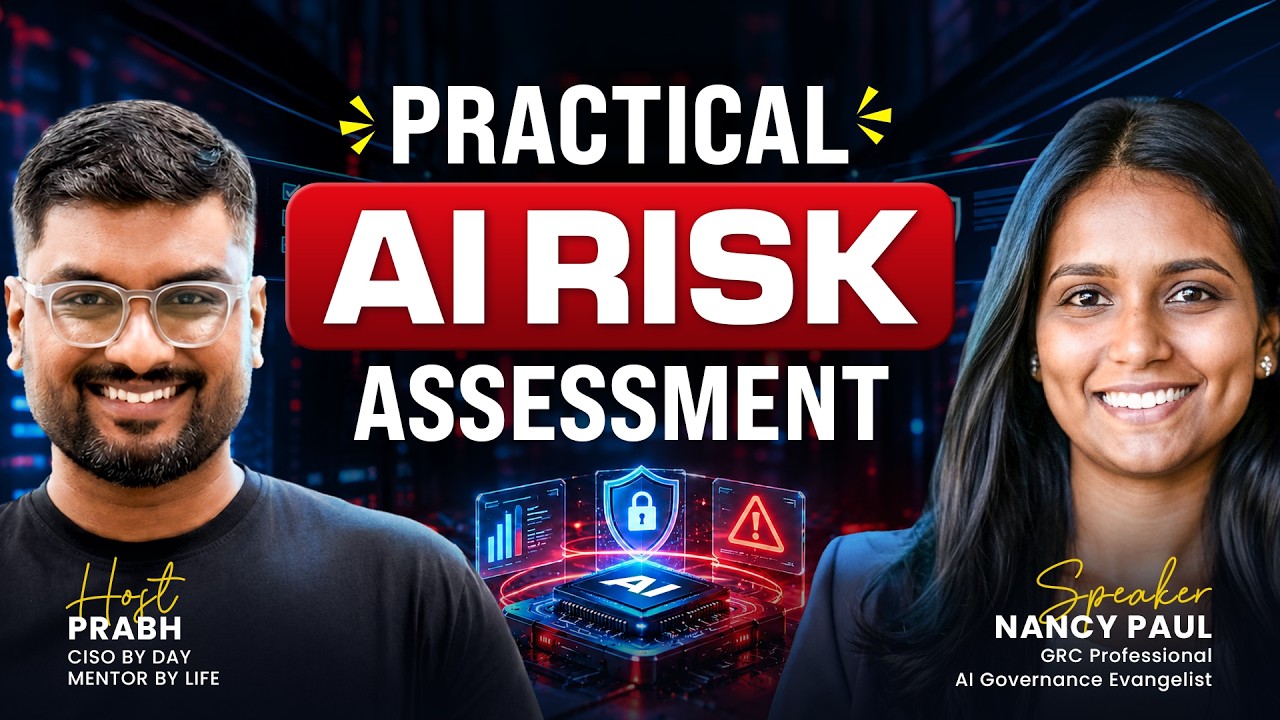
How to Conduct an Practical Risk Assessment for AI System
Title history
- How to Conduct an Practical Risk Assessment for AI System (PSI archive)
- How to Conduct an Practical Risk Assessment for AI System — observed on 20261105-2044 UTC (YouTube)
Keywords
Summary
224 words
Critical Evaluation
Value of the Information & Strength of the Argument
The primary value of this video lies in its concrete, replicable methodology. Unlike many conceptual discussions of AI governance, this session walks through an actual workbook with filled-in examples, enabling viewers to directly adapt the template to their own organizations. The argument is structured: the speakers establish a clear workflow (understand system, assess impact, identify risks, treat risks, and accept residual risk) and justify each step through practical scenarios. The use of a realistic use case (AI policy review assistant) helps ground the abstractions of AI risk in tangible operational concerns. The discussion of GRC knowledge gaps and the collaborative model with technical SMEs is particularly insightful, framing AI risk assessment as a sociotechnical coordination task rather than a purely technical one. The 5x5 risk matrix explanation and the distinction between impact and risk are cogent and accessible. However, the podcast format occasionally meanders, and some decisions—such as how specific risk scores were derived or how the statement of applicability connects to the risk assessment—are under-explored.
Scientific Rigor, Source Quality, Title Accuracy
The scientific rigor of this video is moderate but appropriate for its practical tutorial intent. The methodology aligns with recognized frameworks, notably the NIST AI Risk Management Framework and ISO/IEC 42001, and the speaker references these standards throughout, giving the approach institutional credibility. However, no formal citations, publications, or empirical validation are provided for the workbook itself; its effectiveness rests on the speaker’s professional experience rather than peer-reviewed evidence. The title ‘How to Conduct a Practical Risk Assessment for AI System’ is accurate and matches the content: the session delivers exactly that—a hands-on, practitioner-oriented demonstration. The description correctly summarizes the key points and includes links to related videos on AI governance from the same channel, which serve as useful supplementary context. Overall, the source quality is acceptable for a professional guidance piece, though not for academic rigor.
318 words
Title / Content Match
The title accurately reflects the content: the session delivers a hands-on, step-by-step demonstration of conducting an AI risk assessment using a real-world use case and a downloadable template.
Quality & Reliability
7/10
The session offers a practical, structured methodology grounded in established frameworks such as NIST AI Risk Management Framework and ISO/IEC 42001, with a reusable workbook demonstrated live. The approach is clearly informed by substantial GRC practitioner experience and includes a concrete policy-review use case. However, the method is presented as professional opinion rather than empirical validation, and details on the workbook's scoring criteria are only partially explained.
Key Moments
Markers derived by PSI from the transcript: the creator did not define chapters.
- Introduction: Prabh Nair welcomes Nancy Paul back for a practical AI risk assessment session; initial framing of AI incidents and insider threats.
- WhatsApp analogy: everyday risk assessment in sending a message, connecting familiar reasoning to AI risk assessment.
- Introduction of the Integrated AI Impact and Risk Assessment Workbook; explanation of the template-based approach.
- Use case presentation: an AI policy review assistant, from a business request to GRC questions; intended use scenario.
- Discussion on GRC knowledge requirements: understanding the AI system first, the role of technical SMEs, and coordinating with NIST AI RMF and ISO 42001.
- Explanation of the eight AI risk lenses: accountability, transparency, fairness, privacy, safety, reliability, explainability, environmental impact.
- Analyzing intended use vs. potential misuse: scenarios like uploading confidential documents or treating AI recommendations as final.
- Impact assessment demonstration: filling out the impact assessment sheet for the policy review assistant across applicable risk categories.
- Risk register walkthrough: scoring risks with consequence and likelihood, 5x5 matrix, and connection to controls and residual risk.
- Wrap-up: statement of applicability, dashboard view, and final practical takeaways for implementing AI risk assessment.
Cited Sources
- AI Governance Podcast (Part 1) - Prabh Nair — Link in the video description to a prior podcast episode on AI governance, referenced as Part 1 of the discussion.
- AI Governance Podcast (Part 2) - Prabh Nair — Link in the video description to the full AI governance podcast series ; companion episode to this risk assessment session.
- AI Governance Podcast (Part 3) - Prabh Nair — Link in the video description to related AI governance discussion; extends the conversation to other GRC topics.
- AI Governance - Audience Q&A Session — Link in the video description to an audience Q&A session on AI governance.
Concurring Sources
- NIST AI Risk Management Framework — Referenced in the video as a foundational standard for mapping, measuring, and managing AI risks.
- ISO/IEC 42001 — Mentioned as the international management system standard that AI risk assessments should align with.
External References
Contribution & Novelties
The video’s main contribution is a ready-to-use, integrated AI impact and risk assessment workbook that combines system profiling, impact assessment across eight risk lenses, a risk register with 5x5 scoring, and a statement of applicability in a single tool. This goes beyond merely summarizing regulatory requirements by demonstrating, with a live example, how to translate abstract governance principles into a concrete, auditable process. The distinction between impact assessment and risk assessment—where impact explores what could go wrong across multiple dimensions, and risk quantifies likelihood and consequence—is clearly articulated and operationalised. The session also emphasizes the GRC professional’s role as an orchestrator who coordinates technical SMEs, a perspective often overlooked in technical discussions.
Pour aller plus loin :
- NIST AI Risk Management Framework — The US National Institute of Standards and Technology’s AI RMF, which the speaker references as a core guiding framework for AI risk governance.
- ISO/IEC 42001 — The international standard for AI management systems, cited in the video as a key alignment benchmark for AI risk assessment.
- EU Artificial Intelligence Act — The European regulation shaping AI governance requirements, relevant for understanding the compliance context of AI risk assessments.
191 words
Radar Profile
The radar profile shows high scores in quantity of information and global reliability, reflecting a dense, practical session with credible references. Technical level is moderate, as the content targets GRC and audit professionals rather than AI engineers. Quality of information is solid but not exceptional, as the methodology is practitioner-driven rather than empirically validated.