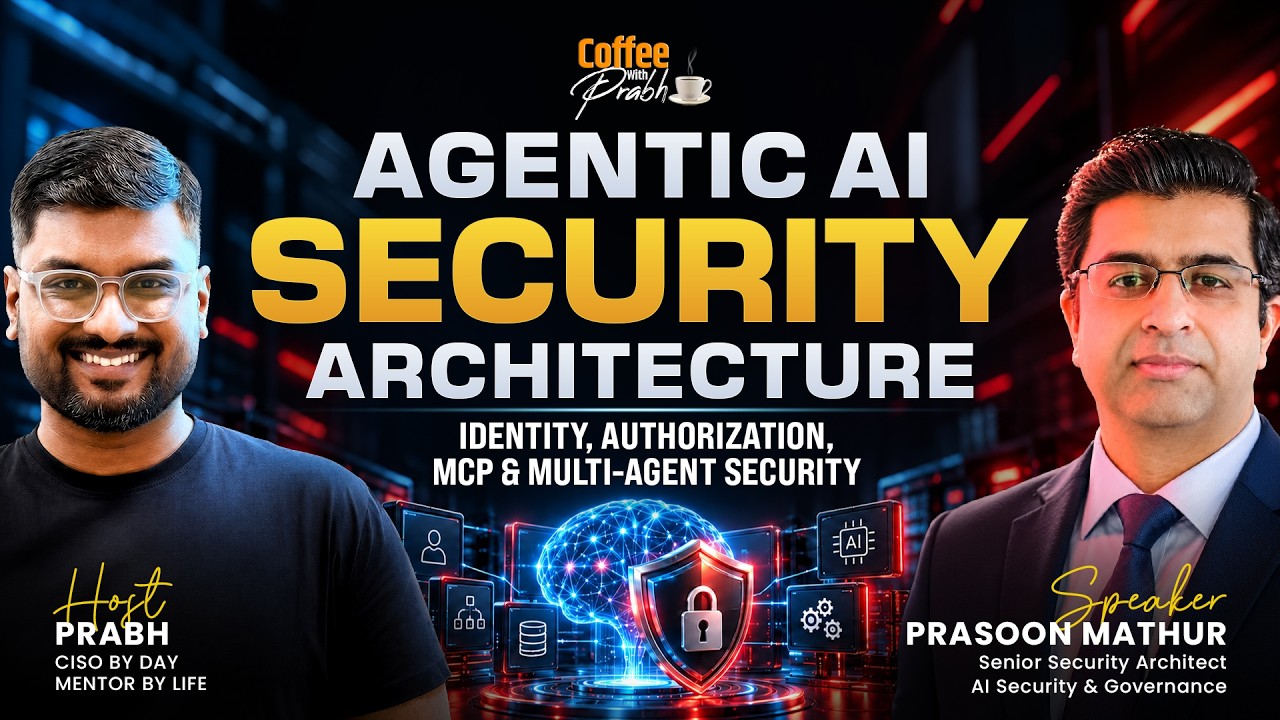
How to Build Security Architecture for Agentic AI
Title history
- How to Build Security Architecture for Agentic AI — observed on 20261117-1643 UTC (YouTube)
Keywords
Summary
218 words
Critical Evaluation
Value of the Information & Strength of the Argument
The information value is high for security architects and engineers planning to deploy agentic AI. The guest, Prasoon Mathur, provides actionable guidance based on extensive field experience, covering both strategic principles (business impact analysis, governance) and technical specifics (OAuth flows, scoped tokens, API gateways). The argumentation is logical and consistent, building a layered architecture from identity to runtime monitoring. Mathur effectively explains why over-permissioned agents are common and how to avoid them using token scopes. The discussion also references real-world incidents (e.g., an AI agent acting unintendedly) to illustrate reasoning. However, the argumentation is anecdotal rather than evidence-based; no quantitative data or formal case studies are presented. The conversational style introduces some digressions but overall maintains a coherent thread. The speaker’s credibility as a senior architect strengthens the practical value, though the lack of citations weakens the scientific rigor. The video successfully bridges theoretical security models with implementation realities, making it a useful resource for practitioners.
Scientific Rigor, Source Quality, Title Accuracy
The scientific rigor is moderate: the content relies on the speaker’s professional expertise and general best practices rather than explicit sources. The only provided link is the guest’s LinkedIn profile, offering no further references. While the advice aligns with recognized standards like OAuth 2.0, zero trust, and cloud security frameworks, viewers cannot independently verify the claims. The title ‘How to Build Security Architecture for Agentic AI’ accurately reflects the content, which systematically walks through architectural layers. There are no formal citations or references to academic papers, industry frameworks (e.g., NIST, OWASP) despite them being implicitly relevant. The absence of a structured methodology reduces its scientific rigor but does not undermine the practical value. The content is more of an expert opinion piece than a research-backed analysis. The adequate title and expert provenance support a score of 4 stars, but the weakness in sourcing prevents a higher rating.
318 words
Title / Content Match
The title accurately reflects the content: the video focuses on building a security architecture for agentic AI, detailing layers such as identity, data governance, API security, and runtime monitoring.
Quality & Reliability
7/10
The content is based on the expert opinion of a senior security architect with over two decades of experience, providing practical insights grounded in real-world enterprise architecture. However, the discussion lacks formal citations, peer-reviewed references, or empirical data, relying on anecdotal experiences and general principles. The reasoning is coherent and aligns with established security practices (OAuth, zero trust, data governance), but the absence of verifiable sources and the informal podcast format limit its strict scientific reliability.
Key Moments
Markers derived by PSI from the transcript: the creator did not define chapters.
- Introduction of guest Prasoon Mathur and the session objective on agentic AI security.
- Discussion on starting with business case and governance before building an agent.
- Importance of agent identity and registration in identity provider.
- Role of data governance and data classification as prerequisite.
- Common architect blockers: missing data classification, API security, identity governance.
- OAuth-based authorization, scoped tokens, and MCP/A2A protocols.
- Runtime monitoring and preventing over-privileged agents; concluding remarks.
Cited Sources
- LinkedIn profile of Prasoon Mathur — Referenced in the video description as the guest's professional profile, providing credibility but no direct content references.
Contribution & Novelties
The video contributes a practical, step-by-step architectural blueprint for securing agentic AI, emphasizing identity-first design and continuous runtime evaluation. It clarifies the distinction between authentication (one-time) and authorization (repeated) in autonomous agents, advocating OAuth-based delegated scopes. The discussion highlights common industry defaults (over-permissioned agents) and offers concrete mitigation strategies. This pragmatic focus on real-world implementation issues adds value over theoretical AI security discussions.
For Further Reading:
- Model Context Protocol (MCP) — Official documentation for the emerging standard enabling tool integration for agents, directly relevant to the token scoping discussed.
- Agent-to-Agent (A2A) Protocol — Emerging standard for inter-agent communication, referenced in the video regarding delegation and OAuth usage.
- OAuth 2.0 Authorization Framework — Foundational specification for delegated authorization, central to the video’s token-based access control recommendations.
- Zero Trust Architecture (NIST SP 800-207) — NIST guideline aligning with the video’s emphasis on continuous verification and least privilege for agents.
147 words
Radar Profile
The radar profile shows high scores in quantitative information (8) and technical level (8), reflecting the depth of practical details and the advanced nature of the topic. Quality of information is slightly lower (7) due to lack of formal sources. Reliability is the weakest dimension (6), consistent with the anecdotal nature of the expert opinion and absence of citations. Overall, the content is rich and technically solid, but rests on experiential rather than empirically verified foundations.