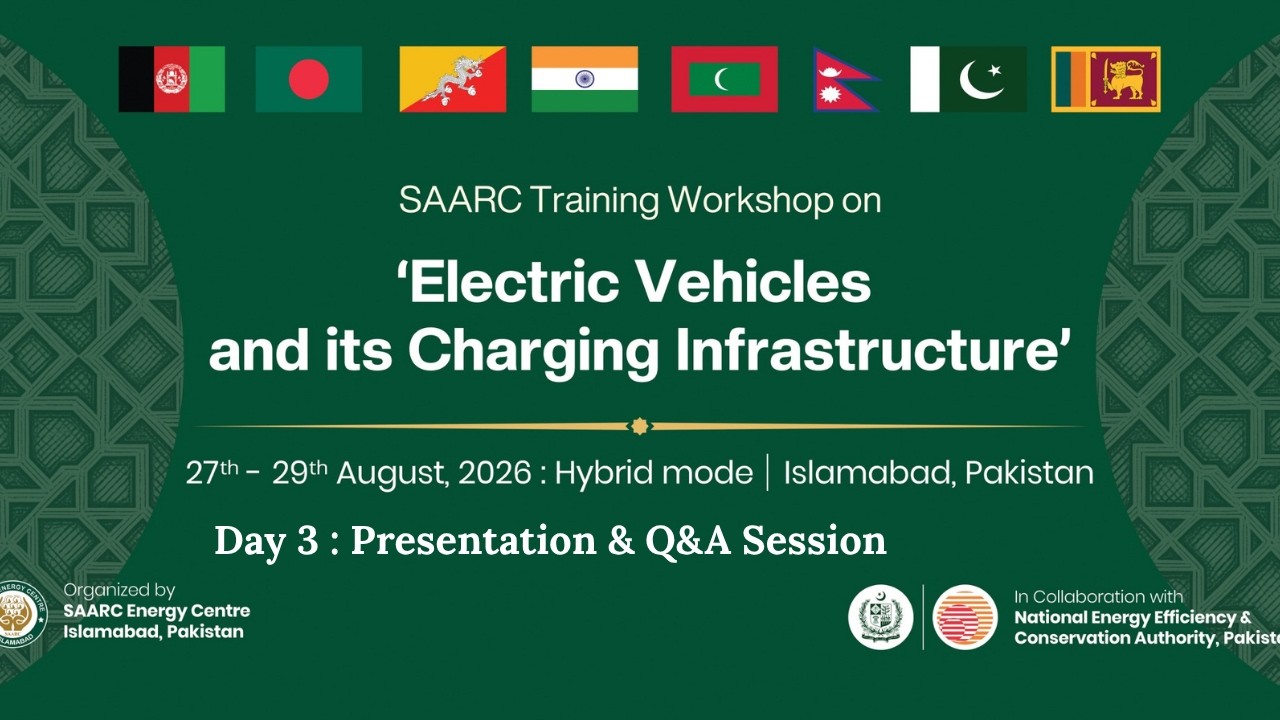
Day 3: Technical Sessions & Q&A | SAARC EV Charging Infrastructure Workshop 2026
Keywords
Summary
172 words
Critical Evaluation
Value of the Information & Strength of the Argument
The presentation offers substantial practical value for policymakers and regulators in developing countries, particularly in South Asia. It provides a clear framework for developing EV standards, emphasising performance-based criteria over technology mandates. The argumentation is grounded in real-world examples, such as the failure of lead-acid batteries to meet cycle life requirements without oversizing, and the need to phase in stricter braking standards to avoid excluding local manufacturers. The speaker argues convincingly for data-driven standards, citing the lack of accident and fatality data in developing countries as a major obstacle. He also highlights the importance of testing battery lifespan, as it is the least accessible parameter for consumers. The discussion on where to test—government versus private facilities—is nuanced, acknowledging trade-offs between cost, speed, and corruption risks. The argument for simplifying tests, such as the rain test, demonstrates a pragmatic approach to making standards accessible. Overall, the reasoning is logical and supported by the speaker’s extensive experience, though some claims remain anecdotal.
Scientific Rigor, Source Quality, Title Accuracy
The presentation is rigorous in its technical content, drawing on established international standards (European, US, Chinese) and the speaker’s own testing experience. However, it lacks explicit citations or references to specific documents, relying instead on general knowledge and examples. The title accurately reflects the content, as the video is indeed a technical session from a workshop on EV charging infrastructure. The Q&A session is mentioned but not fully captured in the transcript. The speaker’s credibility is high, given his role as CTO of a testing facility and involvement in standards development. The absence of a formal bibliography or data sources slightly reduces the scientific rigour, but the practical insights are valuable. No comments were provided for analysis.
292 words
Title / Content Match
The title accurately reflects the content: the video is the third day of a workshop featuring technical sessions and a Q&A on EV charging infrastructure, with presentations on standards, testing, and policy.
Quality & Reliability
7/10
The session is delivered by a recognised technical expert with decades of hands-on experience in EV testing and standards development. The content is grounded in practical engineering and regulatory practice, with concrete examples (Malaysia, Pakistan, Southeast Asia). However, the presentation is largely oral, with few explicit citations or data sources, and some claims (e.g., fire risk comparison, corruption in private testing) are anecdotal rather than referenced.
Key Moments
Markers derived by PSI from the transcript: the creator did not define chapters.
- Introduction to the third day and the technical session on code standards and business models.
- Dr. Horizon Briggs begins his presentation on global standards and testing of electric vehicles.
- Explanation of the three main purposes of standards: safety, quality, and compatibility.
- Discussion on technology-blind standards and the example of battery cycle life.
- Where to test: government vs. private facilities, and issues of corruption.
- How to determine what to specify in standards: customer complaints and manufacturer claims.
- The process of developing standards in Malaysia and the importance of data.
- Challenges in developing countries: lack of data on accidents and fatalities.
- Example of braking standards for two-wheelers in Pakistan and the need for phased implementation.
- Overview of EV-specific standards: battery safety, range, electromagnetic compatibility.
Cited Sources
- SAARC Training Workshop on Electric Vehicles and its Charging Infrastructure — Official workshop page with resources and presentations.
Contribution & Novelties
The presentation provides a practical, experience-based guide to developing EV standards in developing countries, with a focus on South Asia. It offers concrete examples of how to adapt international standards to local conditions, such as flood testing and phased braking requirements. The emphasis on performance-based, technology-blind standards is a valuable contribution to policy discussions. The discussion on testing infrastructure and the trade-offs between government and private facilities is particularly relevant for resource-constrained settings.
Pour aller plus loin :
- Electric vehicle charging standards — Overview of international standards for EV charging.
- IEC 61851 — International standard for conductive charging systems for electric vehicles.
- SAE J1772 — North American standard for EV charging connectors.
112 words
Radar Profile
The radar shows a strong emphasis on information quantity and technical level, with slightly lower scores for quality and reliability due to the lack of explicit citations. The profile indicates a highly informative, technically detailed presentation that is practical but not heavily referenced.