Webinar on Guidelines and SoPs for Solar Power Development through Bidding
Keywords
Summary
214 words
Critical Evaluation
Value of the Information & Strength of the Argument
The informational value of this webinar lies primarily in its practical, practitioner-oriented account of how competitive bidding for solar power is structured in India. The speaker provides concrete institutional detail: the legal mandate for competitive bidding under the Electricity Act 2003, the distinction between central and state jurisdiction over electricity, the role of distribution utilities as retailers, and the creation of SECI as a government-backed intermediary to mitigate payment risk. The argument is built around a clear causal narrative: early solar tariffs were high and discoms were financially weak, which deterred investment; a central intermediary with a payment security corpus and transparent bidding resolved both problems; competitive bidding then drove tariffs down to grid parity and enabled the phase-out of subsidies. This is a coherent and internally consistent account, and the speaker’s operational experience lends it credibility. However, the argumentation is largely descriptive and retrospective rather than analytical. It does not engage with counterarguments, such as the financial sustainability of the intermediary model, the persistence of discom payment delays, or the distributional effects of large-scale competitive bidding on smaller developers. Quantitative claims (e.g., 75 GW of renewable capacity contracted, 43 billion USD in value, tariffs falling to 2.5-3 rupees per unit) are presented without sourcing or methodological context, and the presentation acknowledges that some figures are dated. The discussion of innovations such as firm and dispatchable renewable energy and time-of-day supply is valuable for understanding how procurement design is adapting to grid needs, but it remains at the level of institutional description rather than technical or economic evaluation. Overall, the webinar offers useful procedural knowledge for policymakers and practitioners in SAARC member states, but it functions more as a practitioner’s overview than as a rigorous analytical assessment.
Scientific Rigor, Source Quality, Title Accuracy
The webinar’s scientific rigor is moderate. It is not an academic study but an expert presentation grounded in a well-documented regulatory framework. The speaker references the Electricity Act 2003 and national bidding guidelines, which are verifiable public documents, and the institutional roles described are consistent with India’s known power sector structure. However, no specific sources, reports, or data sets are cited during the talk, and the quantitative claims are not attributed. The presentation relies on the speaker’s professional experience and institutional knowledge, which is a legitimate but not independently verifiable form of evidence. The quality of sources is therefore limited to the implicit authority of the speaker and the organizing institution. The title, “Webinar on Guidelines and SoPs for Solar Power Development through Bidding,” accurately reflects the content, which is centered on guidelines and standard operating procedures for competitive bidding. The regional framing in the description (SAARC member states) is broader than the actual content, which focuses almost entirely on India, but this is a minor mismatch rather than a misleading title. No comments were provided for analysis, so no audience trend assessment is included.
487 words
Title / Content Match
The title accurately reflects the content: the webinar focuses on guidelines and standard operating procedures for solar power development through competitive bidding, with a detailed presentation on India's procurement framework. The scope is somewhat narrower than the broad SAARC regional framing suggested by the title.
Quality & Reliability
7/10
The webinar is delivered by a senior practitioner from Solar Energy Corporation of India with direct operational experience in renewable energy procurement, and the content is grounded in documented Indian regulatory frameworks (Electricity Act 2003, national bidding guidelines). However, the presentation is largely descriptive and experience-based, with limited quantitative sourcing, no citations to independent studies, and no peer-reviewed references. Claims about tariffs and capacity are broadly consistent with public knowledge but are not individually sourced in the talk.
Key Moments
Markers derived by PSI from the transcript: the creator did not define chapters.
- Introduction by the Director of SAARC Energy Centre, outlining the webinar's objectives and the importance of common guidelines and SOPs for solar procurement across SAARC member states.
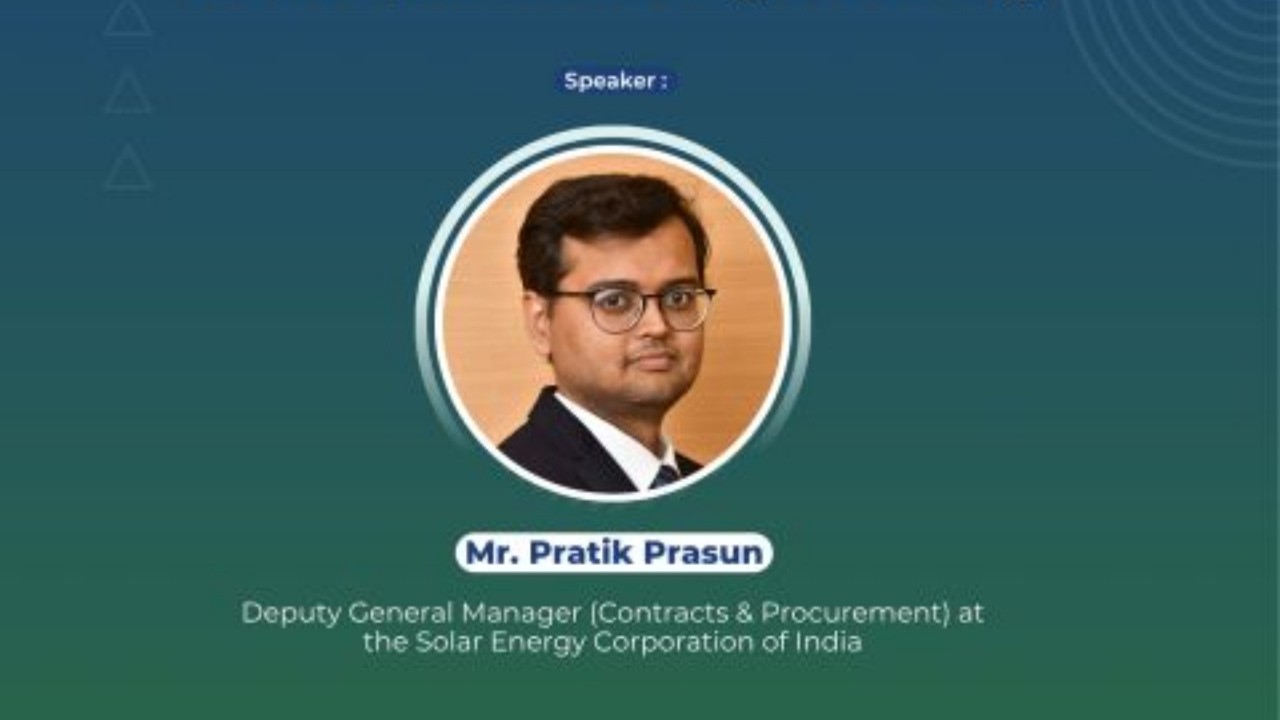
- Moderator introduces the speaker, Mr. Pratik Prasun, highlighting his experience in structuring over 75 GW of renewable energy transactions and his role in drafting India's standard bidding guidelines.
- Speaker begins presentation with an overview of India's renewable energy capacity, ranking fourth in wind and fifth in solar, and notes that non-fossil sources exceed 50% of installed capacity.
- Explanation of India's electricity regulatory framework under the Electricity Act 2003, including the mandate for competitive bidding and the concurrent jurisdiction of central and state governments.
- Description of key stakeholders in the Indian power sector: solar power developers, distribution companies (discoms), transmission utilities, regulators, and the bidding agency SECI.
- Historical context of SECI's creation in 2011 to address high solar tariffs and weak discom finances, including the use of viability gap funding and the first PPA at around 18 rupees per unit.
- Explanation of SECI's role as an intermediary procurer providing payment security, with a corpus growing from 500 crore to over 4,000 crore rupees, and its track record of no payment defaults.
- Discussion of tariff trends, showing solar tariffs falling from around 5.5 rupees to a stabilized range of 2.5-3 rupees per unit, and the achievement of grid parity around 2016-17.
- Introduction of hybrid and storage-integrated procurement models, including round-the-clock power, assured peak supply, and firm and dispatchable renewable energy tenders with time-of-day scheduling.
- Explanation of time-of-day supply mechanisms, where discoms provide static demand profiles and developers must match 90% of the schedule, with tariffs discovered below 5 rupees per unit.
Cited Sources
- SAARC Energy Centre — Official website of the organizing institution, provided in the video description for more information.
Contribution & Novelties
The webinar’s main contribution is a detailed, practitioner-level account of how India operationalized competitive bidding for solar power, including the institutional design of SECI as a payment-security intermediary and the evolution of procurement instruments toward dispatchability. It offers a concrete case study that SAARC member states could adapt, particularly regarding the use of standardized bidding guidelines, viability gap funding in early stages, and the integration of storage and time-of-day supply requirements. The presentation also highlights the shift from simple solar tenders to hybrid, round-the-clock, and firm dispatchable renewable energy products, reflecting a maturing procurement framework.
Pour aller plus loin :
- Electricity Act 2003 — Overview of the Indian legislation that mandates competitive bidding for electricity procurement.
- Solar Energy Corporation of India — Background on the intermediary agency discussed extensively in the webinar.
- Renewable energy in India — Context on capacity growth, tariffs, and policy frameworks referenced by the speaker.
- Competitive bidding guidelines for renewable energy procurement, Ministry of Power, Government of India — The regulatory documents that form the basis of the procedures described, cited by name without URL due to uncertainty about the exact current address.
187 words
Radar Profile
The radar profile shows moderate to high scores across information quantity, quality, technical level, and overall reliability, with reliability slightly higher due to the speaker's direct institutional experience. The profile reflects a practitioner-oriented presentation that is informative and grounded in real regulatory frameworks but lacks independent sourcing and analytical depth.