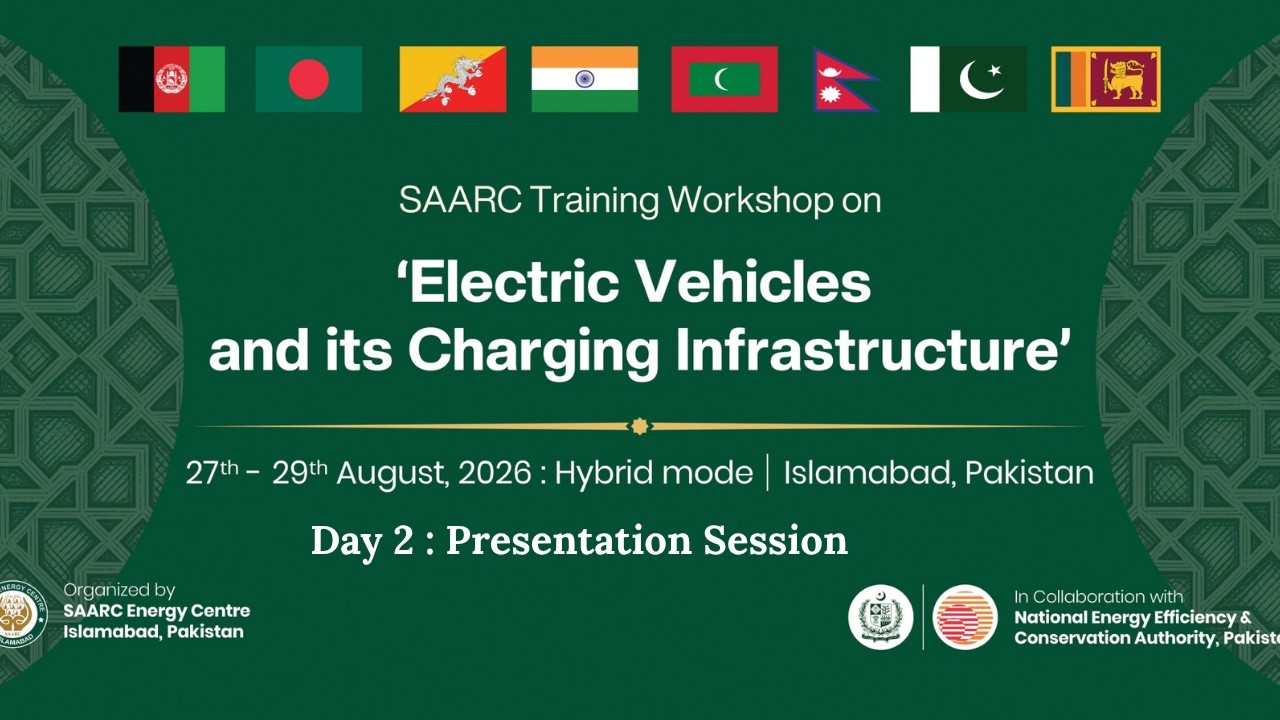
Day 2 : Technical Presentations | SAARC EV Charging Infrastructure Workshop
Keywords
Summary
248 words
Critical Evaluation
Value of the Information & Strength of the Argument
The presentation offers substantial practical value for policymakers and practitioners in South Asia. It synthesises technical fundamentals with a detailed inventory of deployment barriers, moving beyond generic EV advocacy to address region-specific constraints such as vertical urban growth in Karachi and Dhaka, which shapes charging infrastructure planning differently from lower-density cities. The argument is structured logically: technology basics, charging, regional context, challenges, then policy levers. The speaker supports several claims with concrete examples, including the Punjab regulation capping electric three-wheeler motors at 3 kW and the resulting manufacturer dilemma of building multiple variants. The discussion of financing failures is particularly instructive, contrasting an Indian low-carbon auto-rickshaw pilot that collapsed due to insufficient de-risking with Pakistan’s PAVE scheme, where bank-side due diligence rather than government design proved the bottleneck. The argumentation is generally balanced, acknowledging that EVs have zero tailpipe emissions but not zero well-to-wheel emissions. However, the reasoning relies heavily on the speaker’s own pilot experience and informal observation, with limited engagement with counter-evidence or quantitative modelling. Some claims, such as the efficiency comparison between engine and motor, are simplified. The Q&A segment adds clarity on the PHEV versus REEV distinction, though the answer remains somewhat repetitive. Overall, the value lies in its practical, regionally grounded diagnosis rather than in theoretical novelty.
Scientific Rigor, Source Quality, Title Accuracy
Scientific rigour is moderate. The presentation is delivered by a specialist from a recognised energy institute and draws on regional data, but it is a conference talk rather than a peer-reviewed publication. Quantitative claims, such as the global EV sales share of 25% in 2025 and India’s 8% new car sales share, are stated without citations. The speaker references internal testing at the LUMS Energy Institute lab, where claimed top speeds of electric two-wheelers were found to be lower than advertised, but no methodology or sample size is provided. The discussion of battery testing notes that imported cells may be fresh or second-life, yet no source is given for this concern. The only external reference in the description is the SAARC Energy Centre workshop page, which hosts the presentations. The title accurately describes the content: it is Day 2 of a technical workshop on EV charging infrastructure, and the recording matches that description. There is no misleading framing. The absence of defined chapters means the viewer must rely on timestamps, which the speaker does not provide. The overall rigour is appropriate for a training workshop but falls short of academic standards.
418 words
Title / Content Match
The title accurately reflects the content: this is the second day of a technical workshop on EV charging infrastructure, with presentations on EV fundamentals, charging levels and implementation challenges. The match is good, though the video is a full session recording rather than a single focused talk.
Quality & Reliability
7/10
The presentation is delivered by a specialist from a recognised energy institute and is grounded in concrete regional data (EV sales shares, policy schemes, tariff figures). However, it is a conference talk rather than a peer-reviewed study: most claims are not referenced, quantitative figures are given without sources, and some assertions rest on the speaker's own pilot observations. The content is credible and internally coherent but not independently verifiable from the material provided.
Key Moments
Markers derived by PSI from the transcript: the creator did not define chapters.
- Introduction and housekeeping, including instructions on using the Zoom Q&A feature and a tour of the SAARC Energy Centre website where presentations are uploaded.
- Malik Muhammad Arslan begins his presentation on EV fundamentals, contrasting internal combustion engine vehicles with electric vehicles.
- Explanation of the four EV types: HEV, PHEV, BEV and REEV, with regional examples such as the Toyota Prius and JAC models.
- Overview of charging levels: Level 1 (8-12 hours), Level 2 (3-6 hours) and DC fast charging, and their suitability for different locations.
- Discussion of grid load management strategies: peak demand management, renewable pairing and grid reliability improvements.
- Regional snapshot of EV targets, including India's 8% new car sales share and Nepal's leadership in the region.
- Detailed walkthrough of implementation challenges: grid capacity, charging infrastructure gaps, battery supply chain and standards.
- Case studies on EV financing: the failed Indian low-carbon auto-rickshaw pilot and Pakistan's PAVE scheme, highlighting bank-side due diligence barriers.
- Policy levers proposed, including harmonising regional standards, prioritising two- and three-wheelers, and public-private partnerships.
- Q&A session on the key difference between PHEV and REEV, focusing on efficiency and driving patterns.
Cited Sources
- SAARC Training Workshop on Electric Vehicles and its Charging Infrastructure — Official workshop page on the SAARC Energy Centre website, hosting the agenda, concept paper and delegate presentations.
Contribution & Novelties
The presentation’s main contribution is its regionally grounded synthesis of EV deployment challenges in South Asia, moving beyond generic technical descriptions to address specific policy and market failures. It highlights the Punjab regulation capping electric three-wheeler motors at 3 kW and the resulting manufacturer dilemma, a concrete example of regulatory inconsistency. It also provides a detailed comparison of two financing approaches: the Indian low-carbon auto-rickshaw pilot that collapsed due to insufficient de-risking, and Pakistan’s PAVE scheme where bank-side due diligence, rather than government design, proved the bottleneck. The discussion of battery-as-a-service models being blocked by regulations requiring vehicle registration with a battery is another practical insight. The presentation also notes the lack of EV testing facilities in Pakistan and the risks of informal retrofitting without chassis design studies.
Pour aller plus loin :
- Electric vehicle — Overview of EV technology and categories.
- Charging station — Explanation of charging levels and standards.
- Vehicle-to-grid — Concept for grid integration and load management.
- Battery recycling — Context for battery supply chain and disposal challenges.
- SAARC Energy Centre — Institutional context for regional energy cooperation.
181 words
Radar Profile
The radar profile shows high information quantity and good overall reliability, reflecting the breadth of topics covered and the credible institutional context. Technical depth is moderate, as the presentation targets a policy and practitioner audience rather than specialists. The balance suggests a solid, practical briefing with room for more rigorous sourcing.