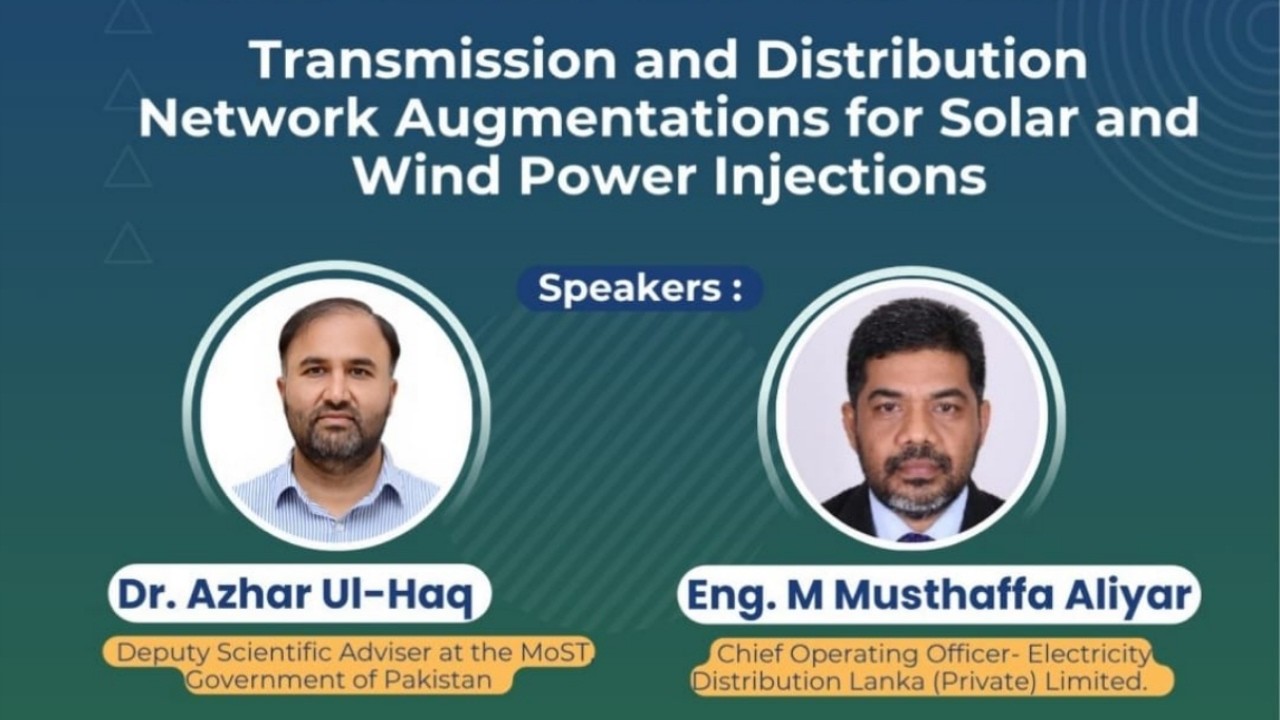
SAARC Webinar on Scheduling of Wind and Solar Power Projects
Keywords
Summary
237 words
Critical Evaluation
Value of the Information & Strength of the Argument
The presentation offers a well-organized conceptual framework rather than new empirical findings. Its value lies in the systematic mapping of how variable renewable generation stresses each layer of the power system and what categories of reinforcement follow. The argument is logically sequenced: drivers → penetration trends → conventional system baseline → renewable-specific challenges → transmission augmentation → distribution augmentation → regional integration. The reasoning is sound and consistent with established power-systems engineering: the claim that generation and demand must balance at all times, that reverse power flow from prosumers changes voltage profiles, and that reactive power compensation is needed to manage voltage are all standard and correctly stated. The argument is weaker where it becomes quantitative or predictive. The IEA figure (17% to 27% by 2030) is cited without a specific report, and the country targets (India’s 500 GW non-fossil, Pakistan’s 30% renewables by 2030, Sri Lanka’s 70%, Bhutan’s 1 GW) are presented without sources or dates of adoption. The HVDC break-even claim (‘more than 600 km or 760 km’) is stated as experimentally proven but with inconsistent figures and no citation. The discussion remains largely qualitative; no case data, load-flow studies, or cost figures are presented to substantiate the magnitude of the problems or the effectiveness of proposed solutions. As an educational overview for a regional audience, the argumentation is clear and credible, but it does not advance a novel thesis or test a hypothesis.
Scientific Rigor, Source Quality, Title Accuracy
Scientific rigor is moderate. The speakers are credible — Dr. Azhar Ul Haq is identified as a deputy scientific advisor at Pakistan’s Ministry of Science and Technology with prior academic appointments, and Eng. M. Musthaffa Aliyar represents Sri Lanka — and the technical content aligns with mainstream power-systems engineering. However, sourcing is thin: the only external authority invoked is the IEA, without a named publication, and no academic papers, national grid studies, or regulatory documents are cited. The description provides only the SAARC Energy Centre website (https://www.saarcenergy.org ) as a reference, which is an institutional homepage rather than a specific source. No data tables, figures, or methodological details are referenced in the transcript. On title/content adequacy, the YouTube title references ‘Scheduling of Wind and Solar Power Projects,’ whereas the webinar actually covers T&D network augmentation for solar and wind integration — a related but distinct topic, indicating a partial mismatch. No viewer comments were provided for analysis.
408 words
Title / Content Match
The YouTube title mentions 'Scheduling of Wind and Solar Power Projects' while the actual webinar, per the description and transcript, concerns transmission and distribution network augmentation for solar and wind integration. There is a partial mismatch, though the broader renewable-energy grid topic overlaps.
Quality & Reliability
6/10
The content is delivered by credentialed experts (a deputy scientific advisor in Pakistan's Ministry of Science and Technology and a Sri Lankan engineer) and is technically coherent, but it is a webinar presentation rather than a peer-reviewed study. Quantitative claims are sparse and mostly attributed generically to the IEA without a specific report citation. No primary data, methodology, or references are provided in the transcript.
Key Moments
Markers derived by PSI from the transcript: the creator did not define chapters.
- Moderator opens the webinar and outlines the format: expert presentations followed by Q&A.
- Director's welcome remarks: IEA projection that variable renewables rise from 17% to ~27% of global generation by 2030; warnings on congestion, curtailment, and financing risk.
- Dr. Azhar Ul Haq introduces the presentation outline and his credentials.
- Four drivers of renewable energy in South Asia: energy security, reliable and inclusive power, economic opportunity, climate sustainability.
- Country penetration levels and 2030 ambitions: India, Pakistan, Sri Lanka, Bhutan.
- Comparison of conventional centralized one-way power systems versus renewables-driven systems with bidirectional flow and prosumers.
- Technical challenges of solar and wind: variability, intermittency, balancing limits, reverse power flow, voltage and power quality issues.
- Transmission augmentation measures: network planning, new lines and substations, reactive power compensation, wide-area monitoring, HVDC, FACTS.
- Distribution system impacts and interventions: hosting capacity, feeder and transformer upgrades, volt-var optimization, smart inverters, automation, adaptive protection.
Cited Sources
- SAARC Energy Centre — Institutional website of the organizing body, provided in the video description for further information.
Concurring Sources
- International Energy Agency — Renewables — IEA analysis broadly supports the webinar's claim that variable renewables' share of global generation is rising rapidly through 2030.
- Variable renewable energy — Wikipedia — General reference confirming the variability, intermittency, and grid-integration challenges described by the speaker.
Contribution & Novelties
The webinar’s contribution is primarily pedagogical and regional: it consolidates, for a South Asian audience, the standard engineering case for treating T&D augmentation as an integral part of renewable energy deployment rather than a separate afterthought. It usefully frames the problem through the lens of SAARC member states’ specific 2030 targets and the region’s shared dependence on energy imports. It does not present original research, new data, or a novel methodology; the technical content is a synthesis of established power-systems knowledge. Its value is therefore in awareness-raising and regional coordination rather than scientific novelty.
Pour aller plus loin :
- Variable renewable energy — Overview of the variability and intermittency challenges central to the presentation.
- Electric power transmission — Background on transmission networks, HVDC, and grid interconnection discussed by the speaker.
- High-voltage direct current — Technical reference for the HVDC economics claim made in the webinar.
- Distributed generation — Context for reverse power flow, prosumers, and distribution-level integration.
- International Energy Agency, World Energy Outlook — The source generically invoked for the 17% to 27% renewables projection; specific edition not cited in the video.
182 words
Radar Profile
The profile is balanced but moderate: information quantity and quality are solid for an educational webinar, technical level is intermediate (conceptual rather than quantitative), and overall reliability is decent given credentialed speakers but limited sourcing. The absence of primary data or specific citations keeps the reliability score from rising higher.