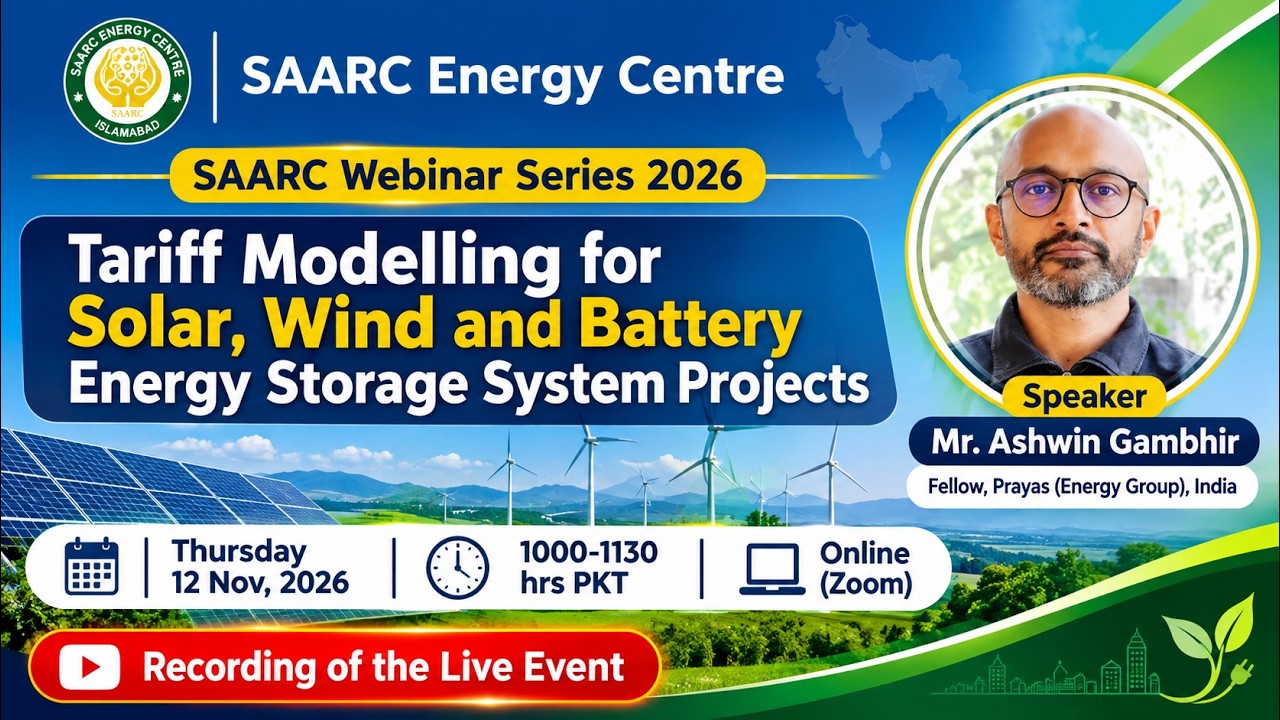
SAARC Webinar on 'Tariff Modelling for Solar, Wind and Battery Energy Storage System Projects'
Title history
- SAARC Webinar on 'Tariff Modelling for Solar, Wind and Battery Energy Storage System Projects' — observed on 20261112-0938 UTC (YouTube)
Keywords
Summary
177 words
Critical Evaluation
Value of the Information & Strength of the Argument
The value of this webinar lies in its practical, data-driven approach to tariff modeling. The speaker leverages extensive Indian market experience to illustrate the evolution from administrative cost-plus tariffs to competitive bidding, highlighting real winning tariffs and project structures. The argumentation is systematic: it starts with context, explains the financial model inputs, and then moves to complex FDRE cases, showing the logical progression of tariff calculation methodologies. The inclusion of specific numbers (e.g., solar tariffs at 2.5-3 INR/kWh, wind at 3.5-4 INR/kWh) and penalty structures adds credibility. However, some claims are not cited in the video, and the talk assumes familiarity with technical financial terms, which may limit accessibility. Overall, the argument is solid, rooted in practical experience, and offers actionable insights for renewable project financing.
Scientific Rigor, Source Quality, Title Accuracy
The speaker references the India Energy Transition Factbook (Bloomberg) for market data and mentions a prior SAARC workshop on tariff modeling held in Colombo, but no direct citations are shown in the video. The primary source available is the SAARC Energy Centre website, which hosts related workshop materials. The title accurately reflects the webinar’s scope, which is indeed tariff modeling for solar, wind, and BESS projects. The rigor is moderate: the speaker demonstrates deep technical expertise, but the lack of explicit source documentation in the video limits full verification. Nevertheless, the content aligns with known renewable energy finance practices and includes specific examples that enhance reliability.
247 words
Title / Content Match
The title accurately reflects the content, which focuses on tariff modeling for solar, wind, and battery storage projects, as presented in the SAARC webinar.
Quality & Reliability
8/10
The webinar features an experienced expert in energy policy and tariff modeling, providing detailed insights based on real data from India. The content is specific and practical, with clear explanations of financial models and regulatory frameworks. However, it is a single expert's perspective, and some claims are not backed by citations in the video.
Key Moments
Markers derived by PSI from the transcript: the creator did not define chapters.
- Introduction and welcome by moderator Esen Javed
- Speaker begins with context on why lessons from India are important
- Overview of India's renewable market size and tariff levels
- Explanation of cost-plus tariff model with financial inputs
- Transition to competitive bidding and battery storage projects
- Discussion of complex FDRE projects and final remarks
Cited Sources
- SAARC Energy Centre — Organizer of the webinar and hosting workshop materials on tariff modeling.
- India Energy Transition Factbook (Bloomberg) — Mentioned by speaker as source for India's renewable capacity and market data.
Concurring Sources
- SAARC Energy Centre — Provides additional workshop materials on tariff modeling, which align with this webinar's content.
Contribution & Novelties
The webinar provides a comprehensive overview of tariff modeling practices in India, focusing on the shift from cost-plus to competitive bidding and the complexities introduced by battery storage and firm dispatchable renewable projects. It offers practical insights on financial modeling inputs, including battery degradation and penalty structures, which are often overlooked in standard models. The speaker’s experience adds credibility to the delivery of real-world tariff ranges and project design considerations.
Pour aller plus loin :
- Levelized Cost of Energy (LCOE) — Foundation concept for tariff calculations.
- Battery degradation — Key parameter in BESS financial models.
- Renewable energy in India — Context for India’s market and policy evolution.
107 words
Radar Profile
The radar shows high values for information quantity and quality, reflecting the detailed technical content and expert presentation. Fiabilité is also strong due to the speaker's credentials, while the technical level is moderate, indicating a balance between accessibility and depth.