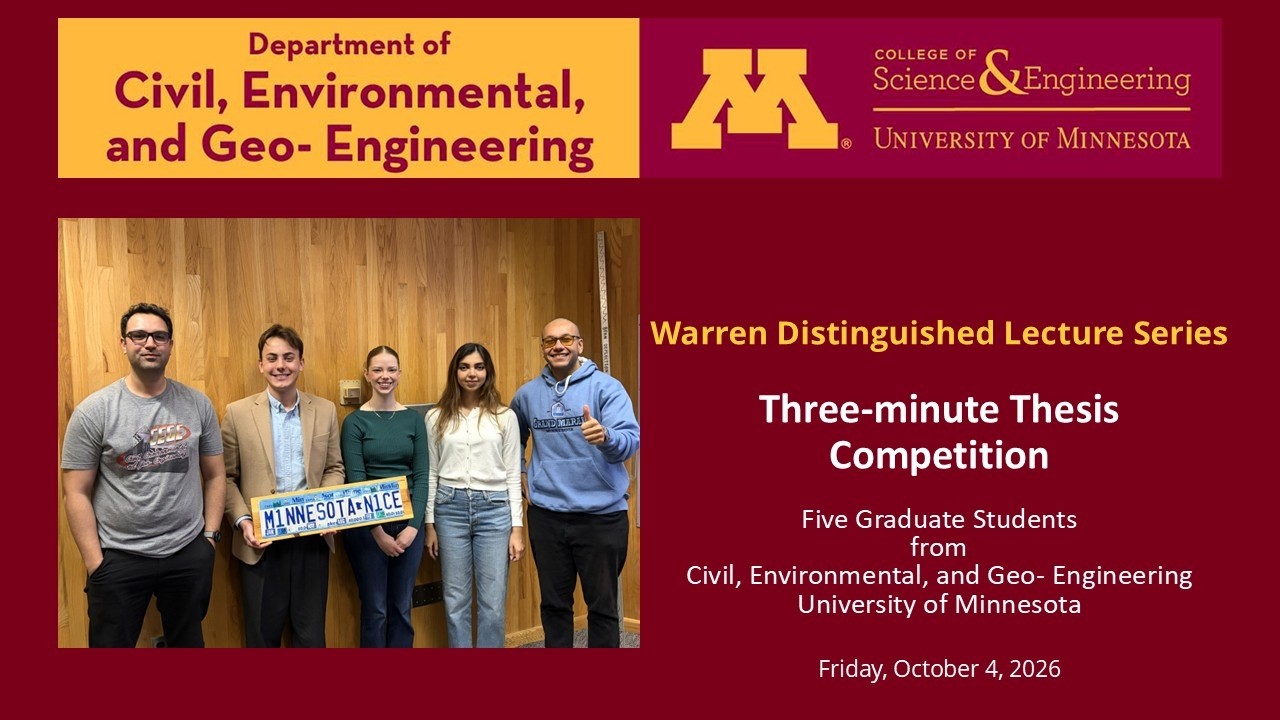
CEGE Three-Minute Thesis Contest 2026
Title history
- CEGE Three-Minute Thesis Contest 2026 — observed on 20261113-2201 UTC (YouTube)
Keywords
Summary
161 words
Critical Evaluation
Value of the Information & Strength of the Argument
The value of the information lies in showcasing current graduate research topics in civil and environmental engineering, each presented with a clear problem, approach, and potential impact. The argumentation is largely descriptive, as each student condenses months of research into a three-minute pitch. For instance, Bastawisy effectively uses an analogy to art to explain metagenomics, while Nankali provides concrete numbers (17% reduction in travel time) to support his model’s benefit. Chesley highlights the lack of understanding regarding plastic additives. The presentations are persuasive for a general audience, but the depth is necessarily limited. The winning presentation by Saia was noted for its engaging narrative and practical relevance.
Scientific Rigor, Source Quality, Title Accuracy
The title accurately reflects the content. The sources cited within the presentations are minimal; the students reference their own research and data but do not point to external references. The host mentions the University of Queensland as the origin of the 3MT format, but no further literature is cited. The description provides no links to published papers, making independent verification impossible. The video’s strength lies in its communication skill rather than scientific detail. The audience criteria (clearly explained) emphasize engagement and clarity, not rigorous source citation. Overall, the scientific rigor is moderate, consistent with a competition format intended to distill rather than expand on technical details.
228 words
Title / Content Match
The title accurately reflects the content: a department-level Three-Minute Thesis competition in civil, environmental, and geo-engineering.
Quality & Reliability
7/10
The video is a departmental 3MT competition where five graduate students present their research at a high level of competence. The presentations are based on ongoing research but lack explicit citations or external sources; the content is largely self-contained, and no verification of claims is possible from the video alone.
Key Moments
Markers derived by PSI from the transcript: the creator did not define chapters.
- Introduction and explanation of the 3MT rules
- Tareq Bastawisy presents metagenomics of wastewater bacteria
- Alexa Chesley on microplastics in wastewater treatment
- Mobina Nankali on dedicated lanes for automated vehicles
- Nicholas Saia on e-bike usage and safety in Minnesota
- Ehsan Zadehali on cohesive sediment erosion
- Voting and announcement of winners
Contribution & Novelties
This video offers a snapshot of ongoing graduate research in civil and environmental engineering, but its primary value is in the communication and presentation of that research rather than in delivering novel findings. Each 3-minute pitch condenses a thesis into a relatable narrative, making complex topics accessible. The novelty lies in the compilation of diverse research areas and the demonstration of effective science communication.
Pour aller plus loin :
- Metagenomics — Explores the direct genetic analysis of microbial communities, relevant to Tareq’s wastewater research.
- Microplastics — Provides an overview of microplastic pollution and its environmental impact, central to Alexa’s presentation.
- Automated vehicle lane — Discusses dedicated lanes for autonomous vehicles, though note the article is broad; the concept of managed lanes is relevant to Mobina’s optimization problem.
- Electric bicycle — Covers e-bike technology and safety, matching Nicholas’s research.
- Sediment transport — Details the movement of particles in fluid, foundational to Ehsan’s work on cohesive sediments.
155 words
Radar Profile
The radar profile would show moderate quantity (5) due to limited depth, but higher quality (7) and technical level (6) indicating well-aimed communication. Reliability (7) reflects the presumed competence of graduate researchers. The overall balance suggests a video that is engaging and informative but not exhaustive in scientific detail.