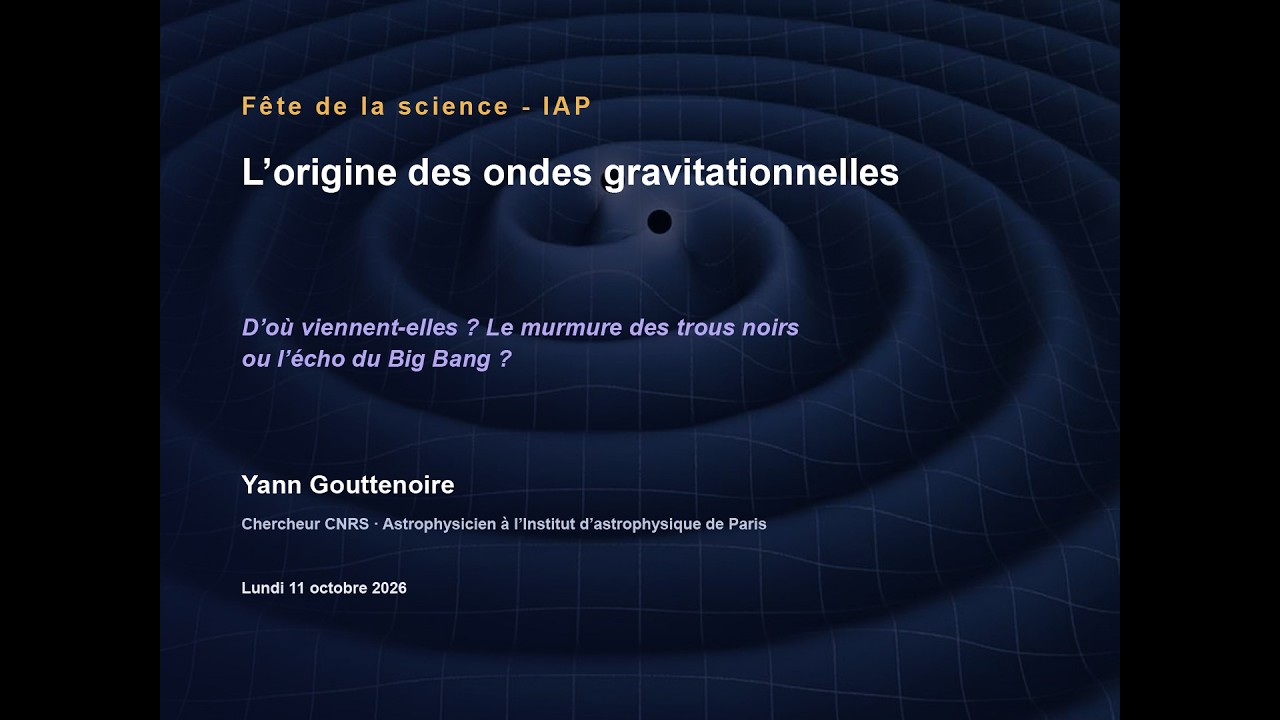
L'ORIGINE DES ONDES GRAVITATIONNELLES : LE MURMURE DES TROUS NOIRS OU L'ÉCHO DU BIG BANG ?
THE ORIGIN OF GRAVITATIONAL WAVES: THE WHISPER OF BLACK HOLES OR THE ECHO OF THE BIG BANG?
Keywords
Summary
183 words
Critical Evaluation
Value of the Information & Strength of the Argument
The lecture delivers substantial educational value by demystifying key concepts of general relativity and gravitational wave astronomy. The argumentation is coherent and well-structured, building from fundamental principles (equivalence principle) to cutting-edge research. The use of thought experiments (e.g., rocket accelerating at 9.8 m/s²) effectively conveys the equivalence principle. The explanation of Mercury’s orbit precession using a paper model is particularly elegant. The case for the 2023 pulsar timing background is presented with clear logical flow, presenting the two main candidate origins and the observational evidence for each. The speaker avoids oversimplification, acknowledging uncertainties (e.g., the nature of dark matter/energy) while keeping the core physics accurate. The scientific reasoning is rigorous, and the speaker consistently distinguishes between confirmed facts and open questions.
Scientific Rigor, Source Quality, Title Accuracy
The speaker is a CNRS researcher active in the field, which lends authority. The content is consistent with established scientific knowledge, and the presentation style is meticulous. Sources are primarily implicit (mentioning LIGO, pulsar timing arrays, Planck satellite), but no explicit references or citations are provided in the talk or description, which limits the verifiability of some figures. The abstractions (e.g., 95% dark sector) are accurate. The title precisely matches the content, focusing on the central question of the origin of the gravitational wave background, and the lecture effectively addresses it. The talk is a popularized synthesis, not an original study, but it is grounded in current literature. No commercial or promotional content appears.
250 words
Title / Content Match
Le titre correspond parfaitement au contenu : il annonce la question de l'origine du fond gravitationnel (trous noirs ou Big Bang) et la conférence traite exactement de ce sujet avec les deux hypothèses.
Quality & Reliability
8/10
Conference by a CNRS researcher in cosmology and particle physics, presenting up-to-date content (including the 2023 pulsar timing discovery) with rigorous scientific explanations and clear pedagogical framing. Minor imprecisions (e.g., 97% vs 95% for dark sector) are noted but do not affect overall reliability.
Key Moments
Markers derived by PSI from the transcript: the creator did not define chapters.
- Introduction and question about apérophobia (fear of infinity), linking to Pascal and cosmology.
- Thought experiment: the accelerating rocket and the equivalence principle as Einstein's happiest idea.
- Explanation of geodesics and Einstein's field equations; demonstration of Mercury's orbital precession using a paper model.
- Expansion of the universe, the Big Bang singularity, and the cosmic microwave background as a probe of the early Universe.
- The composition of the universe (95% dark sector) and the compression of the Earth to illustrate the emptiness of matter and neutron stars.
- Gravitational waves: first detection by LIGO in 2015 from black hole merger, and the 2023 pulsar timing discovery of a nanohertz background.
- Origin hypotheses: supermassive black hole binaries vs. primordial quantum fluctuations from the first second after the Big Bang; future prospects.
- Conclusion and advice on apérophobia; the universe is buzzing, not silent.
Cited Sources
- LIGO Observatory — Mentioned as the detector for the first direct observation of gravitational waves in 2015.
- Planck Satellite — Mentioned as the source of the cosmic microwave background map.
- Pulsar Timing Array (IPTA, NANOGrav) — Referenced as the technique used to detect the nanohertz gravitational wave background in 2023.
Concurring Sources
- Abbott et al. (2016) Observation of Gravitational Waves from a Binary Black Hole Merger — First LIGO detection, confirming a major prediction of general relativity.
- NANOGrav Collaboration (2023) The NANOGrav 15 yr Data Set: Evidence for a Gravitational-wave Background — Discovering the nanohertz gravitational wave background, central to the conference.
Contribution & Novelties
The conference provides an original pedagogical synthesis of current gravitational wave astronomy, clearly explaining both the theoretical framework (general relativity) and the latest observational discoveries. The speaker’s emphasis on the 2023 pulsar timing background is particularly timely, as it represents a recent breakthrough. The discussion of the two competing origin hypotheses (supermassive black hole binaries vs. primordial gravitational waves) is nuanced and highlights how future ‘multi-messenger’ approaches might resolve the question. The use of analogies and demonstrations makes complex concepts accessible.
Pour aller plus loin :
- Gravitational wave (Wikipedia) — Provides a comprehensive overview of the physics and detection methods.
- Pulsar timing array (Wikipedia) — Explains the technique and its role in detecting nanohertz gravitational waves.
- LIGO (Wikipedia) — Details the observatory and its historic detections.
126 words
Radar Profile
Le profil radar montre une excellente quantité d'informations et une bonne fiabilité globale, avec un niveau technique modéré (vulgarisation). La qualité de l'information est solide, mais l'absence de citations explicites limite la vérification directe.