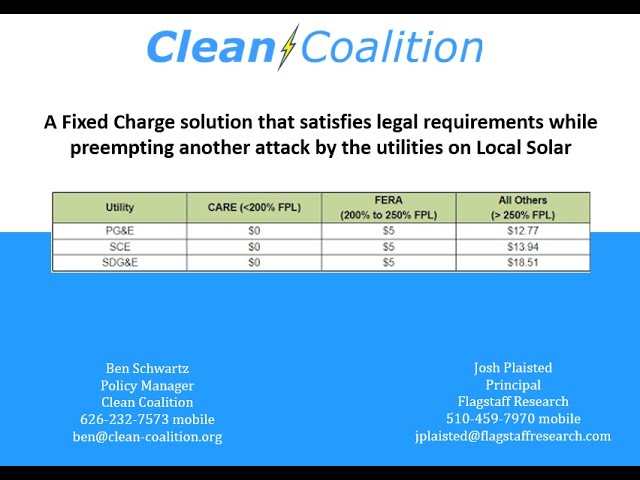
A Fixed Charge solution that satisfies legal requirements while preempting another attack
Keywords
Summary
221 words
Critical Evaluation
Value of the Information & Strength of the Argument
The webinar provides valuable insights into California’s electricity rate design debates, with detailed analysis of the technical and policy aspects of fixed charges. The argumentation is solid, rooted in data from open-source modeling and regulatory documents. The presenters clearly explain the methodology behind the proposed fixed charge and critique alternative proposals, supporting their claims with economic analysis. However, the presentation is inherently partisan, advocating a specific position, which slightly reduces its neutrality.
Scientific Rigor, Source Quality, Title Accuracy
The scientific rigor is moderate: the analysis relies on publicly available data and models, but specific sources are not cited within the video. The description mentions Assembly Bill 205 and CPUC proceedings, but no direct references are provided. The title accurately reflects the content, which is focused on a specific policy proposal. The webinar is informative for viewers interested in California energy policy, but the lack of explicit citations limits its scientific credibility.
160 words
Title / Content Match
The title accurately reflects the content, which focuses on a proposed fixed charge solution that meets legal requirements while countering utility opposition to local solar.
Quality & Reliability
7/10
The webinar presents detailed analysis from experts with backgrounds in energy policy and engineering, uses original modeling and references specific regulatory proceedings. However, no explicit sources are cited, and the content is advocacy-oriented, which limits confidence.
Key Moments
Markers derived by PSI from the transcript: the creator did not define chapters.
- Introduction to the Clean Coalition and the webinar's purpose
- Ben Schwartz explains AB 205 and the fixed charge mandate
- Clean Coalition's proposed fixed charge with three income tiers
- Discussion of cost drivers: transmission, wildfire, and legacy generation
- Josh Plaisted presents economic impact analysis of various proposals
- Impact of fixed charges on electrification and energy efficiency
Contribution & Novelties
The webinar offers a novel perspective by presenting a modest fixed charge proposal that aligns with legal requirements while avoiding the pitfalls of high fixed charges. It provides comprehensive economic modeling of customer impacts and emphasizes the importance of addressing underlying cost drivers rather than relying on rate reallocation. The analysis of electrification impacts is particularly valuable, as it highlights how high fixed charges could hinder California’s decarbonization goals.
Pour aller plus loin :
- California Public Utilities Commission — Background on the regulatory body overseeing the fixed charge proceeding.
- Electricity pricing — Overview of rate design concepts, including fixed and volumetric charges.
- Time-of-use pricing — Context for the demand flexibility discussion relevant to the webinar.
115 words
Radar Profile
The radar chart shows a balanced profile with high scores in information quantity and technical level, while reliability is slightly lower due to the advocacy nature. This indicates a well-informed but partisan presentation.