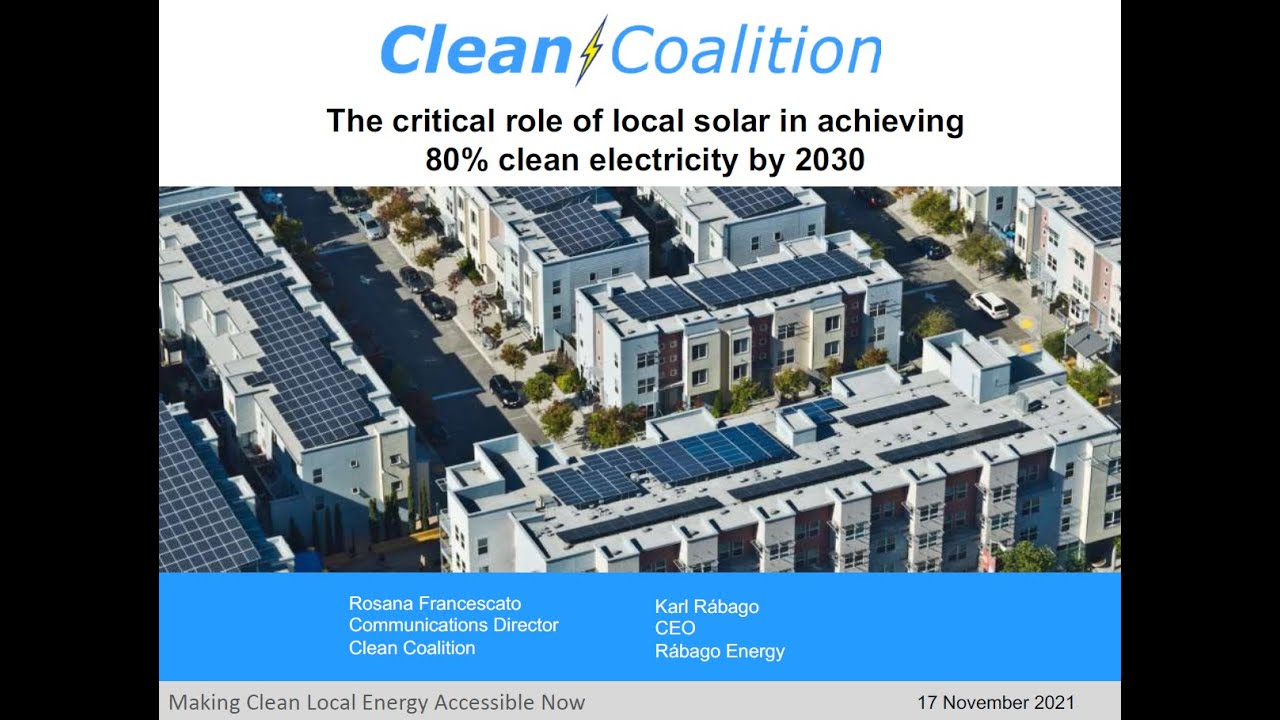
The critical role of local solar in achieving 80% clean electricity by 2030
Keywords
Summary
157 words
Critical Evaluation
Value of the Information & Strength of the Argument
The value of the information lies in its use of a state-of-the-art modeling tool that breaks the traditional barrier between transmission and distribution planning, providing a more holistic view of cost-effective decarbonization. The argument is well-structured: it first critiques the conventional focus on utility-scale only, then uses the model to demonstrate that including distributed solar and storage yields lower total system costs. The presenter strengthens the case by quantifying savings, capacity additions, and job impacts, and by addressing potential counterarguments. However, the reasoning is built on model assumptions that may not be transparently detailed in the webinar, and the advocacy context could be seen as a bias. Nonetheless, the argumentation is logically coherent and supported by comparative scenario analysis.
Scientific Rigor, Source Quality, Title Accuracy
The scientific rigor appears high: the study employs a widely recognized planning model, uses high-resolution data, and clearly defines the policy goals. The sources are limited to the presenter’s own work and references to previous reports by Vibrant Clean Energy and other organizations like the Department of Energy, though specific citations are not provided in the webinar. The title is a faithful reflection of the content, zeroing in on the role of local solar for the 2030 goal. The webinar does not include a Q&A in the transcript, but the presentation itself is methodical and technical. No audience comments are available for analysis.
237 words
Title / Content Match
The title accurately reflects the content, which focuses on the role of local solar in achieving the 80% clean electricity goal by 2030.
Quality & Reliability
7/10
The webinar presents detailed results from a sophisticated utility planning model (WIS:dom®-P) with clear methodology and explicit assumptions. However, the study is commissioned by an advocacy group (Local Solar for All) and may carry a pro-distributed-energy bias, though the modeling framework and peer-reviewed approach lend credibility.
Key Moments
Markers derived by PSI from the transcript: the creator did not define chapters.
- Introduction by Rosanna Franciscotto, mission of Clean Coalition, and focus on local renewables
- Discussion on transmission costs and the TAC distortion in California, illustrating how local solar is disadvantaged
- Explanation of the WIS:dom-P model and its high-resolution capabilities, breaking the large-scale vs distributed barrier
- Presentation of the study methodology: comparison of scenarios with and without optimized local solar and storage
- Key findings: 100 GW of distributed solar, 137 GW of storage, $100B savings, and 1 million incremental jobs by 2030
- Explanation of how local solar smooths load and reshapes demand, improving efficiency of the entire grid
- Discussion of benefits for low- and moderate-income households and the need for policy reforms like fixing TAC
- Conclusion and call to action for supporting policies that enable local solar deployment
Cited Sources
- Vibrant Clean Energy study for Local Solar for All (80% clean electricity by 2030) — Primary study presented, using the WIS:dom-P model
- Previous Vibrant Clean Energy studies for California and New York — Referenced in the webinar as prior applications of the same modeling tool
- Clean Coalition's analysis on transmission access charges — Mentioned as in-depth analysis causing TAC reform advocacy
Concurring Sources
- DOE Solar Futures Study (2021) — Often cited as supporting the significant role of distributed solar
- SEIA reports on solar cost trends — Mentioned in the webinar as compatible with their findings
Dissenting Sources
- Traditional utility-scale-only planning paradigms — The webinar itself contrasts with conventional thinking that ignores distributed resources; no specific opposing publication is cited, but the argument is against this standard approach.
Contribution & Novelties
The main novelty is the application of a high-resolution, supercomputer-based planning model that simultaneously optimizes both transmission and distribution resources, demonstrating that distributed solar and storage are not just complementary but cost-reducing. This challenges the prevailing assumption that utility-scale only is cheapest. The webinar provides quantified evidence (savings, capacity, jobs) and highlights policy blockers like TAC distortions.
Pour aller plus loin :
- Distributed generation — Explanation of DERs and their benefits.
- Community solar — A key component of local solar.
- Energy storage — Essential for integrating renewables and smoothing load.
- Vibrant Clean Energy — Company that developed the WIS:dom model (URL known from context).
104 words
Radar Profile
The radar profile shows high scores for information quantity and quality, with somewhat lower technical depth and reliability due to the advocacy context and limited transparency in some assumptions. This suggests a well-informed, data-rich presentation that still needs careful scrutiny for potential bias.