Oleksii Kachaiev: Learning Ergodic Dynamical Systems from a Finite Trajectory
Keywords
Summary
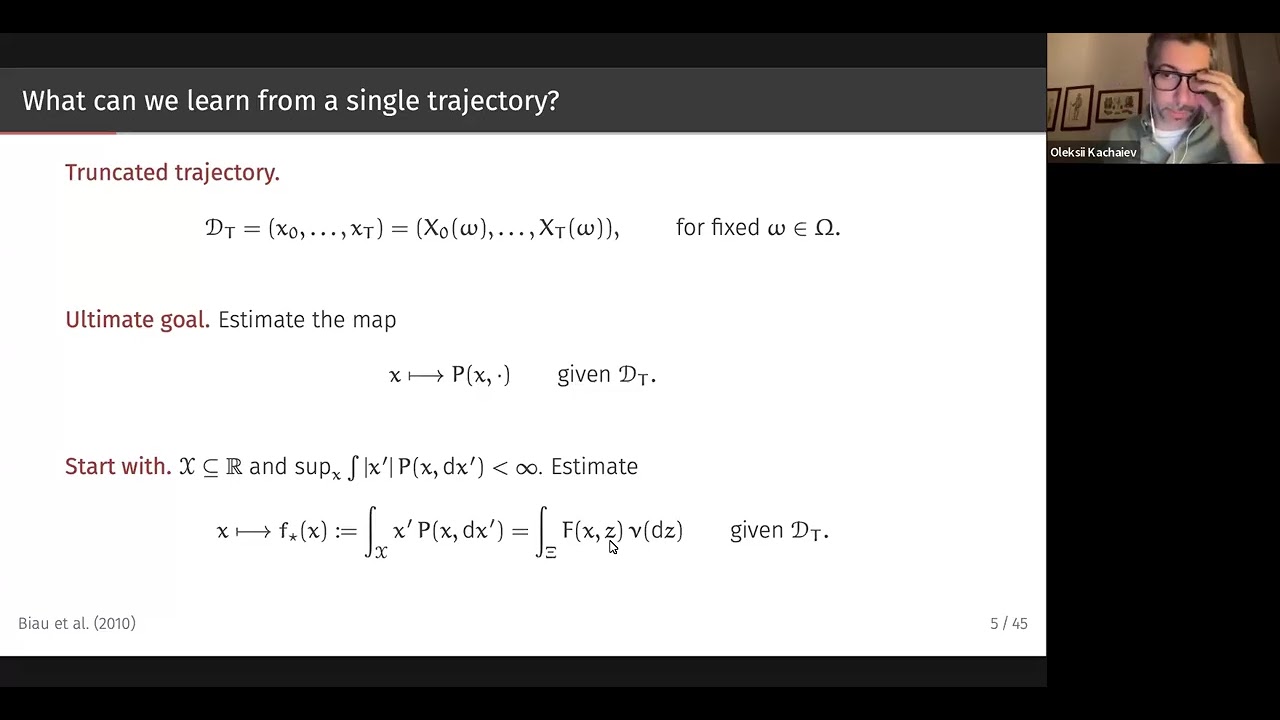
The talk addresses the problem of learning the dynamics of an ergodic stochastic dynamical system from one single finite trajectory. The systems considered are discrete-time, time-homogeneous Markov processes generated by iterated random functions with i.i.d. noise, equivalently described by a Markov kernel and its associated operators acting on functions and on measures. The starting task is the estimation of the optimal one-step prediction function by regularised nonlinear least squares in a Hilbert space of features, with performance measured under the invariant measure of the process.
The central technical difficulty is that consecutive transition pairs are neither independent nor identically distributed: their law depends on time and neighbouring pairs share a random variable. Rather than importing mixing coefficients, the author imposes a quantitative ergodicity condition directly on the kernel — geometric convergence of the k-step transition law towards an invariant measure, measured with an integral probability metric — and works with arbitrary initialisation rather than assuming stationarity.
The framework is instantiated first under uniform ergodicity in total variation, which guarantees ergodic averages from any starting point and introduces the relaxation time as a constant in the error bounds. Two worked examples are given: a nonlinear autoregression with a bounded smooth drift and Gaussian noise, handled through a Doeblin minorisation argument, and the i.i.d. case, which appears as a degenerate kernel that forgets its position in one step.
The resulting high-probability excess-risk bound has the classical bias-plus-variance structure, recovers the usual nonparametric rate in the number of observations, and adds a deterministic correction term proportional to the relaxation time that vanishes asymptotically but can dominate at moderate sample sizes for slowly mixing chains. Strong consistency follows under a suitable joint scaling of sample size and regularisation. The talk sketches the extension to vector-valued states via Bochner integrals, to higher-order and finite-state systems, and to the learning of Koopman operators, and closes on the proof strategy, including a new Hilbert-space-valued concentration inequality for bounded additive functionals of uniformly geometrically ergodic Markov chains built on a Poisson equation decomposition.
335 words
Critical Evaluation
Value of the Information & Strength of the Argument
The informational value lies in the precise reformulation of a classical machine learning problem once the i.i.d. assumption is dropped by construction rather than by approximation. Instead of treating the trajectory as a noisy sample and correcting with mixing coefficients, the author makes the geometry of the process itself the object of the assumption: geometric convergence of the transition kernel to an invariant measure, measured by an integral probability metric, and a risk functional defined with respect to that invariant measure. This choice is justified argumentatively, not rhetorically: the author explains why the population risk is taken under the invariant measure (it is the natural generalisation of the i.i.d. case, and the empirical occupation measure converges to it by Birkhoff’s theorem), why mixing is avoided (the guarantees should be expressed in terms of the kernel and the noise, not through a statistical proxy, and stationarity should not be assumed), and what price is paid for the Markov structure (a deterministic correction term governed by the relaxation time).
The argumentative chain is explicit and well ordered: class of systems, kernel and operator notation, construction of transition pairs, statement of the dependence obstruction, choice of an assumption replacing mixing, statistical learning setup, instantiation under a concrete metric, examples showing the assumption is non-vacuous, then the bound and its reading term by term. Each step is motivated by the previous one, and the two examples serve an argumentative rather than decorative purpose — the i.i.d. case is presented as the degenerate kernel the general results must contain, which functions as a consistency check on the framework. The proof sketch is honest about what is standard (bias decomposition, normal equations) and what is genuinely new (the Hilbert-valued concentration inequality for additive functionals), which helps the listener locate the actual contribution.
The limits are those of a seminar exposition rather than of the reasoning: hypotheses are stated but their necessity is not probed, the well-specified regime is admitted as a simplifying technical condition, min-max optimality is explicitly not claimed, and the practical behaviour of the relaxation-time constant is discussed qualitatively without numerical illustration. The distinction between asymptotic negligibility and finite-sample penalty is nevertheless stated clearly, which is precisely the point a practitioner needs.
Scientific Rigor, Source Quality, Title Accuracy
The talk is built on two publications co-authored with Silvia Villa, Lorenzo Rosasco and a fourth collaborator, and the speaker attributes results to them consistently. Technical apparatus is credited to identifiable classical results: the Diaconis–Freedman review of iterated random functions for the model class, the Doeblin minorisation condition for the nonlinear autoregression example, the Birkhoff ergodic theorem for the convergence of occupation measures, the Azuma–Hoeffding inequality for the martingale part of the error, the Poisson equation decomposition for the remainder, and Caponnetto–De Vito (2007) for the standard bias-variance decomposition of regularised least squares. The genuinely novel ingredient — a concentration inequality for Hilbert-space-valued additive functionals of uniformly geometrically ergodic chains — is presented as new and located precisely at the point where existing tools fail, which is the correct way to signal a contribution.
The sourcing is verbally rigorous but materially thin: no slides with full bibliographic references are visible in the transcript, and the video description contains no links, so a viewer cannot retrieve the papers from the page itself. Some names are rendered phonetically in the transcript and would need checking against the publications. Theorems are stated with their hypotheses and with the meaning of each constant (relaxation time, confidence level, regularisation rate), and the author repeatedly flags what is assumed versus what is proved, which is the appropriate epistemic posture for a proof-based result.
On title-content adequacy, the announced object is delivered without drift: the single finite trajectory is the running constraint of the entire construction, and the announced extensions to higher-order systems, finite state spaces and Koopman operators are indeed discussed, albeit briefly. No advertising or sponsored segment is present in the material provided.
661 words
Title / Content Match
The content matches the announced title closely: learning guarantees for ergodic stochastic dynamical systems from a single finite trajectory, with extensions to higher-order systems, finite state spaces and Koopman operators.
Quality & Reliability
8/10
Research seminar presenting results from two authored publications, with explicit hypotheses, theorem statements, proof sketches and named technical tools (Doeblin minorisation, Birkhoff ergodic theorem, Azuma–Hoeffding, Poisson equation). Claims are framed as proven guarantees under stated assumptions rather than as empirical performance claims. Reliability is limited only by the fact that the talk stays at the level of theorem statements without full proofs, numerical experiments or comparison with baselines, and by the absence of citation links in the description.
Key Moments
Markers derived by PSI from the transcript: the creator did not define chapters.
- Definition of the model class: iterated random functions with i.i.d. noise, their equivalence with a Markov kernel, and the one-step forgetting property that will be used throughout the proofs.
- Operator notation for the Markov kernel (action on functions and on measures), Chapman–Kolmogorov composition, and the law of the process at time t as a power of the operator.
- Formulation of the learning problem from a single truncated trajectory and definition of the one-step prediction function as the target of estimation.
- Construction of transition pairs from the trajectory and statement of the core obstruction: time-dependent marginals and shared random variables destroy independence and identical distribution.
- Why mixing coefficients are deliberately avoided: the guarantees should depend on the kernel and noise, and non-stationary initialisations should be allowed.
- Definition of invariant measure through preservation by the kernel, and of the geometric-ergodicity assumption quantified by an integral probability metric.
- Population risk defined with respect to the invariant measure, excess risk as an L2(pi) distance, and the occupation measure argument via Birkhoff's theorem as the generalisation of the i.i.d. case.
- Regularised least squares in a Hilbert space of features, statement of the statistical assumptions (bounded features, bounded second moment, tail condition, well-specified regime).
- Uniform ergodicity in total variation, the relaxation time as the constant entering the bounds, and the two examples: bounded nonlinear autoregression via Doeblin minorisation, and the i.i.d. degenerate kernel.
- Statement of the high-probability excess-risk bound, reading of the bias, stochastic and relaxation-time terms, sample rates and strong consistency, followed by the proof sketch centred on the new Hilbert-valued concentration inequality.
Cited Sources
- Diaconis & Freedman — review work on iterated random functions — Cited at the beginning as the reference survey for the class of systems generated by iterated random maps with i.i.d. noise.
- Doeblin minorisation condition — Invoked to prove that the bounded nonlinear autoregression with Gaussian noise satisfies uniform geometric ergodicity in total variation.
- Birkhoff ergodic theorem — Used to justify convergence of the empirical occupation measure to the invariant measure for stationary ergodic processes, as the analogue of the Kolmogorov law of large numbers in the i.i.d. case.
- Caponnetto & De Vito (2007), optimal rates for regularised least squares — Cited as the classical reference for the bias-variance decomposition of the regularised least squares error, reused unchanged in the Markov setting.
- Azuma–Hoeffding inequality — Applied to the martingale-difference component of the error to obtain a high-probability bound.
- Poisson equation for Markov chains — Central to the proof of the new concentration inequality: the existence of a bounded solution is used to rewrite the additive functional as a martingale plus a remainder.
- Koopman operator learning — Mentioned as the final extension, where the same least squares and concentration arguments are said to carry over.
- Two joint publications with Silvia Villa, Lorenzo Rosasco and a co-author — The talk is explicitly based on two papers, one on learning dynamical systems and one on Markov convergence properties in different geometries.
Concurring Sources
- Markov chain — transition kernels, invariant measure and ergodicity — Standard reference consistent with the definitions of kernel, invariant measure and geometric convergence used in the talk.
- Ergodic theory — Birkhoff pointwise ergodic theorem — Supports the claim that empirical occupation measures converge to the invariant measure for stationary ergodic processes.
- Reproducing kernel Hilbert space — Standard framework matching the feature-map function class and the closed-form regularised least squares estimator presented.
- Azuma's inequality — Classical concentration result explicitly invoked for the bounded martingale-difference component of the error.
Contribution & Novelties
The originality lies less in the learning algorithm than in the transfer of the statistical learning analysis to a setting where the sampling unit is the trajectory itself. The author replaces the usual mixing-coefficient machinery with an assumption stated on the transition kernel, works with non-stationary initialisations, and defines the risk under the invariant measure so that the i.i.d. case becomes a special, degenerate kernel. This yields an excess-risk bound with the expected bias-variance structure plus an explicit, deterministic penalty governed by the relaxation time, which makes visible a cost that i.i.d. analyses simply do not contain. The technical core is a new concentration inequality for Hilbert-space-valued additive functionals of uniformly geometrically ergodic Markov chains, which is what allows the empirical occupation measure to be controlled uniformly over the function class. The talk also sketches how the same arguments extend to vector-valued states, higher-order and finite-state systems and to Koopman operator estimation, which suggests the framework is meant as a template rather than a single theorem.
Further reading:
- Markov chain — Background on transition kernels, invariant measures and ergodicity used throughout the talk.
- Ergodic theory — Context for the Birkhoff ergodic theorem and the occupation-measure argument that replaces the i.i.d. law of large numbers.
- Reproducing kernel Hilbert space — The canonical example of the feature-map function class in which the regularised least squares estimator is defined.
- Azuma’s inequality — Concentration tool applied to the martingale-difference term of the error decomposition.
- Koopman operator — The linear-operator viewpoint on nonlinear dynamics to which the framework is extended at the end of the talk.
- Doeblin minorisation condition, without URL — The classical sufficient condition invoked to verify uniform ergodicity of the nonlinear autoregression example.
- Poisson equation for Markov chains, without URL — The proof device (solving g − Pg = f with bounded g) used to convert the additive functional into a martingale.
310 words
Radar Profile
The profile is sharply skewed towards technical depth and information density, reflecting a proof-oriented research seminar with little time spent on intuition-building or empirical demonstration. Information quality and reliability sit just below the technical level, held back by the absence of retrievable references and of any experimental validation, while the quantity of information is high but bounded by the single-pass exposition of several distinct result blocks.