Zahra Monfared: Dynamical Systems Theory for Deep Learning
Keywords
Summary
182 words
Critical Evaluation
Value of the Information & Strength of the Argument
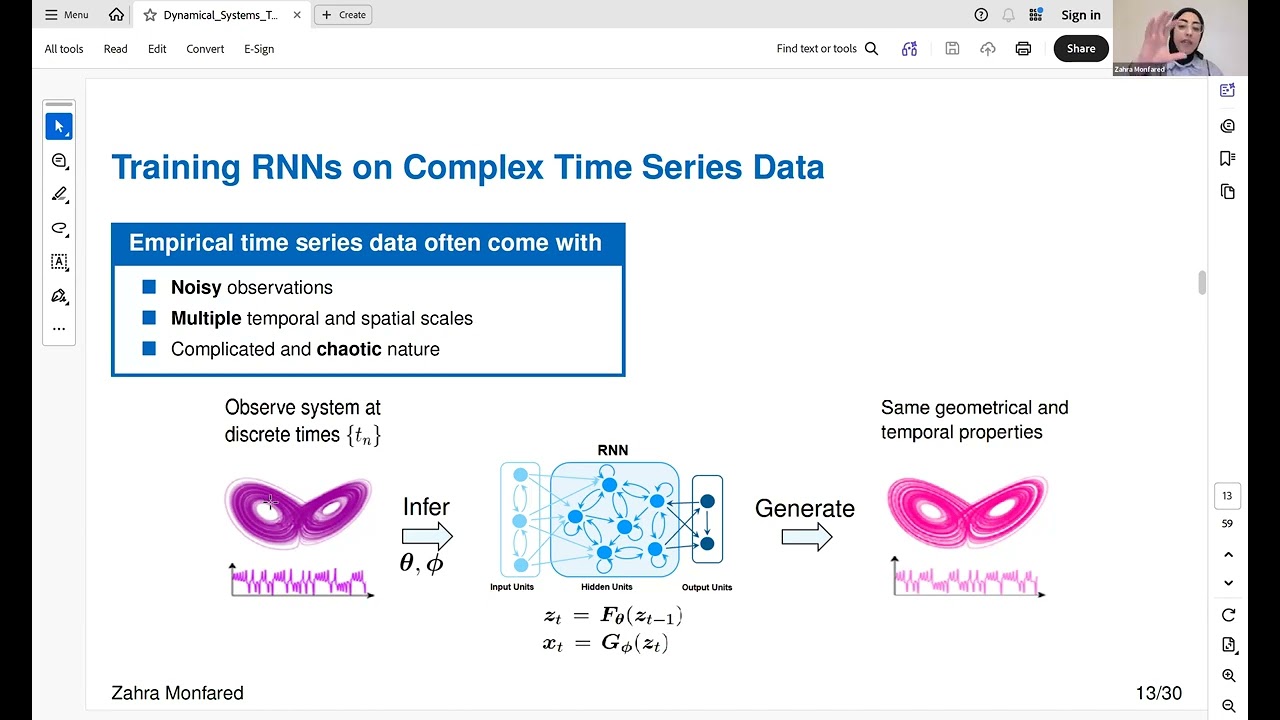
The talk provides a compelling and rigorous argument that dynamical systems theory offers deep insights into deep learning. The value lies in unifying several architectures under a single mathematical framework and linking training challenges to well-known dynamical phenomena (chaos, bifurcations). The argumentation is solid: the speaker presents specific theorems with references, and uses concrete examples (Lorentz system, bifurcation diagrams) to illustrate concepts. The proposed GTF method is backed by mathematical proofs and experimental demonstrations. The speaker also addresses practical concerns, such as gradient clipping, explaining its limitations. Overall, the value is high for researchers in ML theory and dynamical systems, offering a fresh perspective and actionable solutions.
Scientific Rigor, Source Quality, Title Accuracy
The talk is grounded in several peer-reviewed publications: [1] Bolager et al. (TMLR 2026), [2] Eisenmann et al. (NeurIPS 2023), [3] Hess et al. (ICML 2023), [4] Mikhaeil et al. (NeurIPS 2022). These are credible sources in top ML venues. The title accurately describes the content, though it is broad; the substance focuses heavily on RNNs, but the speaker notes that the principles extend to other architectures. No public comments or feedback were provided for analysis.
198 words
Title / Content Match
The title accurately reflects the content: the talk explicitly explains how dynamical systems theory applies to deep learning, using RNNs as a case study.
Quality & Reliability
8/10
The talk is based on published peer-reviewed papers (NeurIPS, ICML, TMLR), with rigorous mathematical formulations and proofs. The speaker is a recognized researcher in the field. The content is highly specialized and technically accurate, though some claims are asserted without full derivation in this presentation format.
Key Moments
Markers derived by PSI from the transcript: the creator did not define chapters.
- Introduction to dynamical systems in deep learning, overview of talk.
- Definition of continuous and discrete-time dynamical systems, examples.
- Showing feedforward, RNN, residual networks, and transformers as discrete-time dynamical systems.
- Training as a dynamical system; question of using dynamical systems theory for deep learning.
- Introduction to bifurcations in smooth and piecewise-smooth systems, border collision bifurcations.
- Definition of PLRNs and their piecewise-smooth nature, analytical tractability.
- Explaining the link between Lyapunov exponents and gradient explosion/vanishing; two theorems.
- Generalized Teacher Forcing (GTF) technique and its mathematical justification.
- Application of GTF to stabilize training on chaotic data, demonstration with Lorentz system.
- Introduction of SHILRN variant and application to EEG signal reconstruction.
- Brief discussion of Koopman operator theory and future directions in interpretable AI.
Cited Sources
- Koopman-informed recurrent neural networks — Referenced as [1] in the description, describing Koopman operator theory applied to RNNs.
- Bifurcations and loss jumps in RNN training — Referenced as [2] in description, NeurIPS 2023 paper by Eisenmann et al.
- Generalized Teacher Forcing for Learning Chaotic Dynamics — Referenced as [3] in description, ICML 2023 paper by Hess et al.
- On the difficulty of learning chaotic dynamics with RNNs — Referenced as [4] in description, NeurIPS 2022 paper by Mikhaeil et al.
Concurring Sources
- On the difficulty of learning chaotic dynamics with RNNs — Provides supporting evidence for the theoretical claims about chaotic dynamics and gradient explosion.
- Generalized Teacher Forcing for Learning Chaotic Dynamics — Directly supports the GTF method presented in the talk.
Contribution & Novelties
The talk presents original contributions from the speaker’s research: formal connections between chaos/bifurcations in RNN dynamics and the exploding/vanishing gradient problem, proven in two theorems. It introduces Generalized Teacher Forcing (GTF) as a novel training stabilization method with provable guarantees. The piecewise-linear RNN (PLRN) family is shown to be analytically tractable, enabling exact bifurcation analysis. The talk also hints at Koopman operator theory for understanding training dynamics. Compared to existing knowledge, this provides a deeper theoretical grounding for why standard techniques like gradient clipping are insufficient, and offers a principled alternative.
Pour aller plus loin :
- Koopman operator theory — Directly related to the talk’s mention of Koopman operator theory for analyzing nonlinear dynamics.
- Teacher forcing — Background on the standard teacher forcing technique, which GTF generalizes.
- Vanishing gradient problem — Core issue addressed in the talk, with broader context in deep learning.
143 words
Radar Profile
The radar profile shows high scores in quality and technical level, with somewhat lower but still strong scores in quantity and reliability. The talk is technically deep, well-supported by peer-reviewed research, but the information volume is moderate due to the seminar format. The reliability is high due to published results, but the lack of full derivations in the talk slightly reduces it.