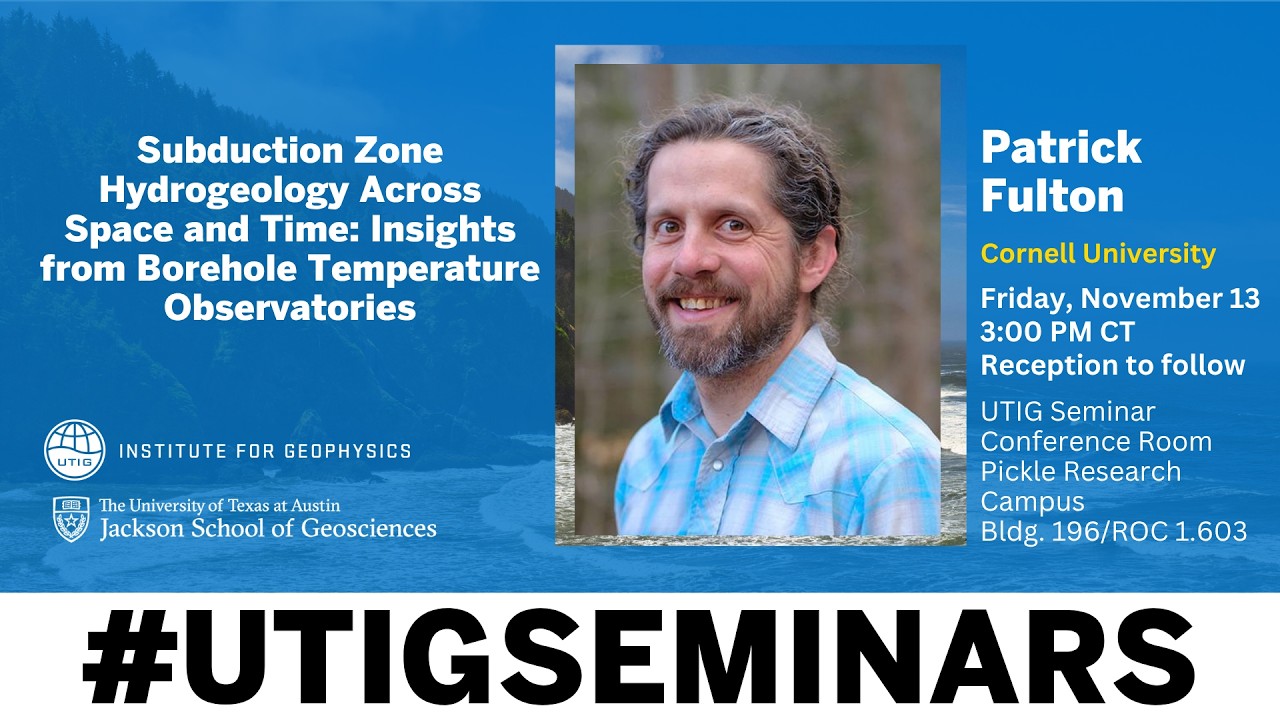
Fall 2026 UTIG Seminar Series: Patrick Fulton
Title history
- Fall 2026 UTIG Seminar Series: Patrick Fulton — observed on 20261117-0331 UTC (YouTube)
Keywords
Summary
232 words
Critical Evaluation
Value of the Information & Strength of the Argument
The talk provides valuable, original insights into the hydrogeologic structure of subduction zone faults. The key novelty is the use of high-resolution borehole temperature measurements to infer permeability and fluid flow where direct pressure measurements are unavailable. The argumentation is clear and methodical: starting from basic principles (Darcy’s law, effective stress), the speaker builds a physical framework, then applies it to real data. The reasoning is robust: he carefully acknowledges limitations (broken equipment, incomplete pressure data) and explains how temperature anomalies are used as a proxy. The surprising result—that the permeable fault zone has limited extent—is well supported by comparisons to analytical models and is consistent with independent geochemical observations. The talk makes a strong case for the creative use of temperature as a tracer of fluid flow and for the importance of characterizing hydraulic connectivity (or its absence) in fault zones.
Scientific Rigor, Source Quality, Title Accuracy
The scientific rigor is high. The speaker references collaborative work with well-known researchers (Damian Saffer, Laura Wallace, Evan Solomon, et al.) and builds on prior methods by Kier Becker, Andy Fisher, and others. He clearly distinguishes between observations and interpretations, and uses data from international ocean drilling expeditions. The methods are described in enough detail to be evaluated, and the limitations are transparently discussed. The title of the video, ‘Fall 2026 UTIG Seminar Series: Patrick Fulton’, accurately reflects that this is a seminar presentation; the content is indeed a research talk. The abstract in the description correctly outlines the talk’s scope, though the YouTube title itself does not indicate the topic. No external URLs are provided in the description, but the talk is consistent with published literature in the field, which lends credibility to the findings.
293 words
Title / Content Match
The video title is generic (seminar series) but accurately reflects that it is a seminar by Dr. Fulton. The actual content—subduction zone hydrogeology—is more specific than the title suggests, yet the title does not mislead.
Quality & Reliability
9/10
Presentation by a recognized expert (Patrick Fulton, Associate Professor at Cornell) based on primary research from scientific ocean drilling (IODP Expeditions 372 and 375). The talk integrates in-situ borehole temperature measurements, pressure data, and modeling, with a clear description of methods and limitations. The scientific content is rigorous and well-supported by evidence, though no external references were explicitly shown.
Key Moments
Markers derived by PSI from the transcript: the creator did not define chapters.
- Introduction by seminar host and speaker biography
- Primer on hydrogeology: effective stress, Darcy's law, excess pressure
- Illustration of how permeable pathways redistribute fluid pressure, including non-intuitive example of bounded permeable zone
- Overview of Hikurangi subduction zone and borehole observatory design
- Explanation of temperature-based flow characterization and results from the Papu fault: permeability of ~1.9e-14 m²
- Analysis of flow rate decay and interpretation of a bounded permeable zone (10-50 m radius)
- Discussion of implications for slow slip and connections to Japan Trench studies
Contribution & Novelties
The talk offers an original contribution by demonstrating that a borehole-observatory approach using high-resolution temperature measurements can effectively characterize fault zone permeability and hydraulic connectivity even when direct pressure measurements fail. The finding that the Papu fault is permeable but of limited lateral extent challenges assumptions of extensive fluid drainage along shallow splay faults. This has implications for understanding overpressure distribution and slow slip dynamics. The methodology is adaptable to fractured rock and subsurface reservoirs.
Pour aller plus loin :
- Slow earthquakes on Wikipedia — Slow slip events are key to the hydrogeology-fault interaction discussed in the talk.
- IODP (International Ocean Discovery Program) — The expeditions (372 and 375) that provided the borehole data.
- Darcy’s law — Fundamental flow equation frequently referenced in the presentation.
- Borehole temperature logging — The temperature sensors used are thermistors; the method illustrates thermal geophysics applications.
141 words
Radar Profile
The radar profile shows high scores in information quantity, quality, and reliability, with a slightly lower technical level indicating the talk is dense but still accessible to a broad scientific audience. The high format quality and explicit methodology outweigh the moderate novelty relative to existing literature, yielding an overall excellent rating.