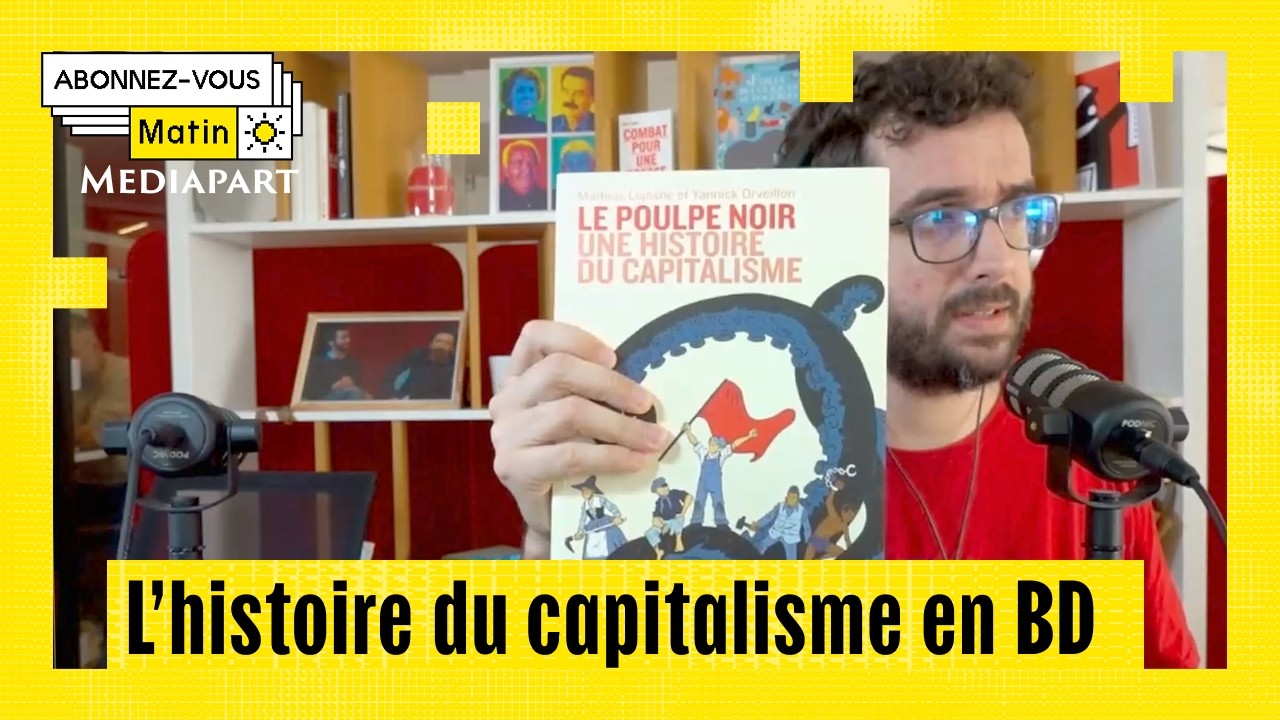
Peut-on raconter l'histoire du capitalisme en BD ?
Can we tell the history of capitalism in comics?
Keywords
Summary
133 words
Critical Evaluation
Value of the Information & Strength of the Argument
The value of the information lies in the authors’ candid account of how they created a comic book to explain capitalism’s history, including the challenges of vulgarization without oversimplification. Their argumentation is coherent: they emphasize moving away from a top-down authority figure, using a friendly octopus to guide the readers, and deliberately blending various sources to create a dynamic narrative. The discussion underscores the importance of visual storytelling in making complex ideas accessible, while also acknowledging the limits of their own expertise. The authors articulate a clear pedagogical intent and show awareness of potential pitfalls in simplifying economic history.
Scientific Rigor, Source Quality, Title Accuracy
The scientific rigor is moderate: the authors openly state they are not specialists and relied on self-education, citing works like Karl Polanyi’s ‘The Great Transformation’ and mentioning YouTube vulgarization channels. They do not provide detailed citations in the video, but the comic book itself likely includes a bibliography. The title effectively matches the content, as the entire conversation revolves around the feasibility and method of presenting capitalist history in a comic format. The discussion is honest about the project’s limitations, which enhances its credibility.
198 words
Title / Content Match
The title directly asks whether it is possible to narrate capitalist history in comic book form, and the video answers by discussing the authors' approach to doing so.
Quality & Reliability
6/10
The discussion is transparent about its non-academic approach, citing various books and videos, but the content is self-promotional and not peer-reviewed.
Key Moments
Markers derived by PSI from the transcript: the creator did not define chapters.
- Introduction of the comic book and its scope.
- Discussion on the choice of the octopus narrator and avoiding authority figures.
- Explanation of the research process and sources, including books and YouTube channels.
- Yannick talks about the illustration challenges and visual storytelling techniques.
- Discussion of the final chapter linking capitalism to ecology, colonialism, and patriarchy.
Cited Sources
- Mediapart subscription offer — Link to subscribe to Mediapart, mentioned during the video.
- Mediapart donation page — Link to support Mediapart by donation, mentioned in the description.
- Mediapart newsletters — Link to sign up for newsletters, mentioned in the description.
Contribution & Novelties
The original contribution of this video is the perspective on creating a comic book that attempts to synthesize the history of capitalism in accessible form, emphasizing the role of non-human narration and visual metaphors. The authors discuss integrating contemporary issues like ecology and colonialism into the narrative, which adds a fresh angle to economic history education.
Pour aller plus loin :
- The Great Transformation (book) — This book by Karl Polanyi is referenced in the video as a key source for understanding economic history.
- Tendency of the rate of profit to fall — A Marxist concept mentioned in the context of explaining complex theories.
- Karl Marx — Background on the theorist whose ideas are discussed in the comic.
118 words
Radar Profile
The radar profile shows moderate scores across all dimensions, with qualitative information slightly higher than technical level, indicating an accessible yet informative discussion without deep scientific rigor.