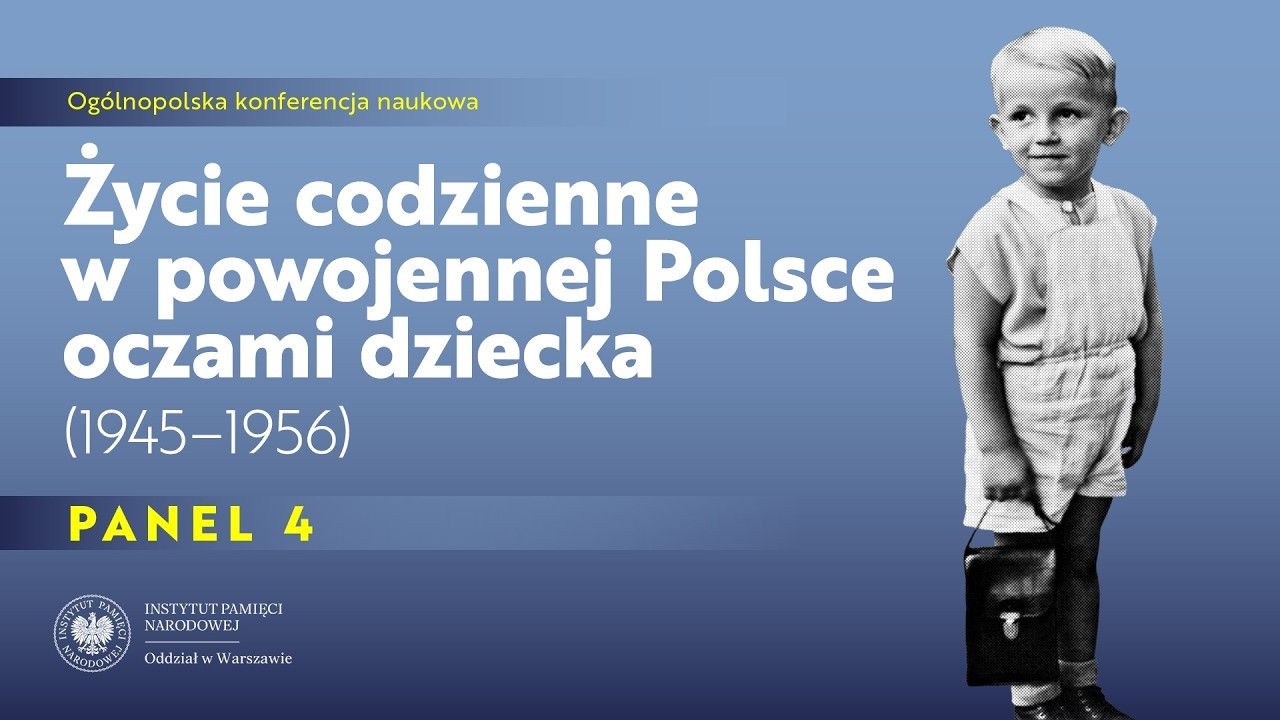
Życie codzienne w powojennej Polsce oczami dziecka (1945-1956) – PANEL IV
Daily Life in Post-War Poland Through the Eyes of a Child (1945–1956) – PANEL IV
Keywords
Summary
208 words
Critical Evaluation
Value of the Information & Strength of the Argument
The presentations offer substantial value through their use of previously unpublished primary sources, particularly the personal diary that sheds light on subjective experiences often absent from official histories. The arguments are well-supported by detailed evidence, including specific dates, names, and contexts. The first presentation methodically analyzes the diary’s content, situating it within the broader historical framework of wartime and post-war Poland, while the second synthesizes institutional records and personal accounts to explain the cadets’ formation and dissolution. Both speakers demonstrate analytical rigor, though the first leans more on a single source, and the second relies heavily on insider-produced accounts, which may carry a degree of bias that is only partially acknowledged.
Scientific Rigor, Source Quality, Title Accuracy
The scientific rigor is high for a conference format: both researchers are affiliated with reputable academic institutions and show careful attention to archival detail. The quality of sources is mixed; the diary is an authentic, non-public document with rich narrative depth, while the cadet history relies on commemorative publications from former members, which could idealize the past. The title precisely matches the content, framing the panel as an exploration of children’s perspectives. However, no external sources or citations are provided in the video description, limiting immediate verification. Adequation between title and content is excellent, as both presentations directly address the theme without deviation.
229 words
Title / Content Match
The title accurately reflects the conference panel's focus on children's daily life in post-war Poland, with the two presentations directly addressing this theme through personal and institutional perspectives.
Quality & Reliability
9/10
Two detailed academic presentations based on archival sources and unpublished diaries, with strong methodological grounding and factual precision. The content is well-structured and historically reliable, though the lack of external references in the description limits immediate verification.
Key Moments
Markers derived by PSI from the transcript: the creator did not define chapters.
Cited Sources
- Pamiętniki Niny (Janiny) Jesionowskiej — Unpublished diary kept from 1942 to 1949, cited extensively by Prof. Płaszczewska as the primary source for her analysis.
- Środowisko byłych żołnierzy kompanii małoletnich i wychowanków korpusu kadetów imienia generała broni Karola Świerczewskiego — Memoir collection edited by Kazimierz Czuba, based on a 1979 reunion, used as a source by Dr. Studniarek.
Contribution & Novelties
The panel contributes original insights into post-war Polish childhood by foregrounding a rare adolescent diary and institutional histories of a unique military school. The diary offers a microhistory of emotional and intellectual life under communism, while the cadet corps analysis illuminates state attempts to shape children ideologically. Pour aller plus loin :
- History of Poland (1945–1989) — Provides essential background on the political context of post-war Poland.
- Karol Świerczewski — Details the life of the general after whom the cadet corps was named.
- Institute of National Remembrance — Official IPN site with archival resources and educational materials relevant to the sources used.
102 words
Radar Profile
The profile shows high scores across quantity, quality, and reliability, with a slightly lower technical level reflecting the conference's accessible yet academic tone. The strengths lie in the depth of archival research and expert delivery, while the moderate technical level ensures broad audience engagement.