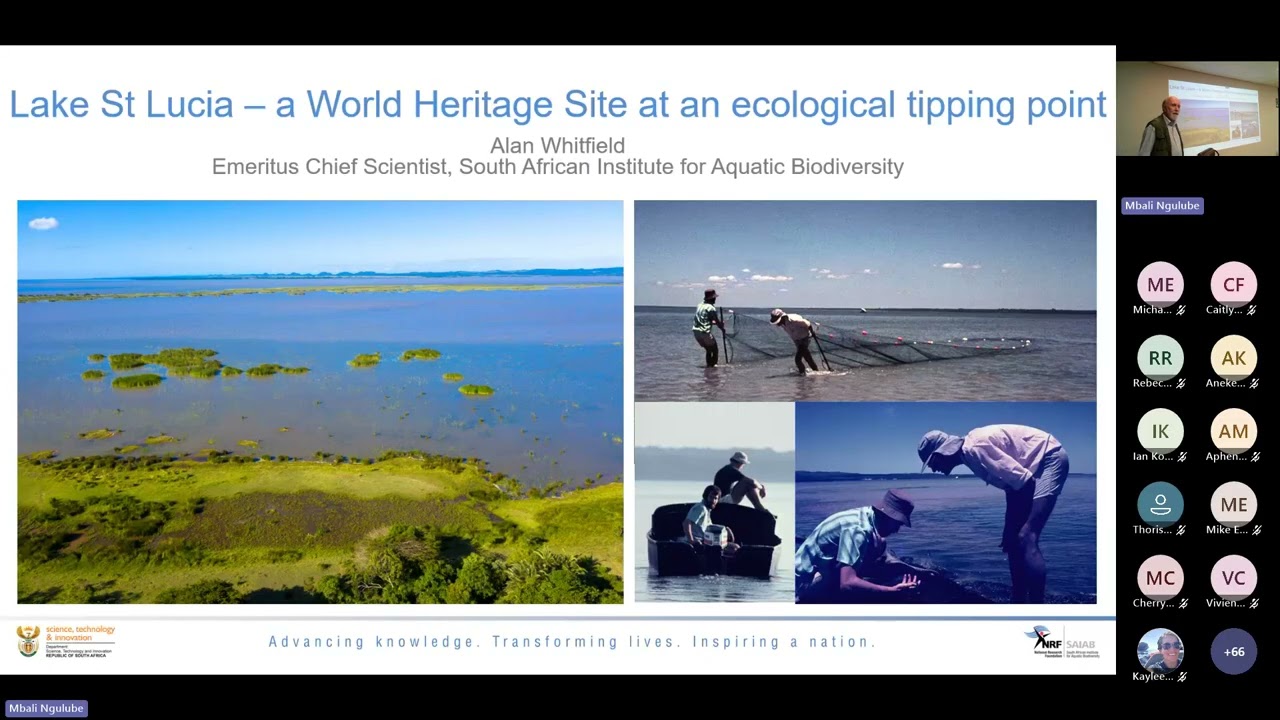
SAIAB Seminar Series 2026: Prof Alan Whitfield
Keywords
Summary
230 words
Critical Evaluation
Value of the Information & Strength of the Argument
The informational value of this talk is high because it condenses five decades of personal field observation, a peer-reviewed analysis and a long historical record into a single coherent narrative. The argument is built as a causal chain rather than a list of symptoms: each human intervention is linked to a measurable physical consequence, and each physical consequence to a biological outcome. The 1936 Warner’s drain is tied to sediment deposition in the estuary; the relocation of the Umfolozi mouth is tied to the loss of the largest freshwater supply; the link canal breach is tied to the rapid sedimentation of Honeymoon Bend and the Narrows; the reduced tidal prism is tied to the failure of saline penetration; and the resulting freshening is tied to the collapse of marine fish life cycles and the loss of the swimming prawn nursery. The salinity graph from Caroline Fox’s data is used as the central empirical anchor, and the speaker is careful to distinguish between the natural trajectory of the system, which he accepts as inevitable over thousands of years, and the human-accelerated trajectory, which he presents as the actual problem. The argument is also honest about uncertainty: the fish-kill projection and the one-decade loss of piscivorous species are framed as expectations rather than observed facts. The main weakness is that the talk is a single-expert synthesis, so alternative explanations for the freshening, such as regional rainfall cycles or changes in catchment hydrology, are not systematically weighed against the sedimentation hypothesis. The recommendation to block the link canal is presented as a priority but is not accompanied by a cost-benefit analysis or by a discussion of the ecological risks of such an intervention.
Scientific Rigor, Source Quality, Title Accuracy
The scientific rigor is solid for a seminar format. The central claims are supported by a peer-reviewed open-access paper in the African Journal of Aquatic Science (March issue), co-authored with Ricky Taylor, Caroline Fox and Janine Adams, and by a popular article in the Water Wheel, the publication of the Water Research Commission. The salinity dataset spans April 2019 to May 2024 and is complemented by a historical record from 1958 to 2000, which gives the argument both a recent and a long-term baseline. The speaker explicitly attributes the data to Caroline Fox and the mangrove expertise to Janine Adams, which makes the division of labor and the provenance of the evidence clear. The historical claims about the 1895 game reserve, the 1833 hunting ship and the 1936 Warner’s drain are presented as documented history rather than as speculation. The title is purely descriptive and does not overpromise; it simply identifies the seminar series and the speaker, and the content delivers exactly what the abstract announces. No comments were provided for analysis, so no audience-trend assessment is offered.
473 words
Title / Content Match
The title simply names the seminar series and the speaker, so it is accurate but uninformative; the content matches the announced topic on the St. Lucia ecosystem flip.
Quality & Reliability
8/10
The presentation is delivered by an emeritus chief scientist with over 50 years of direct field experience at Lake St. Lucia, and it is based on a peer-reviewed open-access paper in the African Journal of Aquatic Science, co-authored with a long-serving reserve ecologist and a botanist. The core claims rest on a continuous monitoring dataset (April 2019–May 2024) and on a long historical salinity record (1958–2000). The reasoning is transparent and the causal chain (sugarcane farming, Warner's drain, mouth relocation, dredging, sedimentation, loss of connectivity, freshening) is laid out step by step. The main limitation is that the talk is a single-expert synthesis rather than a systematic review, and some forward-looking statements (fish kills, one-decade loss of piscivorous species) are projections rather than measured outcomes.
Key Moments
Markers derived by PSI from the transcript: the creator did not define chapters.
- Introduction by the host, who notes that South Africa has only three UNESCO World Heritage Sites and that Lake St. Lucia is one of them.
- Whitfield explains that Lake St. Lucia is the largest estuarine system in Africa, about 35,000 hectares, and the oldest game reserve in Africa, declared in 1895 to protect hippos.
- Historical background on the 1833 hunting ship that killed over a thousand hippos, and the use of hippo teeth for false teeth and elephant tusks for piano keys.
- Explanation of the Umfolozi swamp, Warner's drain completed around 1936, and how sugarcane farming led to sediment being dumped into the St. Lucia estuary.
- The relocation of the Umfolozi mouth, the permanent dredger from the 1950s, and Cyclone Demoina washing the dredger out to sea in 1987.
- The link canal breach and the 2023 flood photograph showing turbid water entering the estuary instead of the beach channel, choking Honeymoon Bend and the Narrows.
- Caroline Fox's salinity data from April 2019 to May 2024, showing the lake freshening to around 2–4 parts per thousand and the risk of massive fish kills.
- Conclusions: the natural transition to a freshwater system should take thousands of years, but human impacts have fast-tracked it into decades, and blocking the link canal breach is presented as a priority.
Cited Sources
- African Journal of Aquatic Science — March issue paper on St. Lucia — Peer-reviewed open-access paper co-authored by Whitfield, Ricky Taylor, Caroline Fox and Janine Adams, providing the core monitoring data and analysis.
- The Water Wheel — St. Lucia at an ecological tipping point — Popular article published by the Water Research Commission, presenting the tipping-point argument to a broader audience.
Concurring Sources
- UNESCO World Heritage Centre — iSimangaliso Wetland Park — Confirms the World Heritage status of the St. Lucia system and its ecological values.
- Ramsar Sites Information Service — St. Lucia System — Confirms the international importance of St. Lucia as a wetland, particularly for birds.
Contribution & Novelties
The talk’s original contribution is the integration of a long historical record with a recent high-frequency salinity dataset to argue that Lake St. Lucia is not merely fluctuating but is undergoing a directional ecosystem flip. It reframes the problem from a salinity crisis to a connectivity crisis: the key variable is not how salty the lake is at any moment, but whether marine water can still reach the lake at all. It also identifies a specific, actionable intervention, the blocking of the link canal breach, and shows with photographic evidence how that breach has redirected turbid floodwater into the estuary. The presentation adds a temporal dimension by contrasting the natural transition timescale of thousands of years with the human-accelerated timescale of decades.
Pour aller plus loin :
- iSimangaliso Wetland Park — UNESCO World Heritage listing for the park that contains Lake St. Lucia.
- Ramsar Convention — International framework under which St. Lucia is recognized as a wetland of international importance.
- Estuary — General reference on estuarine systems, salinity gradients and connectivity.
- Phragmites australis — The common reed whose expansion is a marker of sedimentation and freshening.
- Oreochromis mossambicus — The Mozambique tilapia, one of the few species able to tolerate the extreme salinities recorded at St. Lucia.
207 words
Radar Profile
The profile is strong on information quantity and quality, reflecting a data-rich, historically grounded synthesis, and strong on overall reliability given the peer-reviewed basis and the speaker's direct expertise. The technical level is moderate because the talk is aimed at a general seminar audience rather than at specialists in estuarine hydrodynamics. The main gap is the absence of a systematic comparison with alternative explanations for the freshening trend.