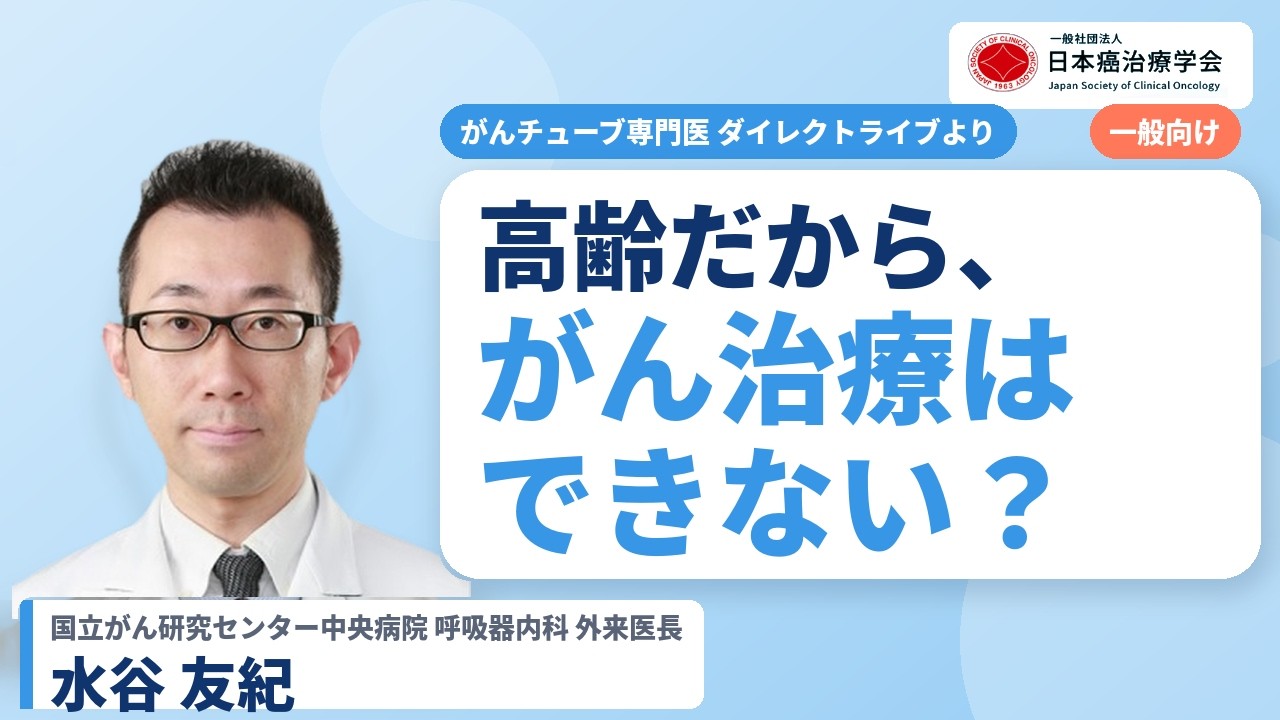
高齢だから、がん治療はできない?
Are You Too Old for Cancer Treatment?
Title history
- 高齢だから、がん治療はできない? — observed on 20261109-0802 UTC (YouTube)
Keywords
Summary
174 words
Critical Evaluation
Value of the Information & Strength of the Argument
The video offers substantial practical value by demystifying cancer care for the elderly. It provides clear, clinically grounded explanations of why age alone should not dictate treatment and presents actionable tools such as the G8 screening and comprehensive geriatric assessment. The case contrasts (90-year-old fit patient vs. 73-year-old frail patient) effectively illustrate the diversity among older adults and the need for individualized evaluation. The argumentation is sound, built on logical progression from biological/physiological/social characteristics to clinical assessment and treatment decisions. The discussion also adds valuable insights on communication, confidentiality, and the role of caregivers, reinforcing a holistic approach. The reasoning is cautious and nuanced, acknowledging uncertainties in evidence and promoting shared decision-making.
Scientific Rigor, Source Quality, Title Accuracy
The scientific rigor is good: the presenter is a senior oncologist from the National Cancer Center, and the content reflects standard professional recommendations (ASCO guidelines, G8 tool). However, the talk is primarily experience-based with few precise literature citations; no specific studies are named despite references to ’evidence’ and ‘guidelines.’ The only explicit source provided is the link to the JSCO certified navigator system in the description, which is a recognized institutional resource. The title/content fit is strong, as the video directly challenges the notion that age precludes cancer treatment and explains an alternative approach. No critical discrepancies are observed.
226 words
Title / Content Match
The title questions whether elderly patients cannot receive cancer treatment, and the video directly addresses this by explaining that chronological age alone is insufficient and by describing comprehensive geriatric assessment and personalized decision-making. The title is well aligned with the content.
Quality & Reliability
8/10
The video is presented by a board-certified oncologist from a national cancer center and is based on clinical experience, established screening tools (G8), and recognized guidelines (ASCO). However, it relies primarily on expert opinion and illustrative cases rather than systematic evidence synthesis, which justifies a high but not perfect reliability score.
Key Moments
Markers derived by PSI from the transcript: the creator did not define chapters.
- Introduction and first clinical case: 90-year-old woman with lung cancer.
- Second case: 73-year-old man with multiple comorbidities illustrating complexity.
- Definition of elderly in different contexts and diversity among older patients.
- Comprehensive geriatric assessment and introduction of G8 screening tool.
- Overview of modern cancer treatments: chemotherapy, targeted therapy, immune checkpoint inhibitors.
- Five suggested questions to ask the doctor about treatment goals and side effects.
- Panel discussion on communication, confidentiality, and caregiver involvement.
Cited Sources
- Certified Cancer Navigator System (JSCO) — Mentioned in the video description as a relevant supportive resource; not explicitly discussed in the lecture.
Contribution & Novelties
The video provides an expert, accessible explanation of how to approach cancer treatment in elderly patients, going beyond the common assumption that age alone determines candidacy. It highlights the use of comprehensive geriatric assessment and the G8 screening tool, and discusses the importance of understanding individual patient values and preferences. It also addresses practical communication issues between patients, families, and caregivers.
Pour aller plus loin :
- Geriatric Assessment - Wikipedia — Provides an overview of the comprehensive geriatric assessment domains described in the video.
- Geriatric Oncology - Wikipedia — Covers the field of oncogeriatrics and its principles.
- G8 screening tool — A validated screening test for frailty in elderly cancer patients, mentioned as a recommended starting point.
- WHO Ageing and Health — International perspective on healthy ageing relevant to the video’s theme.
132 words
Radar Profile
The radar profile shows a well-balanced video with high scores in information quantity and quality, and moderate technical level, indicating that the content is rich and reliable but not overly technical. The global reliability score is high, suggesting the information is trustworthy.