QISCA Joint Seminar 2024 Winter - Entanglement in Linear Optics
Keywords
Summary
244 words
Critical Evaluation
Value of the Information & Strength of the Argument
The informational value of this talk lies in its clear pedagogical progression from general concepts to a specific experimental result. The speaker correctly distinguishes entanglement from quantum discord, explains why full tomography becomes impractical in higher dimensions, and situates the paper within the broader framework of quantum metrology. The argumentation is logically structured: definitions, theoretical bounds, estimator design, experimental implementation, and comparison of results. The speaker is honest about the limits of his own expertise, notably on quantum discord, and refers the audience to the paper for details. However, the argumentation remains largely expository rather than critical: the paper’s assumptions (e.g. the specific form of the input state, the choice of non-optimal estimators) are reported but not challenged. The Q&A reveals that the authors did not justify the particular non-optimal estimators, which is a genuine weakness of the original work that the speaker acknowledges without further analysis. The talk is therefore valuable as a guided reading of a technical paper, but it does not add independent argumentation or evaluate the robustness of the results beyond what the paper claims.
Scientific Rigor, Source Quality, Title Accuracy
The main source is explicitly cited with a DOI (Virzì et al., Sci Rep 9, 3030, 2019), and the speaker also mentions a companion video on the Korea Quantum Clubs channel. The theoretical background is attributed to lecture notes by Professor Yoon-Ho Kim (KAIST), and the optical component explanations refer to Hecht’s ‘Optics’ (5th edition). These are appropriate and verifiable references. The title ‘Entanglement in Linear Optics’ accurately reflects the content, which is a seminar on entanglement estimation in a linear-optics experiment. The talk does not overstate the results: it presents the experimental agreement with the quantum Cramér-Rao bound as reported in the paper. No comments were provided for analysis.
304 words
Title / Content Match
The title 'Entanglement in Linear Optics' matches the content, which is a seminar presentation of a paper on optimal estimation of entanglement and discord in two-qubit states using a linear-optics setup.
Quality & Reliability
7/10
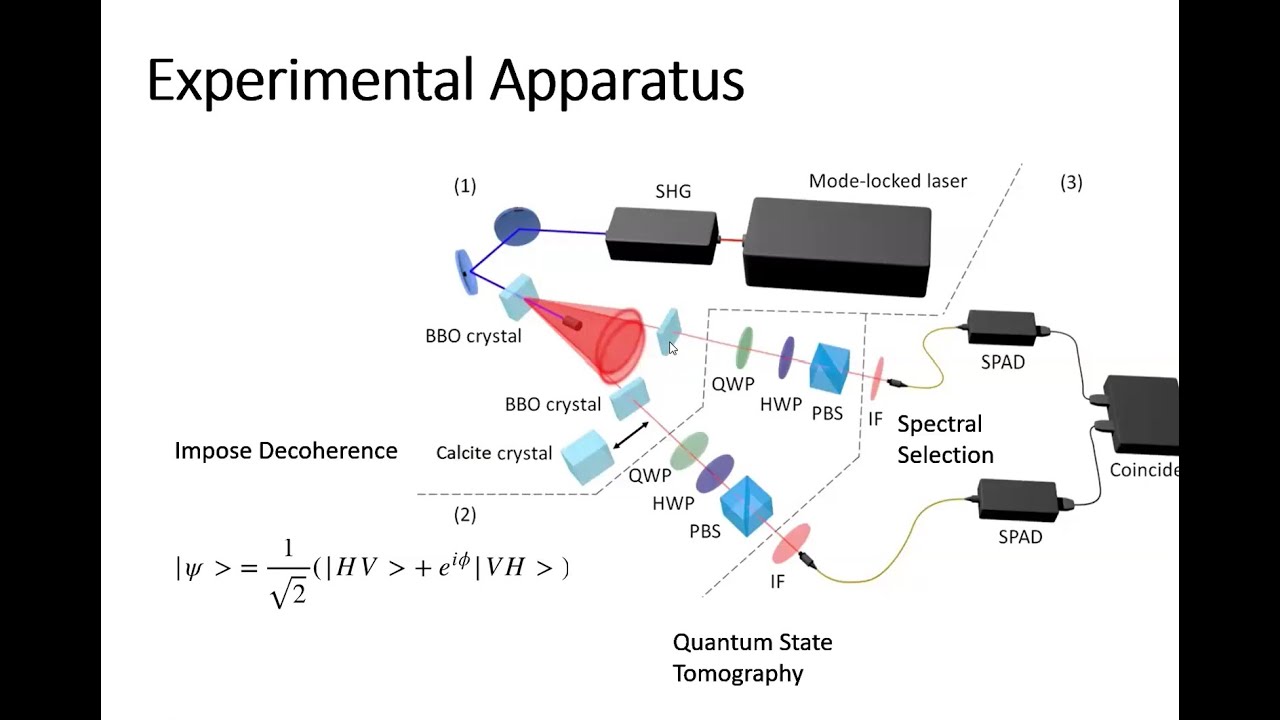
The talk is a faithful, well-structured walkthrough of a peer-reviewed paper (Virzì et al., Sci Rep 9, 3030, 2019) by a junior researcher who explicitly states what he does and does not master (e.g. quantum discord). The main reference is given with a DOI, the experimental scheme (SPDC, BBO, wave plates, PBS, SPAD, quantum tomography) is described accurately, and the theoretical framework (Fisher information, Cramér-Rao bound, quantum Cramér-Rao bound, Heisenberg limit) is presented correctly. Reliability is limited by the fact that the speaker is not the author of the work, some passages are approximate (e.g. the role of the BBO compensation crystal, the exact form of the estimators), and no independent replication or critical discussion of the paper's limitations is offered.
Chapters
Cited Sources
- Optimal estimation of entanglement and discord in two-qubit states — Main reference of the presentation, cited in the description and discussed throughout the talk.
- QISCA Joint Seminar 2024 Winter - Entanglement in Linear Optics (Korea Quantum Clubs) — Alternative video of the same presentation on the Korea Quantum Clubs channel, mentioned in the description.
Concurring Sources
- Optimal estimation of entanglement and discord in two-qubit states — The paper itself, which the talk summarises and whose results it reports.
Contribution & Novelties
The talk does not present original research; it is a seminar-style review of a published paper. Its main contribution is pedagogical: it makes accessible the connection between abstract estimation theory (Fisher information, Cramér-Rao bounds) and a concrete linear-optics experiment, and it illustrates how optimal estimators can saturate the quantum Cramér-Rao bound for entanglement and discord quantifiers. The speaker also provides a concise overview of the experimental toolbox (SPDC, wave plates, PBS, SPAD) that is useful for non-specialists.
Pour aller plus loin :
- Quantum entanglement — General reference on the concept central to the talk.
- Quantum discord — Background on the less familiar quantity discussed in the presentation.
- Cramér–Rao bound — Mathematical foundation of the optimal estimation framework.
- Spontaneous parametric down-conversion — Key nonlinear process used to generate entangled photons.
- Quantum Fisher information — Central quantity for quantum metrology bounds.
139 words
Radar Profile
The profile shows a high technical level and good information quantity, reflecting the specialised nature of the topic and the detailed experimental description. Quality and reliability are solid but not maximal, as the talk is a faithful exposition rather than a critical analysis, and some points are simplified or left to the paper.