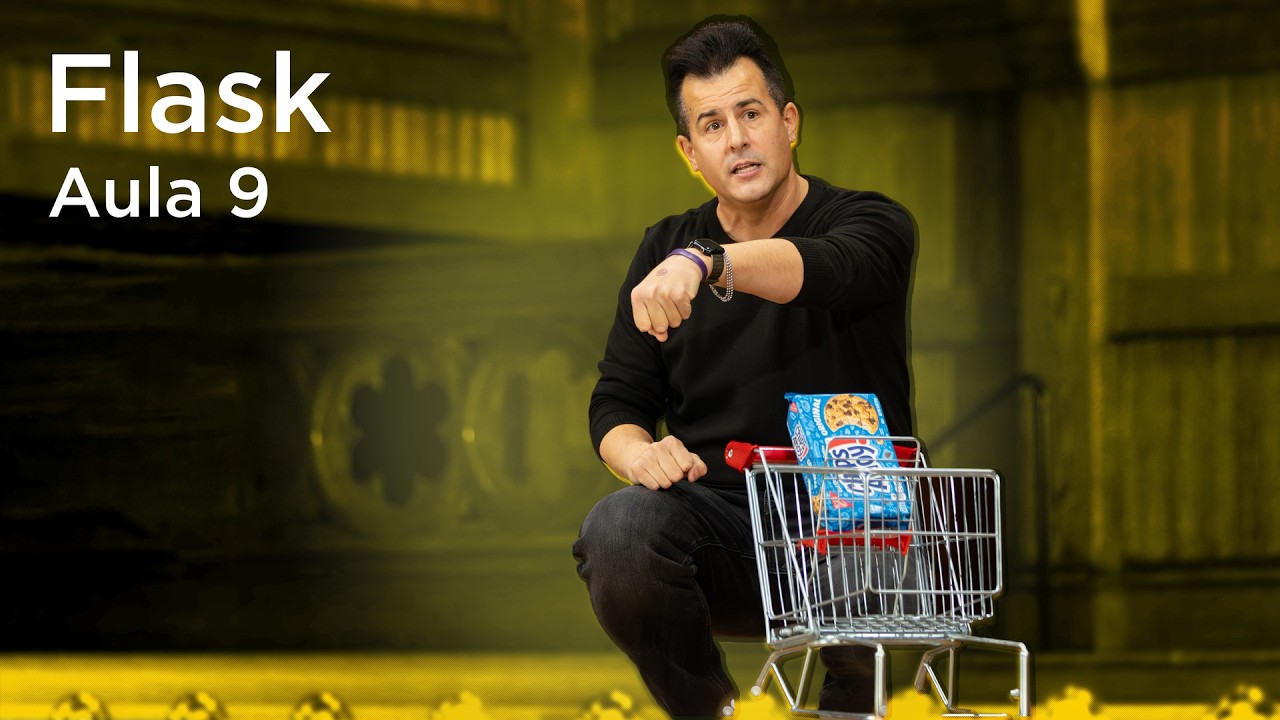
CS50x em Português - Aula 9 - Flask
CS50x in Portuguese - Lesson 9 - Flask
Keywords
Summary
165 words
Critical Evaluation
Value of the Information & Strength of the Argument
The lecture offers high informational value by structuring a coherent progression from basic routing to full-stack web application concepts. Each concept is introduced with a clear rationale: why use a framework instead of writing a server from scratch, why separate logic from presentation via templates, and why use sessions for state management. The argumentation is pedagogical and cumulative, building on prior weeks’ material (Python, SQL, HTML) and explicitly connecting new syntax to familiar constructs such as f-strings and printf placeholders. The examples are concrete and immediately runnable, reinforcing understanding through demonstration. The instructor anticipates common pitfalls, such as missing query parameters leading to HTTP 400 errors, and explains them in context. The overall argument is that mastering these building blocks enables students to create their own web and mobile applications, which is a strong and well-supported claim for an introductory course.
Scientific Rigor, Source Quality, Title Accuracy
The scientific rigor is high for an educational context: the explanations of Flask, Jinja, HTTP methods, SQLite and sessions are technically accurate and aligned with official documentation. The lecture does not cite external academic papers, but it relies on authoritative technical documentation and the instructor’s expertise. The sources cited in the description are institutional and community resources (CS50 website, edX, GitHub, Stack Exchange, etc.), which are appropriate for further learning. The title ‘CS50x em Português - Aula 9 - Flask’ accurately reflects the content, which is entirely focused on Flask and related web development topics. No misleading or exaggerated claims are made. The presence of a dubbed version is noted in the description, but the content remains faithful to the original English lecture.
279 words
Title / Content Match
The title accurately reflects the content: the lecture is entirely dedicated to Flask and its integration with Python, HTML templates, databases and web application concepts, matching the announced topic.
Quality & Reliability
9/10
The content is a university-level lecture delivered by a recognized academic institution (Harvard's CS50), with a coherent pedagogical progression, accurate technical explanations of Flask, Jinja, HTTP methods, SQLite integration, cookies and sessions, and APIs. The code examples are correct and reproducible. The only minor limitation is the absence of explicit citations of external academic literature, which is normal for an introductory programming course.
Chapters
Cited Sources
- CS50 Official Website — Main course website with problem sets, notes and additional resources.
- CS50 on edX — Platform hosting the CS50 course for online learners.
- CS50 GitHub Organization — Repository containing course code, examples and libraries.
- CS50 Stack Exchange — Community Q&A for students taking CS50.
- Creative Commons BY-NC-SA 4.0 License — License under which the course materials are distributed.
Concurring Sources
- Flask Official Documentation — Confirms the routing, templating and session mechanisms explained in the lecture.
- Jinja Official Documentation — Supports the explanation of variable interpolation and template rendering.
- MDN Web Docs: HTTP — Corroborates the description of HTTP methods, status codes and request/response structure.
External References
Contribution & Novelties
The lecture’s originality lies in its synthesis approach: rather than introducing isolated new concepts, it integrates previously learned Python, SQL, HTML and CSS into a complete web application development workflow using Flask. It provides a clear mental model of server-side rendering, routing, templating and state management, which is essential for building dynamic websites. The progression from simple ‘Hello, world’ to a shopping cart with sessions and an API demonstrates the practical power of the framework. For learners, this represents a significant step from static pages to interactive applications.
Pour aller plus loin :
- Flask Official Documentation — Comprehensive guide to Flask, including routing, templates, sessions and extensions.
- Jinja Template Documentation — Details on template syntax, inheritance and filters used in the lecture.
- MDN Web Docs: HTTP Methods — Reference for GET, POST and other HTTP methods discussed.
- SQLite Documentation — Official documentation for the database used in the lecture.
- OWASP Session Management Cheat Sheet — Best practices for cookies and sessions, relevant to the security aspects.
166 words
Radar Profile
The radar profile shows very high scores in information quantity, quality and overall reliability, reflecting the lecture's comprehensive and accurate coverage. The technical level is moderately high, appropriate for an introductory course that assumes prior programming knowledge. The slight dip in technical level compared to other metrics is due to the pedagogical nature of the content, which prioritizes clarity over advanced complexity.