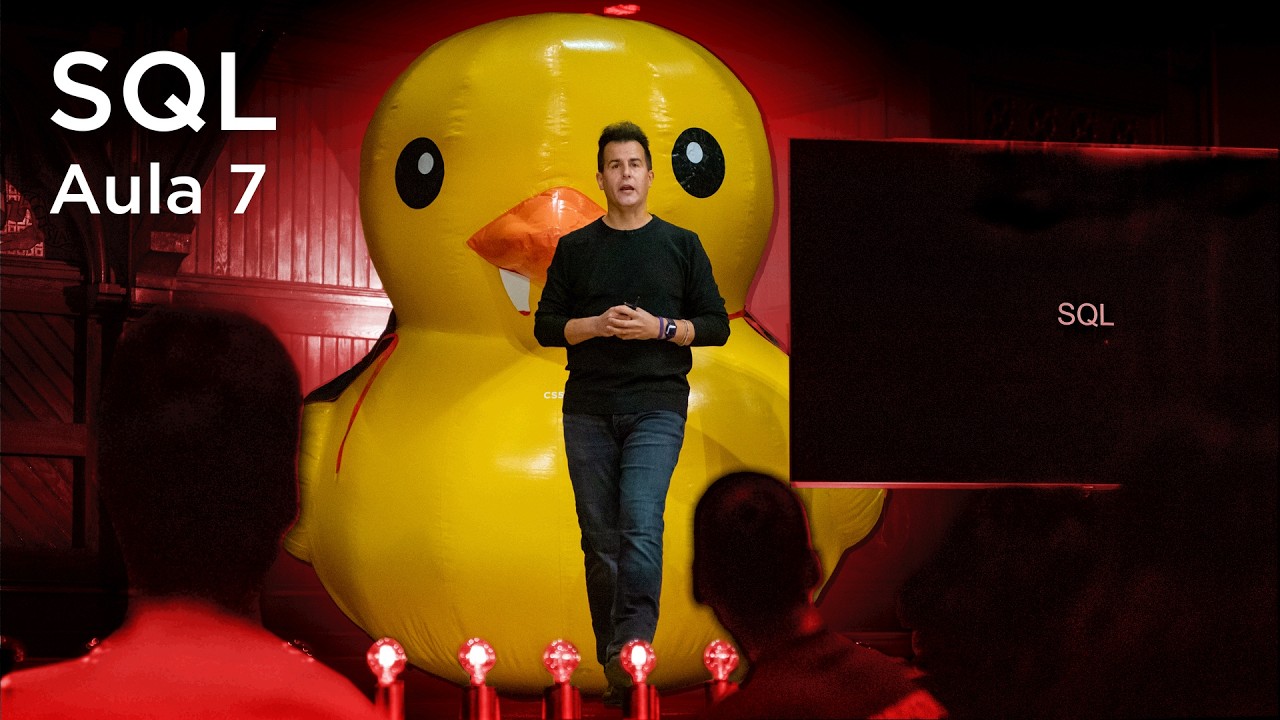
CS50x em Português - Aula 7 - SQL
CS50x in Portuguese - Lesson 7 - SQL
Keywords
Summary
156 words
Critical Evaluation
Value of the Information & Strength of the Argument
The lecture’s value lies in its carefully scaffolded progression from a concrete, familiar artifact (a Google Forms CSV export) to abstract database concepts. Malan begins with a live data-collection exercise, which grounds the abstraction in immediate experience, then writes a small Python program to read the CSV and count language preferences. This is a deliberate pedagogical move: the audience sees the manual, error-prone nature of flat-file processing before being shown why relational databases exist. The argumentation is cumulative and Socratic. Malan repeatedly asks the audience to identify bugs (the header row being printed, the KeyError when incrementing a missing dictionary key) and then presents multiple valid solutions, explicitly noting that several approaches are reasonable. This models engineering judgment rather than prescribing a single correct answer. The discussion of dictionary readers versus list readers introduces robustness to column reordering, a practical concern that motivates schema design later. The transition to relational databases is framed as a natural response to the scaling problems of individual variables and flat files. The reasoning is sound throughout, and the examples are minimal but sufficient to illustrate each concept. The main limitation of the excerpt is that it stops before the substantive SQL querying material, so the depth of the database discussion cannot be fully evaluated from the transcript alone.
Scientific Rigor, Source Quality, Title Accuracy
The lecture is produced by Harvard’s CS50 team and hosted on institutional infrastructure (cs50.harvard.edu, cs50.edx.org), with a clear open license (CC BY-NC-SA 4.0) and attribution to David J. Malan. The technical content is standard, well-established computer science material with no contested claims. Sources are not cited in the academic-paper sense, which is appropriate for an introductory lecture; the authority derives from the institution and the instructor’s recognized expertise. The title, ‘CS50x em Português - Aula 7 - SQL,’ accurately reflects the content: it is a Portuguese-dubbed CS50x lecture on SQL. The description credits the dubbing to lingopal.ai and provides the full chapter list, which matches the topics discussed in the transcript. No advertising sequence is present in the provided transcript. No viewer comments were supplied, so no audience-trend analysis is offered.
360 words
Title / Content Match
The title accurately announces a CS50x lecture on SQL, and the transcript confirms this is a dubbed Portuguese-language session of CS50's Week 7 on SQL. The match is direct and unambiguous.
Quality & Reliability
9/10
Content produced by Harvard's CS50 team, a long-established academic course with a public syllabus, open licensing (CC BY-NC-SA 4.0), and institutional hosting (cs50.harvard.edu, edX). The lecture is a pedagogical introduction to SQL, not a research claim, and its technical content is standard, verifiable computer science material. No unverified empirical claims are made. The only minor caveat is that the transcript provided is partial (it ends mid-lecture), so the full scope of the session cannot be assessed.
Chapters
Cited Sources
- CS50x on edX — Official platform for taking the CS50 course, referenced in the video description.
- CS50 OpenCourseWare — Harvard-hosted course materials for CS50x, referenced in the description.
- CS50 GitHub organization — Official CS50 code repositories, referenced in the description.
- Creative Commons BY-NC-SA 4.0 License — License under which the lecture is distributed, referenced in the description.
- David J. Malan's Harvard page — Instructor's institutional page, referenced in the description.
Concurring Sources
- CS50x official course page — Institutional source confirming the course structure and content of CS50x Week 7.
- SQL standard documentation (ISO/IEC 9075) — The international standard defining SQL, consistent with the technical content presented.
External References
Contribution & Novelties
This lecture is not a presentation of new research but a pedagogical synthesis. Its original contribution is the sequencing: it uses a live, real-time data-collection exercise to make the case for relational databases empirically rather than abstractly. By having students submit responses and then exporting the CSV, Malan creates a shared dataset that the class can immediately interrogate, turning a lecture on SQL into a hands-on demonstration of why flat files fail at scale. The discussion of dictionary readers as a robustness measure against column reordering is a practical insight often omitted in introductory treatments. The lecture also explicitly frames SQL as a declarative paradigm, positioning it alongside procedural and object-oriented paradigms as part of a broader programming-languages education.
Pour aller plus loin :
- SQL — Wikipedia entry providing historical and technical context for the language introduced in the lecture.
- Relational database — Overview of the relational model that the lecture transitions into.
- SQL injection — Background on the security topic covered in the later portion of the lecture.
- Edgar F. Codd — Originator of the relational model, relevant to the conceptual foundations discussed.
- Database normalization — Related concept for schema design, relevant to the schema section of the lecture.
200 words
Radar Profile
The profile is that of a high-credibility educational resource: maximum reliability and information quality, moderate information density appropriate to an introductory lecture, and a deliberately accessible technical level. The low technical-depth score reflects the pedagogical target, not a weakness in the material.