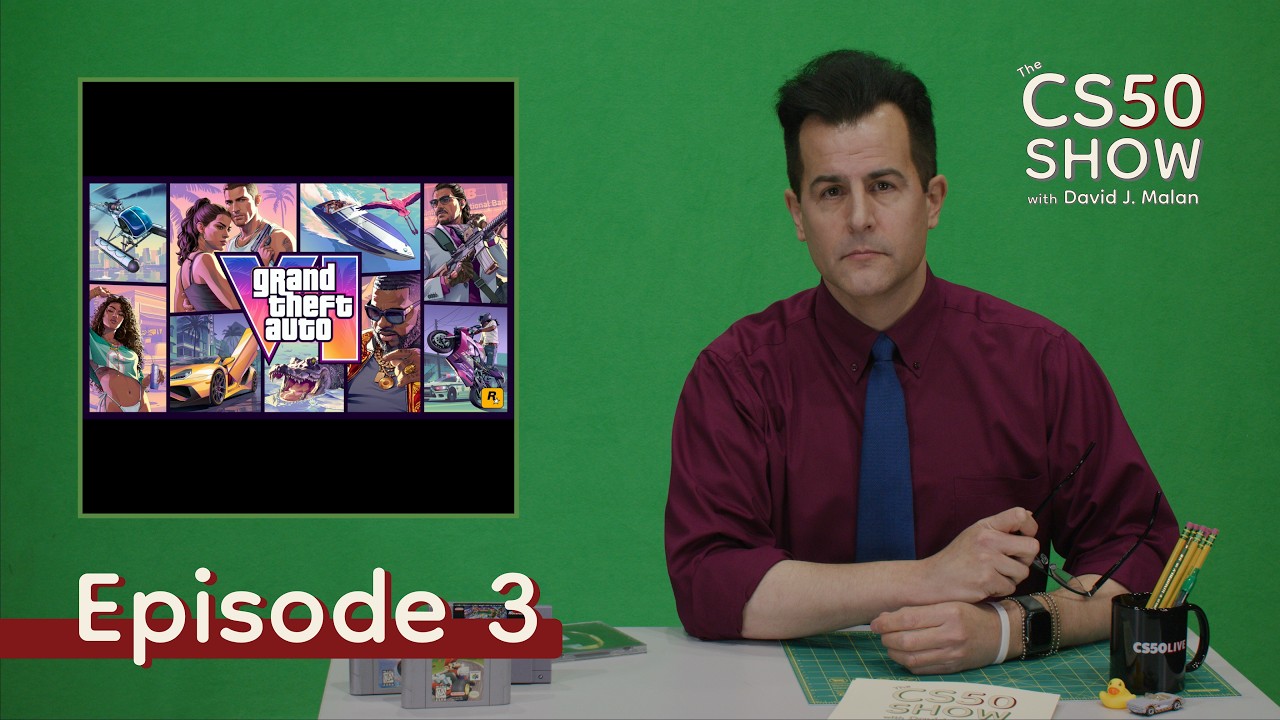
GTA VI | The CS50 Show with David J. Malan | Season 1, Episode 3
Title history
- GTA VI | The CS50 Show with David J. Malan | Season 1, Episode 3 — observed on 20261118-1746 UTC (YouTube)
Keywords
Summary
181 words
Critical Evaluation
Value of the Information & Strength of the Argument
The value of the information is high, as the show effectively breaks down complex technical topics into understandable segments. Each topic is explained with clear analogies (e.g., latency compared to a faucet) and step-by-step logical reasoning. The argumentation is solid, relying on concrete data (e.g., download speed calculations, statistics from pre-orders) and authoritative sources. The host presents multiple perspectives, such as discussing the potential upsell motives of ISPs, and carefully navigates the nuances of the exponential time hypothesis, clarifying that the AI proofs do not necessarily resolve P vs NP. The arguments are well-structured and logically persuasive, contributing to the episode’s educational value.
Scientific Rigor, Source Quality, Title Accuracy
The show demonstrates high rigor in sourcing, citing specific articles (e.g., PC Gamer, Forbes) and official press releases (e.g., Comcast). The inclusion of the Wikipedia article on Musl and links to OpenAI’s academic initiatives shows attention to verifiable references. The title accurately represents the content, focusing on GTA VI while appropriately framing it within the CS50 Show’s educational mission. The video also includes a clear disclaimer about licensing (CC BY-NC-SA 4.0). Overall, the sources are credible, and the title-contenu alignment is excellent.
200 words
Title / Content Match
The title accurately reflects the content, as the episode discusses GTA VI download speeds among other tech news. The title clearly identifies the show and episode number.
Quality & Reliability
8/10
The video provides accurate explanations of technical concepts and cites reliable sources such as PC Gamer, Forbes, and official company press releases. The host is a well-known computer science educator, contributing to trustworthiness.
Chapters
Cited Sources
- Comcast Xfinity gives gamers a free 15-day WiFi speed increase for GTA VI launch — Mentioned when discussing Comcast's promotion for GTA VI download speed boost.
- Sensor Tower GTA VI Sales Tracker — Referenced to support the claim of over 15 million pre-orders.
- Musl - Wikipedia — Cited in the section explaining the OpenSSH vulnerability, providing background on the C library.
- OpenAI Building Scientific Understanding with Academic Communities — Referenced in the segment on the exponential time hypothesis and AI-generated proofs.
- CS50 Course Resources — Mentioned as a resource for viewers to learn more about computer science.
External References
- creativecommons.org
- cs.harvard.edu
- cs50.edx.org
- cs50.edx.org
- cs50.harvard.edu
- cs50.harvard.edu
- cs50.medium.com
- cs50.stackexchange.com
- github.com
- github.com
- gitter.im
- www.linkedin.com
- www.linkedin.com
- www.nvidia.com
- www.nvidia.com
- www.pcgamer.com
- www.reddit.com
- www.snapchat.com
- sshhole.com
- www.stepsecurity.io
- support.zoom.com
- t.me
- www.threads.net
- www.threads.net
- www.tomshardware.com
Contribution & Novelties
This episode adds value by making recent tech news accessible to a lay audience, particularly through its clear explanations of technical concepts like the exponential time hypothesis and SSH bugs. It also connects historical context (Nvidia’s evolution) to current AI trends, helping viewers understand the industry’s trajectory. The show’s ability to demystify complex topics without oversimplifying is its unique contribution.
Pour aller plus loin :
- Exponential time hypothesis — Delves deeper into the computational complexity theory behind the hypothesis.
- P versus NP problem — Essential background on one of the biggest open questions in computer science.
- CUDA — NVIDIA’s parallel computing platform, central to understanding GPU programming for AI.
109 words
Radar Profile
The radar profile shows balanced scores across all dimensions, with slightly lower technical depth compared to information quantity and quality. This indicates that the video excels in delivering comprehensive and reliable content but may not require extreme technical expertise to follow, making it suitable for a broad audience.