Module 3: Preserving Wayuu knowledge in Musichi, Colombia
Keywords
Summary
254 words
Critical Evaluation
Value of the Information & Strength of the Argument
The informational value here is ethnographic rather than technical. The video’s real contribution is a compact, internally coherent account of how one Wayuu community understands its own livelihood system: mangrove, salt, shrimp and fishing are described as a single fabric in which ecological function, food security, identity and memory cannot be separated. That framing is stated repeatedly by different speakers — a teacher, a community leader, an older resident — which gives it a consistency that purely individual testimony would not have. The argument for technifying shrimp production is developed with some care: seasonal, purely extractive harvesting is contrasted with a permanent, productive cycle; the prospect of continuous supply is linked to stable employment, to reduced pressure on the wild stock, and to the possibility of a community-owned brand capturing more of the value. The equity argument is the most substantive part, since it addresses a concrete structural problem — outside firms operating in the territory while indigenous residents remain labourers rather than owners — and proposes traditional authorities and participatory rights as the governance mechanism. The weakest link is the causal chain itself: the video asserts that restoring seawater circulation would make shrimp farming viable, that a permanent resource would reduce overexploitation, and that this would reverse out-migration, without presenting any feasibility study, yield data, market analysis, water-quality assessment or comparison with failed aquaculture projects elsewhere. Nothing is said about the well-documented risks of shrimp farming — effluent, mangrove clearing, salinisation, disease outbreaks, volatile export prices — even though those risks bear directly on the model being proposed. The renewable-energy passage (wind, solar, green hydrogen) is introduced as an assertion of territorial potential and then dropped, so it functions as rhetoric rather than as analysis. The result is a persuasive statement of community aspiration whose internal logic holds up but whose empirical foundations remain unexamined; viewers receive a clear picture of what the community wants and why, but no tools to judge whether the proposed path would work.
Scientific Rigor, Source Quality, Title Accuracy
On scientific rigour, the video makes no claim to be a research output and cites no study, dataset, monitoring result or technical report. The only named institutions are local ones — the Maracarí educational centre and the Julio Rosado school — invoked as sites of practice rather than as sources of evidence, and no document, author or reference is attached to any factual statement. The claims about shrimp productivity, water circulation, employment effects and the environmental consequences of coal extraction are all advanced by interviewees in the first person, without corroboration, quantification or attribution to an external body. There is no methodological transparency: the viewer is not told how the speakers were selected, whether dissenting voices exist in the community, or on what basis the aquaculture project has been assessed. This is entirely normal for a documentary format, but it means the material should be treated as primary testimony, not as validated analysis. On source quality, the absence of any linked reference in the accompanying description leaves nothing to cross-check; the value of the piece lies in the authenticity and specificity of the voices, not in documentable evidence. On title/content fit, the title is broadly honest — mangrove restoration, shrimp production and traditional fishing are all covered and the Musichi setting is central — though the emphasis drifts noticeably towards a development project proposal rather than the preservation of knowledge announced in the title, and the coal-extraction angle promised in the description is only gestured at.
590 words
Title / Content Match
The title promises the preservation of Wayuu knowledge in Musichi, and the video does deliver community voices on mangroves, fishing and shrimp; however, a large share of the runtime is devoted to a forward-looking shrimp-farming project rather than to knowledge preservation as such.
Quality & Reliability
5/10
First-hand testimony from community members, teachers and traditional authorities gives authentic, locally grounded content, but the video offers no data, no methodology, no named studies and no independent verification of its central claims (shrimp aquaculture feasibility, environmental impacts of coal extraction). Reliability rests on the credibility of the speakers rather than on documented evidence.
Key Moments
Markers derived by PSI from the transcript: the creator did not define chapters.
- Opening: Wayuu identity framed through weaving, ancestral inheritance and the idea of a culture that 'weaves dreams'.
- The territory's renewable-energy potential is raised — wind, solar, green hydrogen — as a lever to convert visible poverty into better living standards.
- The mangrove is reframed as an element of resistance and territorial identity, not merely an environmental feature, with reference to the estuarine dynamics of the San Agustín lagoon.
- The Maracarí educational centre and its student 'semilleros' group working on mangrove preservation as both conservation and memory.
- Shrimp presented as a seasonal pillar of food and income; restoring seawater circulation is proposed as the basis for a viable shrimp-farming project.
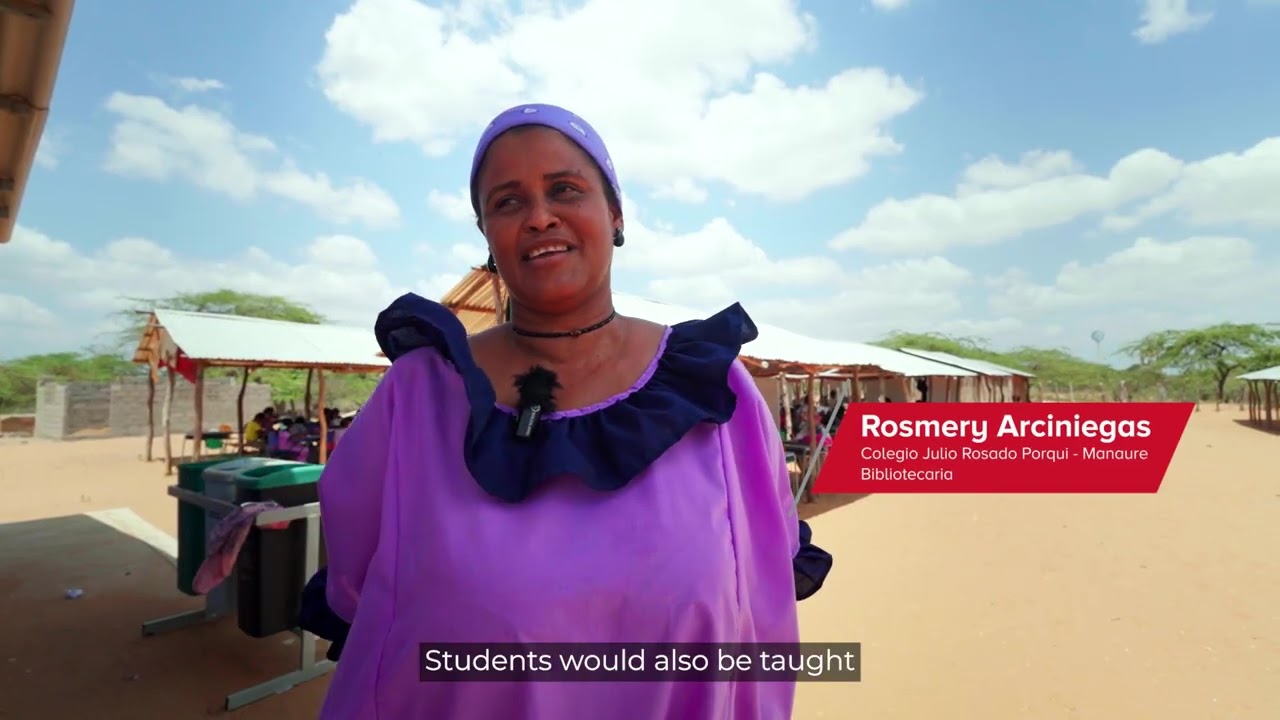
- Teaching dimension: workshops on shrimp production and practical work planned for the upper school grades.
- Environmental culture along the coastline: fishing, shrimp and lebranche harvesting described against the backdrop of the salt-industry crisis.
- Youth out-migration is named as a core problem, with the project framed as a reason for young people to stay in the territory.
- Case for technifying shrimp: permanent rather than extractive supply, new jobs, lighter pressure on the wild stock, and a community brand.
- Equity and governance: traditional authorities, participatory rights, and indigenous ownership of the enterprise rather than outside firms hiring Wayuu as labour.
- Closing: the project imagined as the 'resurrection' of the territory as a food-producing entity, with work for women and adults and a visible change in quality of life.
Concurring Sources
- Wayuu people (Wikipedia) — General background on the Wayuu nation of the Guajira peninsula, its territorial organisation and traditional authorities, consistent with the governance model described by the speakers.
- Mangrove (Wikipedia) — Provides the ecological baseline for the coastal-protection and nursery functions that interviewees attribute to the mangroves of the San Agustín lagoon area.
- Just transition (Wikipedia) — Frames the series' overarching concept and the tension the video raises between coal extraction, community livelihoods and alternative productive models.
- La Guajira Department (Wikipedia) — Geographic and socio-economic context for Musichi, the coastal salt economy and the wind and solar resources mentioned in the video.
Contribution & Novelties
The distinctive contribution is the juxtaposition of two normally separate registers: a conservation narrative centred on mangroves as cultural heritage, and a development narrative centred on commercial shrimp aquaculture as an exit from the salt-economy crisis and from youth out-migration. Rather than treating mangrove protection as a constraint on economic activity, the speakers present it as the productive infrastructure on which the aquaculture proposal depends, and they add a governance condition that is often missing from just-transition discussions — that the community itself, through its traditional authorities, should be the owner of the enterprise rather than a supplier of labour to an outside operator. The video also gives an unusually explicit account of what a ‘just’ transition means from the receiving end of large-scale coal extraction and large-scale renewable-energy siting, in a territory that is simultaneously presented as a wind, solar and green-hydrogen prospect. Its limitation is that this framing is asserted rather than tested: no feasibility data, no comparison with the region’s aquaculture precedents and no engagement with the environmental risks of shrimp farming are offered, so the contribution is a well-articulated statement of local priorities that would need technical and economic validation before being read as a roadmap.
Further reading:
- Just transition — Conceptual frame of the series and the lens through which the coal-extraction context should be read.
- Mangrove — Ecological reference for the coastal protection, nursery and carbon functions the community attributes to its mangroves.
- Wayuu people — Background on the nation, its territorial organisation and traditional authority structures invoked in the governance discussion.
- La Guajira Department — Regional context for the salt economy, the coal zone and the wind and solar resources mentioned.
- Shrimp aquaculture — environmental and social impact assessment literature (effluent, mangrove conversion, disease, market volatility), the risk dimension absent from the video; to be consulted by name in academic databases.
- Cerrejón coal mine, La Guajira — the large-scale extraction operation implicitly behind the ‘regional coal extraction’ framing; relevant for cross-checking the environmental pressures described.
332 words
Radar Profile
The profile is markedly asymmetric: technical depth and verifiable reliability sit low, while the value carried by first-hand testimony keeps information quantity and quality in the middle range. It reads as a high-context, low-formality documentary profile — strong on lived experience, territorial identity and governance questions, weak on measurement. The gap between the technical score and the qualitative value reflects a piece that is informative about a community's priorities without being evidential about the solutions it proposes.