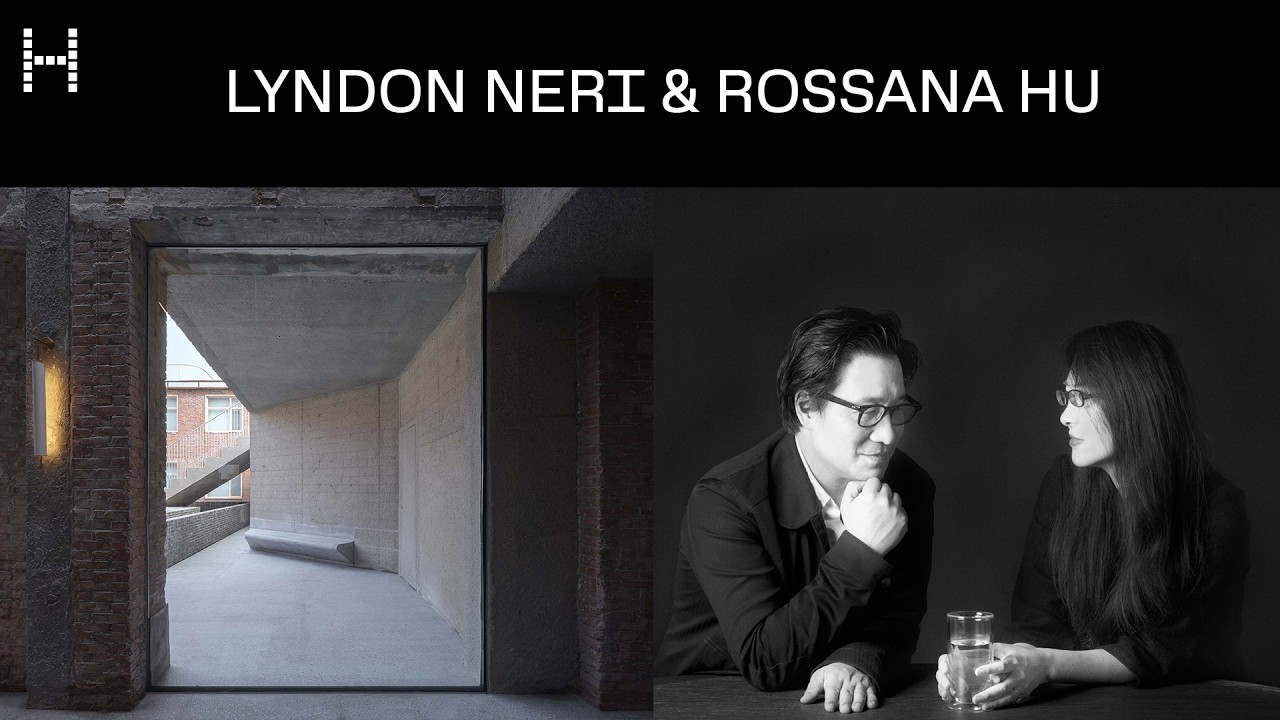
Kenzō Tange Lecture: Lyndon Neri and Rossana Hu, “Liminal Ground”
Keywords
Summary
179 words
Critical Evaluation
Value of the Information & Strength of the Argument
The value of the information lies in its synthesis of complex cultural theories with concrete design decisions, offering a rare glimpse into how a leading practice navigates between theoretical reflection and pragmatic responses. The argumentation is coherent and well-supported by extensive project documentation, including photographs and plans. The speakers convincingly demonstrate how concepts like ’liminality’ and ‘reflective nostalgia’ can be operationalised in architectural design, particularly in contexts of rapid urban transformation. However, the presentation is inherently subjective, reflecting the practitioners’ personal viewpoints and experiences, which may limit its general applicability. Nevertheless, the intellectual rigor and the breadth of references (Benjamin, Boym, Bhabha) elevate the lecture beyond a mere project showcase, providing a substantive contribution to architectural discourse.
Scientific Rigor, Source Quality, Title Accuracy
The scientific rigor is high: the lecture cites academic sources (Habermas, Boym, Benjamin, etc.) and engages with scholarly debates on memory, ruins, and cultural hybridity. The speakers also reference their own publication ‘Thresholds: Space, Time, and Practice’ and a paper for CICA, indicating an ongoing theoretical contribution. The title ‘Liminal Ground’ is precise and accurately captures the central theme, with no noticeable disconnect between title and content. The structure is clear, moving from theoretical introduction to case studies, and the Q&A adds interactive depth. While the argumentation relies heavily on personal interpretation, the consistent use of footnoted ideas and the critical engagement with historical precedents lend credibility. The sources are credible and the lecture aligns well with its stated theme.
252 words
Title / Content Match
The title 'Liminal Ground' directly reflects the lecture's core theme of thresholds and in-betweenness in architecture, and the content consistently explores this concept.
Quality & Reliability
8/10
The lecture presents well-established theoretical frameworks (Bhabha, Boym, Benjamin) applied to architectural practice, with credible references and concrete project examples. The speakers are recognized practitioners, and the event is hosted by a prestigious institution.
Chapters
Cited Sources
- Homi K. Bhabha - Wikipedia — Referenced for the concept of 'third space' in cultural theory.
- Svetlana Boym - Wikipedia — Her book 'The Future of Nostalgia' is discussed, highlighting restorative and reflective nostalgia.
- Walter Benjamin - Wikipedia — The 'Arcades Project' and 'dialectical image' are cited for their analytical framework.
- Gordon Matta-Clark - Wikipedia — Mentioned for his practice of cutting into existing buildings.
- Wu Hung - Wikipedia — His research on Chinese ruins and their representation informs the discussion of ruin aesthetics.
- Jürgen Habermas - Wikipedia — Theory of communicative action is used to bridge autonomy and engagement.
Contribution & Novelties
The lecture offers an original contribution by integrating heterogeneous theories—Bhabha’s third space, Boym’s nostalgia, Benjamin’s dialectical imagery—into a coherent design methodology for adaptive reuse, particularly within the Chinese context. It challenges conventional notions of preservation and proposes a ’liminal’ stance that embraces ambiguity and transformation. The inclusion of specific projects as test cases demonstrates the practical applicability of these ideas.
Pour aller plus loin :
- Liminality (concept) — A key concept explored in the lecture; relates to thresholds and rites of passage.
- Homi K. Bhabha’s Third Space theory — Central to the discussion of cultural hybridity and negotiation.
- Svetlana Boym’s ‘The Future of Nostalgia’ — Provides the nuanced understanding of nostalgia used in the lecture.
115 words
Radar Profile
The radar profile shows strong scores in information quality and reliability, with moderate technical depth and quantity. This reflects a thoughtfully crafted, academically grounded lecture that balances theoretical rigor with practical examples.