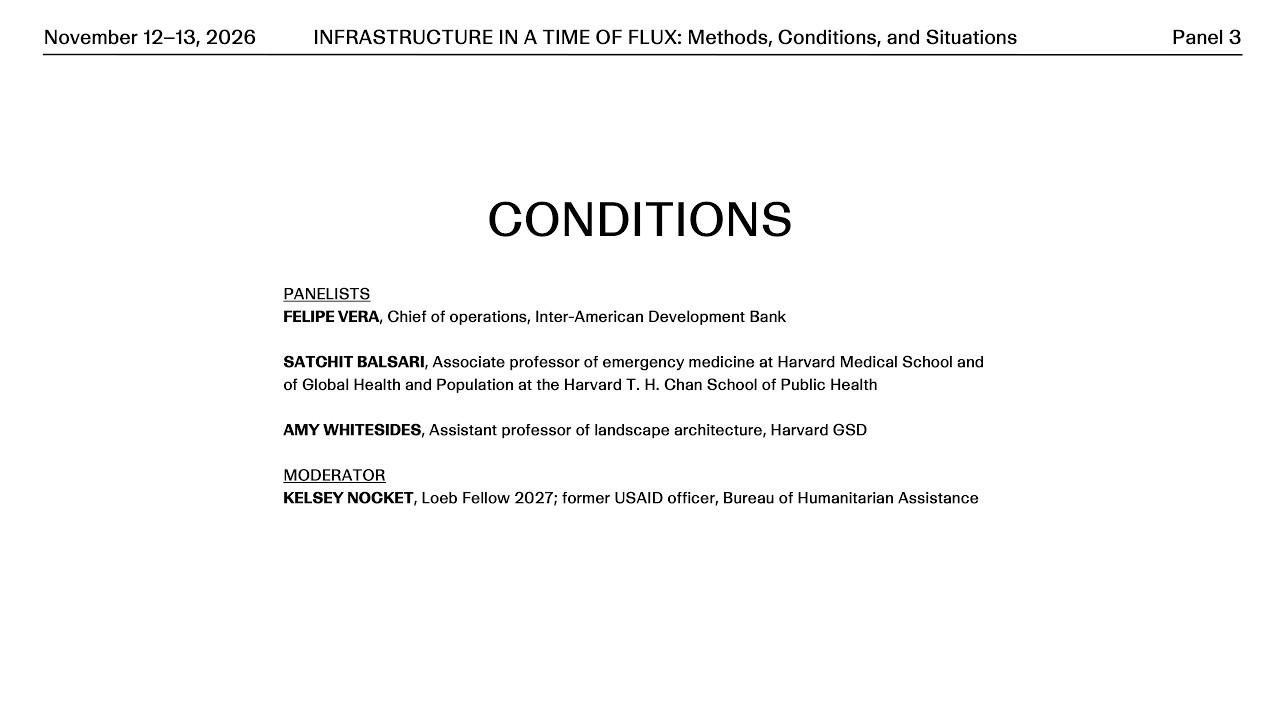
Infrastructure in a Time of Flux: Methods, Conditions, and Situations | Panel 3: Conditions
Keywords
Summary
326 words
Critical Evaluation
Value of the Information & Strength of the Argument
The informational value of the panel lies less in novel research than in the operational density of its two transcribed talks. Vera supplies a usable typology of contemporary migration — forced rather than aspirational, sudden rather than gradual, split-family rather than staged, reversible rather than permanent — and immediately ties each shift to a design consequence: if arrivals are reversible, infrastructure built for permanence is mis-specified. His figures (8.2 billion today, roughly two billion more by 2050 concentrated in Global South cities, about one billion people in movement of whom 300 million-plus are international, a 117 percent increase in Latin American migration, 8.3 million departures from Venezuela) are delivered quickly and without attribution, but they frame a genuinely concrete argument. Villa 31 gives the reasoning an empirical spine: a settlement beside the country’s wealthiest district, sixty bus lines passing and none entering, a 100 million dollar budget, an on-site housing-improvement programme that trains residents, and an audition-style CV experiment in which identical applications citing Villa 31 drew about 30 percent fewer callbacks than those citing Retiro. That experiment is the strongest evidentiary moment of the panel because it isolates a single variable — the name of a place — and converts a design question into a measurable one. The argumentation is weaker where causal claims outrun the design: attributing employability to the address without describing the sample, sector or controls, and linking a resident’s new window to pandemic survival, which is offered anecdotally and cannot carry the weight placed on it. Balsari’s segment is more conceptually ambitious and more careful about uncertainty. Heat as ‘permanent temporariness’ is a useful reframing; the three failures of imagination give the argument a clean structure; and the SEWA parametric-insurance episode is the most instructive passage of the panel, since a product launched in the hottest year on record triggering zero payouts is a self-demonstrating failure of index design. He is explicit that the efficacy of cool roofs, shading, fans and passive cooling is ‘still emerging’, and he converts the measurement problem into a question a designer can hold onto: do we measure the roof’s temperature, the storey below it, or whether a child sleeps through the night. The panel’s epistemic virtue is this willingness to name the limits of what is known; its weakness is a reliance on round, unsourced figures and on declarative claims — ‘inequality decides where the flux lands’ — that are asserted rather than demonstrated. Nothing in the transcribed portion is technically abstruse; the value is in framing and case detail rather than in method. Because the transcript ends mid-sentence during Balsari’s talk, roughly half the advertised programme, including the landscape-architecture perspective and the moderated discussion, cannot be evaluated.
Scientific Rigor, Source Quality, Title Accuracy
Citation practice is oral and overwhelmingly secondary. Four sources are named in the transcribed portion: the UN Environment Programme ‘Limiting Overshoot’ report of September 2026, an NPR report asserting that extreme heat killed nearly five times as many people in the United States as official records indicate, International Labour Organization figures on 2.4 billion workers exposed to dangerous heat, and the Self Employed Women’s Association’s parametric heat insurance product. None is accompanied by a slide-level bibliography, DOI or peer-reviewed attribution, and the video description carries no reference list at all — only the exhibition and symposium framing and the speakers’ institutional affiliations. Institutional credibility is nevertheless high: the IDB, Harvard Medical School, the Harvard T. H. Chan School of Public Health and Harvard GSD, with speakers drawing on direct operational and clinical work rather than on literature synthesis. The single claim most in need of a primary citation — the fivefold undercount of heat mortality — is delivered as a press citation whose underlying study is not identified, and the demographic projections (two billion additional urban residents by 2050, one billion migrants, 117 percent regional growth, 8.3 million Venezuelan departures) are presented as self-evident from maps. The one genuinely original piece of evidence, the CV callback experiment, is described without its methodology. Title and content are well aligned: the panel promises a discussion of the forces reshaping settlements beyond the scale of individual buildings, and delivers migration, informality and heat as exactly those forces, without digression.
710 words
Title / Content Match
The title announces a panel on the 'conditions' that continuously reshape settlements, and the two transcribed talks address exactly that: migration pressure on cities and extreme heat as a chronic condition. No drift between promise and content.
Quality & Reliability
7/10
Three credentialed practitioners (IDB chief of operations, Harvard Medical School/Chan global health professor, Harvard GSD landscape architect) speaking from direct operational and clinical experience, with concrete case material (Villa 31 in Buenos Aires, SEWA parametric heat insurance). Reliability is limited by an oral, largely secondary citation practice: only four named sources (UNEP, NPR, ILO, SEWA), no bibliography in the description, several unattributed round figures, and a transcript that ends mid-way through the second talk, leaving the third presentation and the panel discussion unverifiable.
Chapters
Cited Sources
- UN Environment Programme — 'Limiting Overshoot' report (September 2026) — Cited by Satchit Balsari as declaring that the world has fallen short of holding warming to 1.5 °C above pre-industrial levels.
- NPR — reporting on heat-related mortality in the United States — Cited for the claim that extreme heat killed nearly five times as many people in the US as official records indicated, in the same week as the UNEP report.
- International Labour Organization — workers exposed to dangerous heat — Source for the figure of 2.4 billion workers exposed to dangerous heat, used to shift the frame from mortality to productivity, wages and compounding health costs.
- Self Employed Women's Association (SEWA) — parametric heat insurance — Trade union of four million women in the informal labour economy that launched a parametric heat insurance product in 2023; it triggered zero payouts in what was then the hottest year on record, prompting the collaboration with Balsari's team.
- Infrastructure in a Time of Flux — exhibition, Druker Design Gallery, Harvard GSD — The exhibition accompanying the symposium, examining lightweight, adaptable, deployable and materially efficient building methods and why their social applications remain unrealised.
Concurring Sources
- International Labour Organization — heat and labour — Corroborates the panel's core claim that a very large share of the global workforce, concentrated in outdoor and informal work, is exposed to excessive heat and to associated productivity and income losses.
- UN-Habitat — informal settlements and urban population data — Provides the institutional figures on the number of people living in informal settlements that underpin Vera's argument about where future urban growth will be absorbed.
- IPCC — Assessment Reports on 1.5 °C and overshoot — Consistent with the UNEP finding cited by Balsari that warming is on a trajectory exceeding 1.5 °C above pre-industrial levels.
- Lancet Countdown on Health and Climate Change — Independent monitoring of heat-related mortality, occupational heat exposure and adaptation finance that broadly matches the health and labour framing presented in the talk.
Dissenting Sources
- Official heat-mortality attribution (national vital statistics and excess-mortality studies) — The claim that heat deaths are five times official records depends heavily on method: death-certificate counts, excess-mortality estimation and attribution studies give substantially different multipliers, so the ratio should be treated as method-dependent rather than as a single established figure.
- Evaluations of municipal heat action plans and cooling centres — Several public health evaluations of heat action plans report measurable reductions in mortality and morbidity, which tempers the panel's scepticism toward large-scale, top-down adaptation measures such as cooling centres and cool-roof programmes.
Contribution & Novelties
The panel’s original contribution is to join two literatures that are usually kept apart — the political economy of urban informality and the clinical epidemiology of heat — through a single design question: what should be built to stay, when everything around it is expected to move. Vera’s contribution is a design heuristic that inverts the symposium’s own vocabulary: rather than fetishising flexibility, temporariness and adaptability, he argues for identifying what must be conserved so that the rest can change, with the housing-improvement programme in Barrio Padre Carlos Mugica offered as an operational example, alongside the literal conflation of building and bridge in the IDB office designed with Alejandra Ravena. Balsari’s contribution is the notion of heat as ‘permanent temporariness’ and the diagnostic triad of spatial, temporal and contextual failures of imagination, applied concretely to parametric insurance design and to cooling-centre policy. The SEWA episode is the most transferable finding: a well-intentioned index product failed not because of actuarial error but because the threshold (43 °C sustained over three days and nights, with night-time dips resetting the count) encoded a climate imaginary drawn from temperate heat waves rather than from the lived exposure of outdoor women workers.
Pour aller plus loin :
- Urban heat island — Background on the differential night-time cooling that underpins Balsari’s argument about where trees should go.
- Villa 31 — The Buenos Aires settlement discussed by Vera (now Barrio Padre Carlos Mugica), useful for checking the historical and demographic claims made in the talk.
- Parametric insurance — Explains index-based triggers and basis risk, the mechanism behind SEWA’s zero-payout year.
- Self Employed Women’s Association — The Indian trade union whose heat insurance product is the panel’s central case study.
- UN-Habitat world slum population estimates — for verifying the scale of informal settlement residence that Vera references.
- IPCC Assessment Report synthesis on 1.5 °C overshoot trajectories — to situate the UNEP report cited by Balsari.
317 words
Radar Profile
The profile is broad rather than deep: high on information quantity and reliability of framing, moderate on technical density, since the panel works through cases and concepts rather than methods or data. Quality and global reliability sit in the same band, reflecting credentialed speakers with direct field experience but an oral, secondary citation practice. The missing third presentation and discussion would likely have raised the technical score.