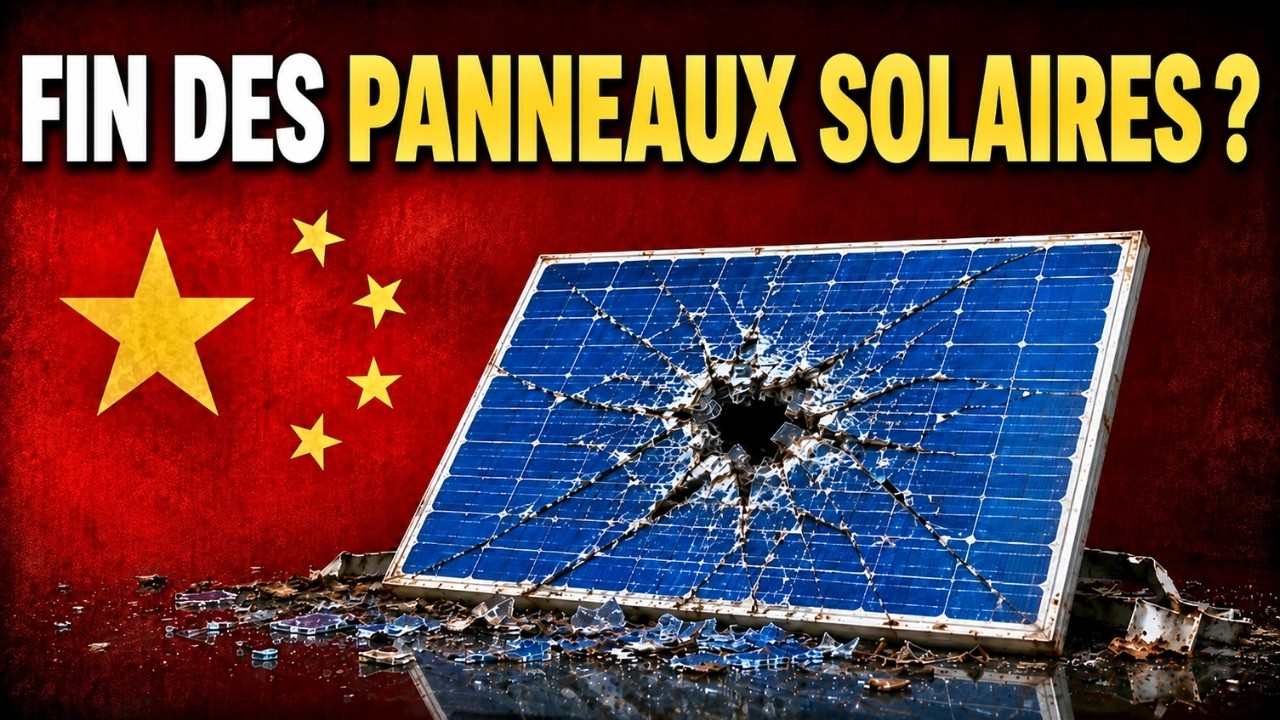
La Chine mise sur un nouveau matériau qui pourrait remplacer les panneaux solaires
China bets on a new material that could replace solar panels
Title history
- La Chine mise sur un nouveau matériau qui pourrait remplacer les panneaux solaires — observed on 20261101-0050 UTC (YouTube)
Keywords
Summary
161 words
Critical Evaluation
Value of the Information & Strength of the Argument
The video provides a well-structured and informative overview of perovskite solar technology. It presents concrete figures (e.g., 28% efficiency in 2026, 29.2% tandem module) and explains physical principles, such as the Shockley-Queisser limit and spectrum splitting in tandem cells. The argumentation is coherent: it builds from the discovery of perovskite to lab achievements, then to industrial scale-up, and finally to economic and regulatory challenges. The distinction between laboratory records and commercial viability is clearly made, avoiding overhype. The value lies in its balanced treatment of both potential and obstacles, including the durability issue and lead toxicity. However, it lacks direct citations to specific studies or reports, which weakens verifiability. The narrative is persuasive but relies on authoritative statements without providing sources for key claims (e.g., CO2 emission reductions, Chinese production timelines).
Scientific Rigor, Source Quality, Title Accuracy
Rigour: The video generally aligns with known developments in perovskite research. It correctly attributes the first perovskite solar cell to Tsutomu Miyasaka in 2009 and mentions the efficiency record around 2026. It accurately describes the tandem concept and the limits of silicon. However, no sources are cited on screen or in the description, making it difficult to verify specific numbers (like the 97 W power output or the CO2 savings). The advice to check with authoritative sources is implicit but not provided. The title’s claim of ‘replacing solar panels’ is an overstatement, as the video itself explains that perovskite will likely work in tandem with silicon, not replace it entirely. This slight mismatch is compensated by the accurate content on the whole.
268 words
Title / Content Match
The title is slightly overstated: the video explains that perovskite is more likely to complement silicon in tandem cells rather than fully replace it, but this is a minor nuance in an otherwise accurate title.
Quality & Reliability
7/10
The video presents accurate scientific and industrial information about perovskite solar cells, including key milestones (2009 Miyasaka's first cell, recent efficiency records) and Chinese industrial scale-up. It clearly distinguishes scientific possibilities from current commercial reality, and acknowledges limitations (durability, lead content). However, specific sources are not cited on-screen or in the description, and some claims (e.g., CO2 emissions reduction) are attributed to 'a manufacturer' without verifiable reference.
Key Moments
Markers derived by PSI from the transcript: the creator did not define chapters.
- Introduction: perovskite as a potential breakthrough in solar energy.
- Discovery of perovskite in 1839 and first solar cell by Miyasaka in 2009.
- Explanation of silicon's efficiency limit and why perovskite offers a path forward.
- Advantages of perovskite manufacturing and the tandem cell concept.
- China's industrial scale-up, government support, and challenges (durability, lead).
- Conclusion: perovskite as a complement to silicon rather than a replacement.
Contribution & Novelties
The video synthesizes the state of perovskite technology with a focus on China’s industrial trajectory, which is often underreported in Western media. It clarifies that tandem cells are the more realistic path, countering the common ‘replacement’ narrative. Its originality lies in stressing the manufacturing advantages (low-temperature deposition) as a key driver for Chinese dominance.
Pour aller plus loin :
- Perovskite structure and properties — General background on the mineral and its crystal structure.
- Perovskite solar cell — Detailed account of research milestones and challenges.
- Tandem solar cell — Explanation of multijunction devices and efficiency potential.
- Tsutomu Miyasaka’s contributions — Biography of the pioneer of perovskite photovoltaics.
- NREL efficiency chart — Official record of solar cell efficiencies, useful for verifying claims.
120 words
Radar Profile
The radar shows a balanced profile with high scores in quantity and quality of information, moderate technical depth, and somewhat lower reliability due to lack of cited sources. The video is informative and engaging but would benefit from transparent referencing.