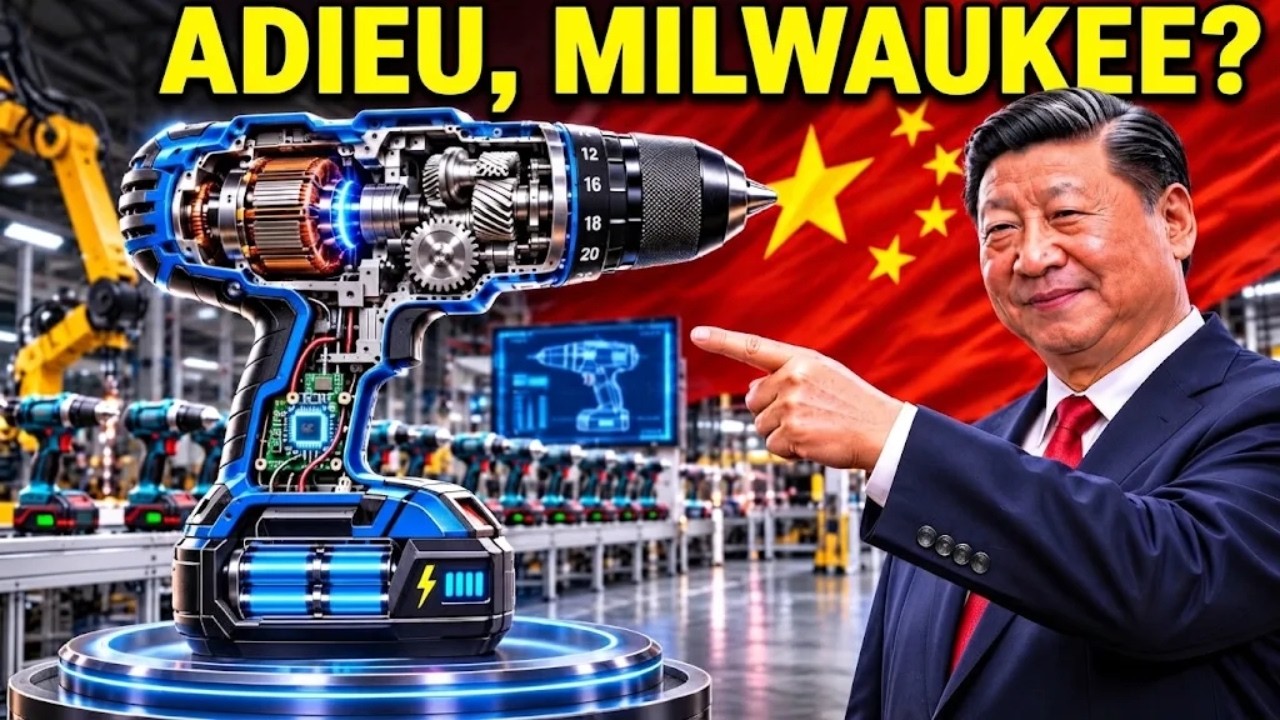
Les nouveaux forets sans fil chinois pourraient mettre fin à toute l'industrie des perceuses !
The New Chinese Cordless Drills Could End the Entire Drill Industry!
Title history
- Les nouveaux forets sans fil chinois pourraient mettre fin à toute l'industrie des perceuses ! — observed on 20261114-1108 UTC (YouTube)
Keywords
Summary
143 words
Critical Evaluation
Value of the Information & Strength of the Argument
The video provides valuable insights into the strategic dynamics of the power tool industry, effectively explaining how battery platforms create lock-in and how new entrants can exploit the cost of switching. The argumentation is solid: it uses concrete examples (Positec, Chervon, Flex, Milwaukee, Ryobi) and logical reasoning to support its claims. It also demonstrates critical thinking by noting that higher voltage alone doesn’t guarantee superiority and that long-term service reliability matters. The narrative avoids oversimplification by acknowledging the complexity of trade and manufacturing globalization.
Scientific Rigor, Source Quality, Title Accuracy
The video does not cite formal academic sources, but it references real companies, historical events (e.g., Amazon, Apollo 15), and recent trade policies. It uses a disclaimer to clarify its educational and narrative nature. The title overpromises with ’end the entire drill industry,’ yet the content actually concludes the industry will persist, only that market leadership may shift. This discrepancy is minor and acknowledged in the final segment. Overall, the rigor is acceptable for a documentary-style explanation, though more explicit sourcing would strengthen credibility.
183 words
Title / Content Match
The title is somewhat sensationalist, suggesting the 'end of the entire drill industry,' while the content actually argues that the industry itself will survive but the dominance of Western brands may be challenged. This slight exaggeration is addressed in the conclusion, so overall the title roughly fits the content.
Quality & Reliability
7/10
The video presents a well-structured and balanced analysis of the cordless drill market, combining historical facts, corporate strategies, and technical explanations about battery platforms and rare earth magnets. It does not cite formal sources but relies on publicly known events and includes appropriate caveats about performance claims. The disclaimer clarifies its educational nature, contributing to a moderate-to-good reliability rating.
Key Moments
Markers derived by PSI from the transcript: the creator did not define chapters.
- Introduction to Chinese cordless drills entering the market and the potential disruption.
- Story of Positec and WORX, from subcontractor to own-brand manufacturer.
- Explanation of battery ecosystem lock-in and why users stay with a brand.
- Discussion on rare earth magnets, supply chain dominance, and 2025 tariff disputes.
- Chervon's acquisition of Flex and the launch of its 24V platform in 2021.
- Technical details of Flex's stacked lithium battery and improved cooling.
- The 'zero' statistic: first-time buyers have no sunk cost, making them open to new platforms.
- Conclusion: Chinese drills won't end the industry but may end Western brand dominance.
Contribution & Novelties
The video offers a fresh perspective on how Chinese manufacturers are leveraging their engineering expertise and supply chain advantages to build credible premium brands, beyond just low-cost imitation. It synthesizes technical aspects (battery chemistry, motor design) with market dynamics (lock-in, switching costs) in a cohesive narrative. This holistic view is valuable for audiences unfamiliar with the power tool industry’s evolution.
Pour aller plus loin :
- Vendor lock-in — Directly relevant to the battery platform lock-in concept discussed.
- Rare-earth magnet — Explains the physics and supply chain importance of neodymium magnets in motors.
- Positec — Background on the company that owns WORX and its transformation.
104 words
Radar Profile
The radar chart likely shows high scores in information quantity and quality, with slightly lower technical depth and reliability due to lack of explicit citations. The profile indicates a well-rounded, engaging analysis that is accessible yet informative.