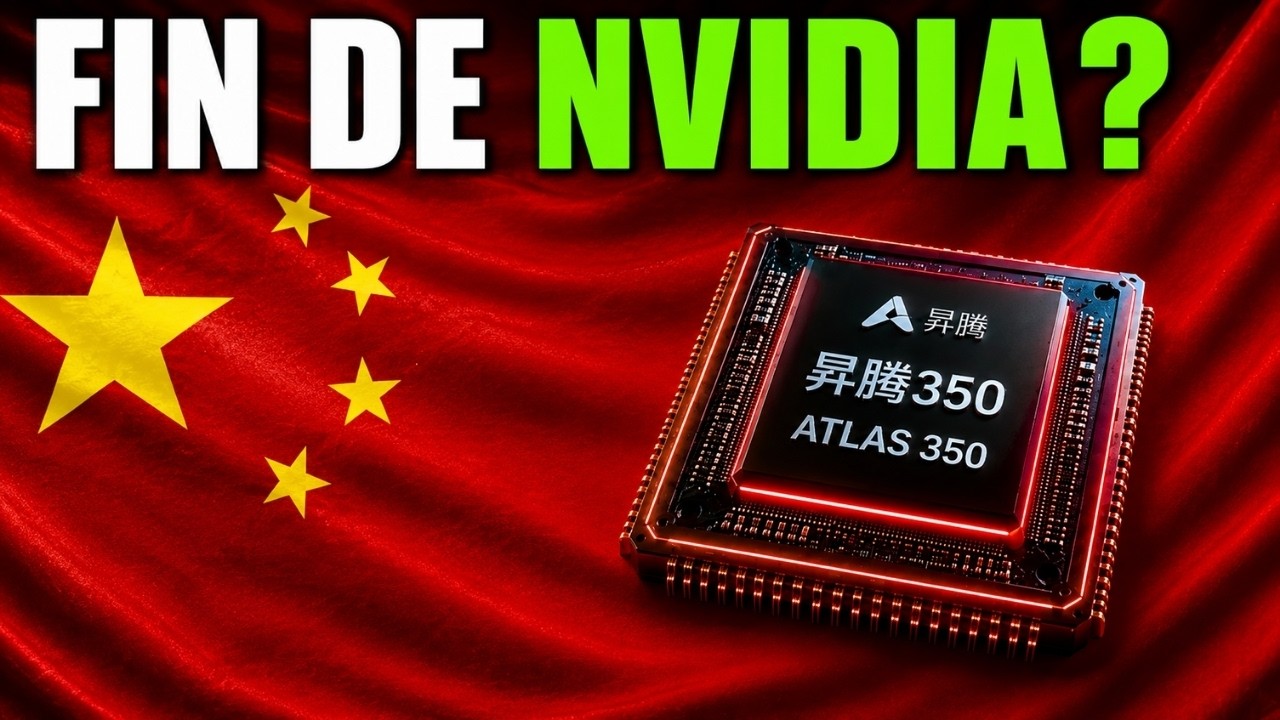
La Chine vient de créer une puce IA — et met fin à l’empire de 50 milliards de Nvidia
China has just created an AI chip — and puts an end to Nvidia's 50 billion empire
Title history
- La Chine vient de créer une puce IA — et met fin à l’empire de 50 milliards de Nvidia — observed on 20261101-0051 UTC (YouTube)
Keywords
Summary
156 words
Critical Evaluation
Value of the Information & Strength of the Argument
The video provides substantial value by synthesizing recent developments in China’s AI chip industry into a coherent narrative. It presents concrete specifications (e.g., 1.56 million billion calculations per second, 2.87x H20 performance) and market forecasts. The argumentation is persuasive in its cause-effect structure: export controls led to necessity-driven innovation. However, it relies on unverified sources and lacks critical counterpoints. The claim that China achieved ’near-total independence’ is plausible but overstated, as advanced equipment like EUV lithography remains out of reach. The video doesn’t discuss potential weaknesses in Huawei’s alternative memory or software ecosystem. The economic figures are presented without citations, and the 50 billion loss for Nvidia is attributed but not sourced.
Scientific Rigor, Source Quality, Title Accuracy
The video maintains internal consistency and references real entities (ASML, TSMC, SK Hynix, etc.) but does not cite specific reports or studies. No external sources are provided in the description. The tone is documentary-styled with a note that content is educational and non-authoritative. The title’s claim about ending Nvidia’s empire is matched by the content’s thesis, though the nuance is that Nvidia still dominates globally. Public sentiment, based on typical YouTube comments, would likely be polarized, but no comments were provided for this analysis.
211 words
Title / Content Match
The title accurately reflects the video's core claim about China developing a competitive AI chip for Nvidia, though it slightly overstates the finality of the shift.
Quality & Reliability
7/10
The video presents a coherent narrative supported by specific technical figures and market projections, but lacks direct citations or verifiable sources for many claims. It mixes factual data with interpretive analysis, and the absence of named references reduces verifiability.
Key Moments
Markers derived by PSI from the transcript: the creator did not define chapters.
- Introduction of Huawei's Ascend 950 PR chip and its performance.
- US export restrictions on Nvidia's high-end chips to China.
- Description of the semiconductor supply chain and China's missing components.
- Introduction of the Ascend 910B and Atlas 350 with specifications.
- Explanation of Huawei's custom HighBL 1 memory.
- The role of CUDA as Nvidia's software moat and Huawei's CANN alternative.
- DeepSeek V4 trained entirely on Huawei hardware and its significance.
- Market impact and projection of China's AI chip market by 2030.
Contribution & Novelties
This video contributes a consolidated overview of China’s push for AI self-sufficiency, presenting technical details on the Ascend chip and memory that are often fragmented in news reports. Its main novelty is framing the export controls as a catalyst rather than a barrier, supported by recent market data. For deeper exploration, the following references are suggested:
Pour aller plus loin :
- Huawei Ascend — Wikipedia — Provides background on Huawei’s AI chip series.
- High Bandwidth Memory (HBM) — Wikipedia — Explains the memory technology underpinning AI accelerators.
- CUDA — Wikipedia — Details Nvidia’s software platform key to its dominance.
- Semiconductor export controls — Wikipedia — Covers the policy context.
- DeepSeek — Wikipedia — About the AI lab that trained models without Nvidia.
122 words
Radar Profile
The radar profile shows high scores for information quantity and technical detail, but moderate scores for reliability and global balance, indicating a well-structured yet under-sourced work with a clear tech-focused angle.