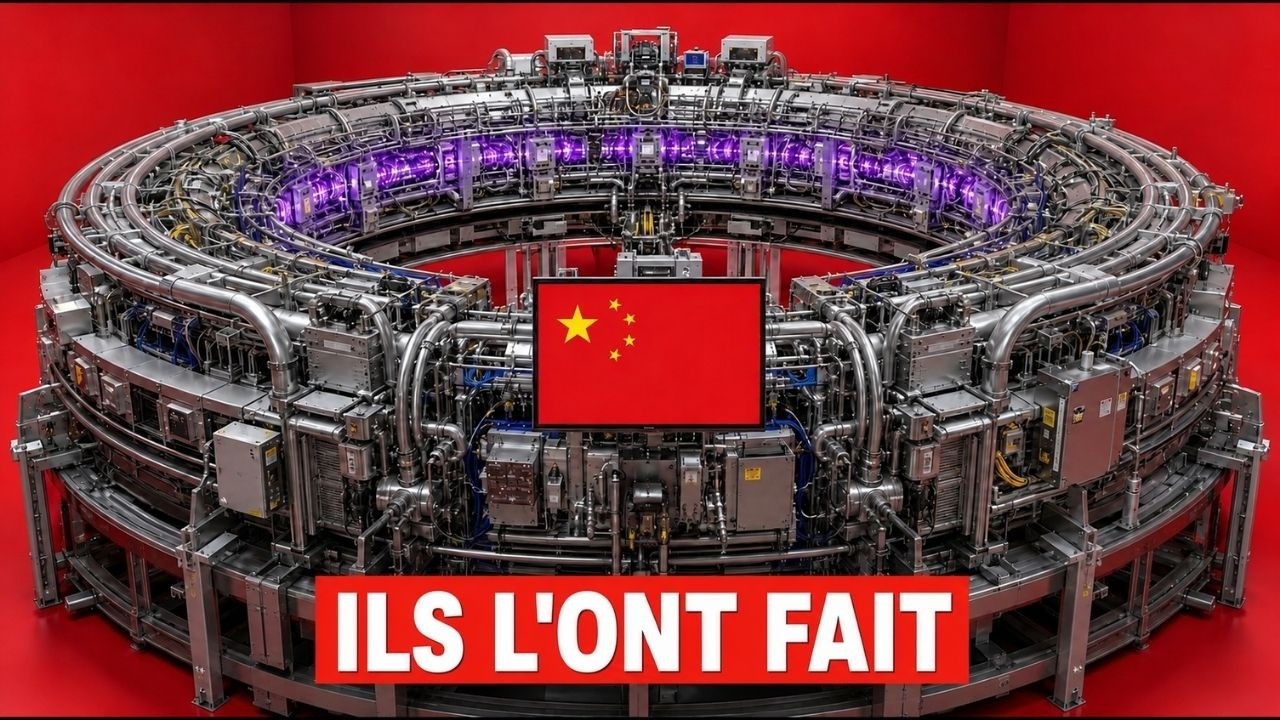
La Chine développe ce qu’ASML a le plus à craindre
China is developing what ASML fears the most
Title history
- La Chine développe ce qu’ASML a le plus à craindre — observed on 20261101-0055 UTC (YouTube)
Keywords
Summary
195 words
Critical Evaluation
Value of the Information & Strength of the Argument
The video provides valuable insight into a lesser-known emerging technology (SSMB) and explains its potential to disrupt the semiconductor industry. The argumentation is solid: it clearly describes the current EUV source limitations, presents the SSMB concept with its theoretical advantages, and supports its claims with references to a published experiment in Nature. The reasoning is logical and avoids sensationalism, appropriately highlighting both the promise and the significant obstacles. The video effectively argues that even if SSMB takes a decade to materialize, the mere possibility undermines the ‘unassailable’ status of ASML’s monopoly. The use of analogies and clear explanations strengthens the argument without oversimplifying the core physics.
Scientific Rigor, Source Quality, Title Accuracy
The scientific rigor is commendable: the video accurately explains the EUV plasma source mechanics and the SSMB concept, and it correctly cites the 2021 Nature paper as a proof-of-principle. It also credits the original proposers (Chao and Ratner) and mentions the Berlin experiment, showing attention to historical accuracy. The sources are primarily the Nature publication and public scientific knowledge; no external references are given in the description, but the video’s content aligns with known research. The title accurately represents the content and does not overstate the current status. The description includes a disclaimer about simplification, which is appropriate for a general audience. Overall, the video maintains a responsible balance between enthusiasm and skepticism.
234 words
Title / Content Match
The title accurately reflects the content, focusing on China's development of a technology that threatens ASML's monopoly.
Quality & Reliability
7/10
The video presents a well-researched overview of ASML's EUV technology and the alternative SSMB approach, citing a Nature paper and known academic research. It explains complex concepts clearly and acknowledges uncertainties, though some simplifications are made for a general audience.
Key Moments
Markers derived by PSI from the transcript: the creator did not define chapters.
- Introduction: ASML's monopoly and the mystery of EUV light.
- Explanation of ASML's tin plasma source and its complexity.
- Introduction of SSMB concept and its potential advantages.
- Discussion of the 2021 Berlin experiment and its significance.
- Challenges facing SSMB and its possible impact on ASML's future.
Cited Sources
- Nature publication on SSMB proof-of-principle (2021) — Cited as the experimental demonstration of SSMB in Berlin, published in Nature.
- Concept of SSMB by Alexander Chao and Daniel Ratner — Credited with proposing the central SSMB concept around 2010.
Concurring Sources
- Nature paper on SSMB (2021) — The video's central claim about a successful proof-of-principle aligns with this published research.
Contribution & Novelties
This video offers a clear and accessible synthesis of the SSMB technology and its potential to challenge the ASML monopoly, a topic rarely covered in mainstream tech media. It adds value by comparing the two approaches (plasma vs. accelerator) in terms of power, maintenance, and scalability, and by contextualizing the geopolitical implications for semiconductor supply chains.
Pour aller plus loin :
- Extreme ultraviolet lithography — Provides background on EUV technology and its challenges.
- Synchrotron light source — Explains the physics of electron storage rings, relevant to SSMB.
- ASML Holding — Overview of ASML’s market position and history.
97 words
Radar Profile
The radar profile shows strong scores in quantity and quality of information, with slightly lower technical depth and reliability. This indicates a video that is informative and well-sourced but may simplify some engineering details, which is expected for a broad audience. The balance suggests a trustworthy educational content.