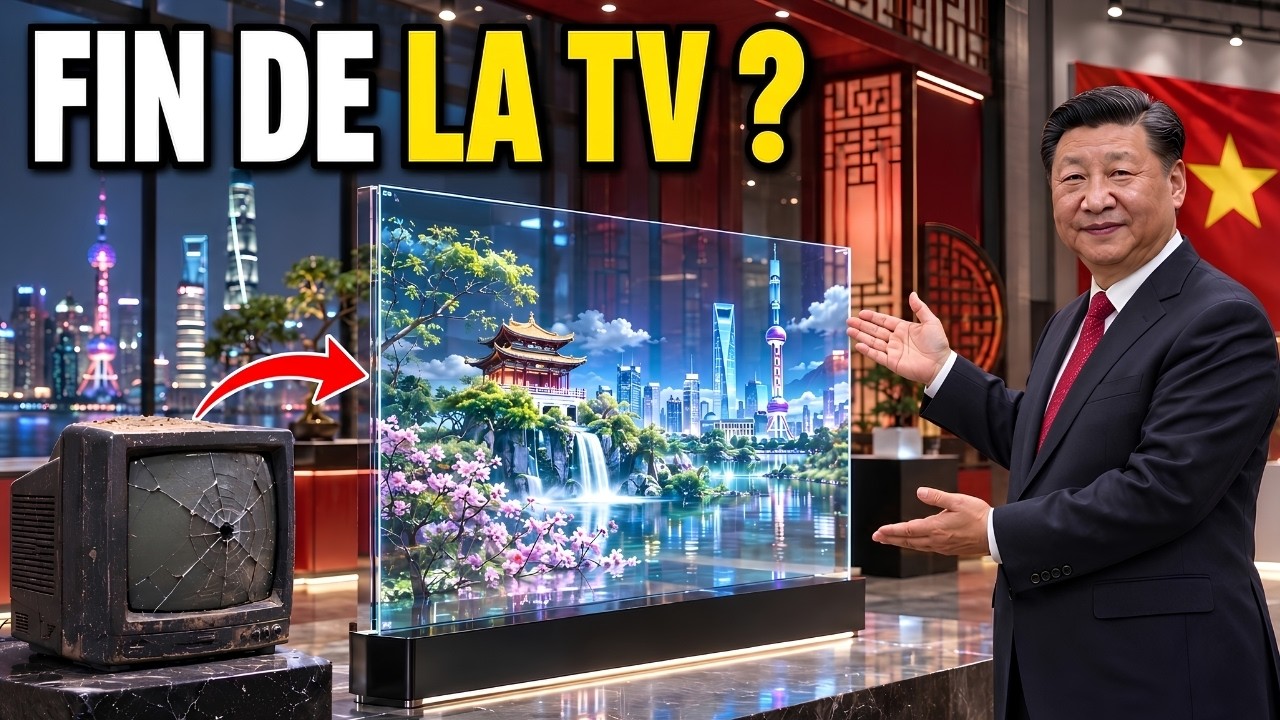
La nouvelle technologie TV chinoise pourrait rendre les téléviseurs classiques obsolètes
New Chinese TV technology could make traditional televisions obsolete
Keywords
Summary
200 words
Critical Evaluation
Value of the Information & Strength of the Argument
The video provides solid value by explaining the technical intricacies of OLED manufacturing, from the traditional fine metal mask process to the novel inkjet printing method. It presents a balanced argument: on one hand, the potential cost savings and efficient material use; on the other, the significant hurdles of drying uniformity, yields, and the historical failure of JOLED. The argumentation is logical, avoiding hype by emphasizing that the claim of making traditional TVs obsolete is premature. The video uses concrete examples (Lenovo laptop, TCL’s factory) and statistical comparisons (30% to 90% material utilization), which strengthens its credibility. However, some technical details are simplified for a general audience, which might reduce depth for specialists.
Scientific Rigor, Source Quality, Title Accuracy
Scientific rigor is moderate: the video cites public reports and mentions specific companies (TCL, JOLED, LG, Samsung) and events (JOLED’s bankruptcy in 2023, TCL and Sony joint venture in 2026), but no formal sources are listed in the description. The content appears well-researched and consistent with common industry knowledge, but the lack of primary references limits verifiability. The title is somewhat sensationalist (‘could make traditional TVs obsolete’), while the content correctly points out that the technology is still in early stages and faces major challenges, which is a slight mismatch. Overall, the presentation is informative and technically sound, but rigorous source citation is missing.
232 words
Title / Content Match
The title suggests a radical shift, but the content nuances by explaining that traditional TVs may not be immediately obsolete, focusing on manufacturing innovations. Adequacy is good but slightly overstated.
Quality & Reliability
7/10
The video is based on public reports and product information, with a clear presentation of technical details and challenges. It does not cite direct sources in the description but references known companies and events, which enhances its credibility, although some claims are simplified.
Key Moments
Markers derived by PSI from the transcript: the creator did not define chapters.
- Introduction: first foldable 65-inch 8K OLED printed by inkjet, setting the stage for a breakthrough.
- Lenovo Legion R9000P laptop with 16-inch high-OLED display from TCL CSOT, highlighting the inkjet-printed sub-pixels.
- Explanation of the fine metal mask method and its size limitation due to gravity, leading to high costs.
- TCL's inkjet approach: depositing picoliter droplets into pixel wells, with the challenge of uniform drying.
- JOLED's failure as a cautionary tale, with bankruptcy in 2023, despite initial promise.
- TCL's new Guangzhou factory (T8) targeting 22,500 substrates per month, focusing on laptops and monitors first.
- Comparison with LG's FLEX technology, and the debate on whether the industry is shifting from quality to cost efficiency.
Cited Sources
- TCL CSOT — Mentioned as the manufacturer of the inkjet-printed OLED panels and the main subject of the video.
- JOLED — Japanese company that failed in inkjet-printed OLED; its bankruptcy is discussed as a lesson.
- LG Display FLEX technology — Cited as a competitive innovation announced in August 2026.
- Samsung and Sony — Mentioned in context of market competition and the joint venture between TCL and Sony.
Concurring Sources
- OMDIA report on inkjet printing cost savings — Citing the analyst firm OMDIA's projection that inkjet printing can reduce OLED panel costs by 30-35% for laptops, as mentioned in the video.
Dissenting Sources
- Claims of immediate obsolescence — The video's central claim that Chinese technology could make traditional TVs obsolete is contradicted by its own content, which notes that no mass-produced inkjet-printed TV yet exists and LCD mini-LED remains a strong competitor.
Contribution & Novelties
The video brings original value by providing an accessible yet detailed analysis of inkjet-printed OLED technology, focusing on the manufacturing revolution rather than just the product features. It highlights a potential shift from traditional fine metal mask (FMM) to digital printing, which could significantly reduce costs and material waste, potentially democratizing high-end displays. The narrative is well-contextualized with historical examples (JOLED) and modern competitive dynamics (LG’s FLEX).
Pour aller plus loin :
- OLED — General background on OLED technology and types, useful to understand the differences discussed.
- Inkjet printing — Overview of the printing technique applied to industrial manufacturing.
- Fine metal mask — Explanation of the traditional method, its limitations, and evolution in display fabrication.
- TCL CSOT — Company context, though the specific subsidiary may not be covered, this gives insight into TCL’s broader business.
135 words
Radar Profile
The radar reveals a balanced profile with high scores in information quantity (8) and technical level (7), indicating a content-rich video. However, the lower reliability (6) reflects the absence of direct sources, which slightly reduces the trustworthiness. The overall shape suggests a good educational effort with room for improvement in source citation.