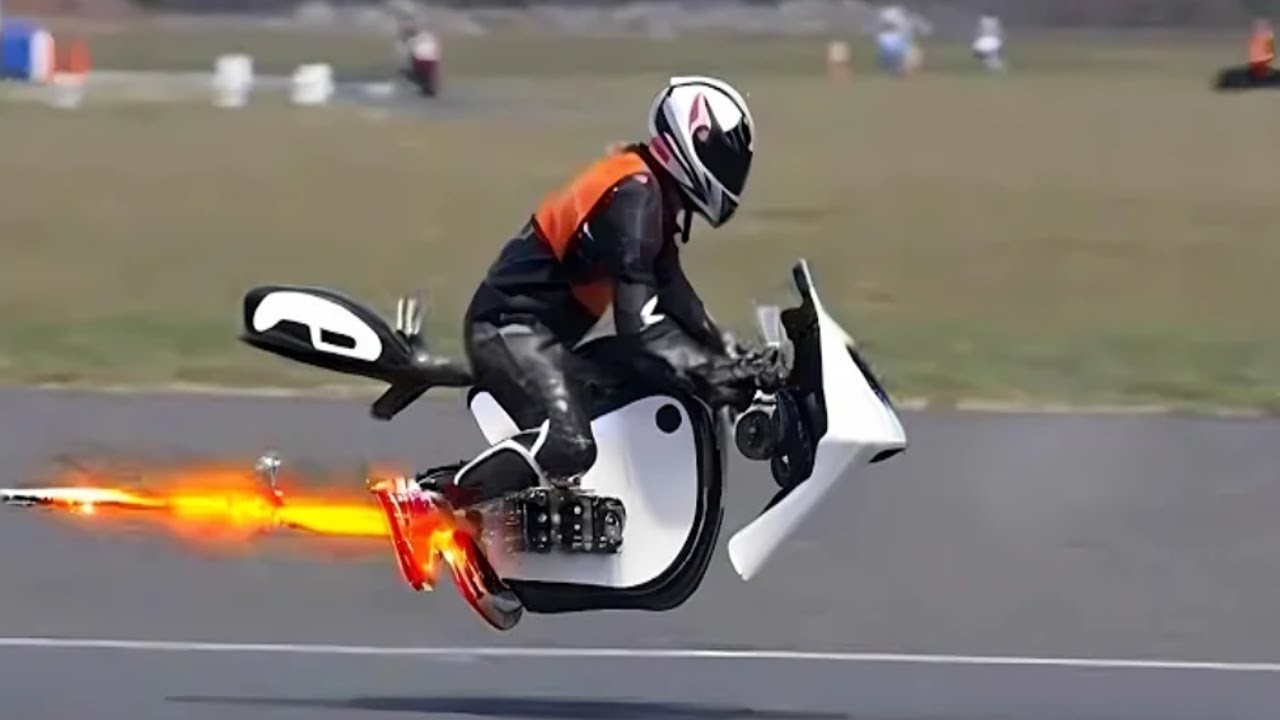
La Chine vient de créer une moto qui pourrait changer le voyage pour toujours !
China Just Created a Motorcycle That Could Change Commuting Forever!
Title history
- La Chine vient de créer une moto qui pourrait changer le voyage pour toujours ! — observed on 20261117-1524 UTC (YouTube)
Keywords
Summary
152 words
Critical Evaluation
Value of the Information & Strength of the Argument
The video provides a balanced overview of the Homo X’s potential and limitations. It effectively presents the engineering challenges of self-balancing, using the analogy of balancing a broom, and places the innovation in the context of China’s evolving motorcycle industry. The argumentation is coherent, acknowledging both promises and practical hurdles such as cost, autonomy, and maintenance. However, it relies heavily on company statements and lacks independent testing data or expert interviews. The narrative maintains a critical perspective, noting that demonstrations are not equivalent to real-world reliability, which adds to its credibility. The value lies in informing viewers about a novel technology while tempering expectations.
Scientific Rigor, Source Quality, Title Accuracy
The video does not cite specific scientific sources or provide links in the description. It references Honda’s Riding Assist, BMW’s research motorcycle, and mentions US statistics on motorcycle fatality risks, but without precise references. The situational context about Chinese manufacturers (CFMoto, Niu, Yadea) is presented as general knowledge. The title is somewhat sensationalist but accurately reflects the content’s scope. The lack of verifiable references and reliance on company announcements reduces scientific rigor. The video does, however, distinguish between corporate promises and proven facts, which is a positive point. Overall, the sources are not robust, and the title slightly overstates the potential impact.
221 words
Title / Content Match
The title is somewhat hyperbolic but accurately reflects the content, which presents a self-balancing motorcycle as a potential game-changer. It aligns well with the video's focus.
Quality & Reliability
5/10
The video is mostly based on company announcements and general context, without independent verification. It provides some factual background but lacks specific scientific sources or expert validation. The tone is narrative and sensationalist, which reduces reliability.
Key Moments
Markers derived by PSI from the transcript: the creator did not define chapters.
- Introduction to the Homo X and its self-balancing feature.
- Description of the motorcycle's features: adaptive cruise control, blind-spot detection, low-speed balance assist, automated parking, and call function; modular platform.
- Discussion on China's industrial advantages, including history of motorcycle manufacturing and battery industry.
- The physics of balancing a motorcycle, analogy from Honda and BMW concepts.
- Indonesia as the first market, its importance for two-wheelers, and the challenges of cost, range, and repairability.
- Potential impact on urban mobility and the question of rider acceptance; conclusion.
Cited Sources
- Honda Riding Assist concept (2017) — Mentioned as a prior self-balancing motorcycle concept presented at CES.
- BMW driverless motorcycle research — Referenced as an earlier research project demonstrating autonomous riding.
- CFMoto, Niu, Yadea, KTM — Cited as examples of Chinese manufacturers improving quality and partnering with global brands.
- US traffic safety data on motorcyclist fatalities — Mentioned to illustrate the higher fatality risk per mile, ratio >20x passenger cars.
Contribution & Novelties
The video contributes to public awareness of an emerging Chinese innovation in electric motorcycles, specifically the Homo X, which integrates AI and sensor-based stabilization into a practical vehicle. It places the development within the broader context of China’s industrial capability, distinguishes it from earlier concepts by Honda and BMW, and critically assesses feasibility. The main novelty is the presentation of a potential production-ready self-balancing motorcycle, contrasting with mere prototypes.
Pour aller plus loin :
- Self-balancing motorcycle — This article covers gyroscopic stabilization principles, relevant to understanding the technology, though it focuses on unicycles.
- Electric motorcycles — Overview of electric two-wheelers, their market and technology, providing background on the EV transition.
- Advanced rider assistance systems — While not a direct page, the concept is relevant; I could not verify an exact URL, so it is mentioned by name only.
138 words
Radar Profile
The radar profile shows moderate scores across quantity, quality, technical level, and reliability. The video performs best on information quantity and technical level, reflecting a decent overview of the technology and challenges. Reliability is lower due to reliance on company claims and lack of independent verification. This balance indicates a documentary that informs but does not deeply substantiate.