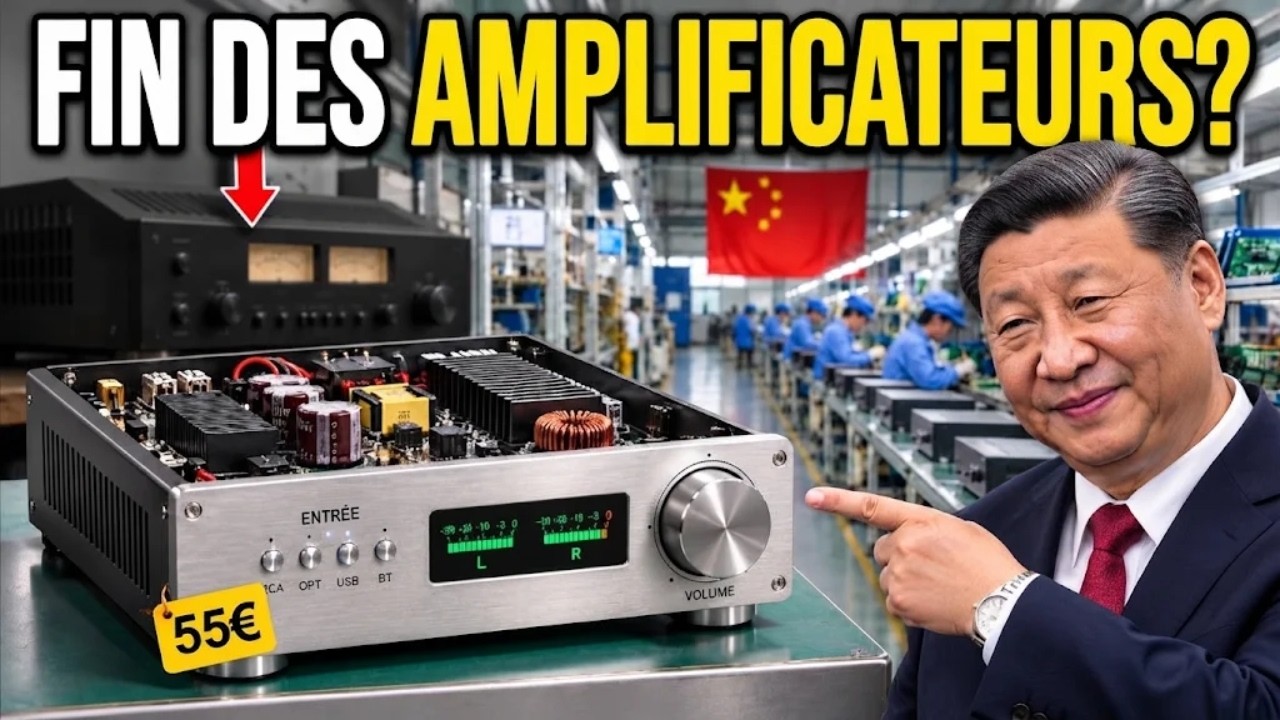
Les amplis chinois à $55 viennent d'écraser l'empire à $1 milliard de Denon & Marantz—Voici pourquoi
$55 Chinese Amps Just Crushed the $1 Billion Denon & Marantz Empire—Here’s Why
Title history
- Les amplis chinois à $55 viennent d'écraser l'empire à $1 milliard de Denon & Marantz—Voici pourquoi — observed on 20261115-1055 UTC (YouTube)
Keywords
Summary
180 words
Critical Evaluation
Value of the Information & Strength of the Argument
The video provides a compelling synthesis of technical and business perspectives, weaving together chip specifications, independent measurements, and corporate financial data. Its argumentation is structured logically: it establishes the historical context of hi-fi as a symbol of craftsmanship, introduces class-D technology as a disruptive innovation, presents test results that demystify the ‘magic’ of expensive amplifiers, and then analyzes the market consequences through the lens of Sound United’s acquisition and devaluation. The use of concrete numbers (SINAD, efficiency percentages, transaction amounts) strengthens the narrative, though the transition from technical superiority to business impact could be more nuanced. The video acknowledges counterpoints (limitations, regulatory changes) but ultimately makes a persuasive case that the value proposition of traditional audio brands has eroded. The style is accessible yet informative, avoiding oversimplification while remaining engaging.
Scientific Rigor, Source Quality, Title Accuracy
The video references several external sources, including Audio Science Review (specifically for SINAD measurements), Texas Instruments (TPA3255 chip specifications and launch date), and the U.S. Federal Trade Commission (2024 rule changes on amplifier power ratings). However, no direct links or citations are provided in the description, so the viewer cannot readily verify these references. The claims about corporate finances are plausible and align with public reporting on Masimo’s acquisition and divestiture of Sound United, but the video does not cite specific financial filings or news articles. The title, while attention-grabbing, accurately reflects the central theme of disruption and value decline, though it overstates the causal link (‘écraser’ implies direct destruction) by simplifying a complex situation. Overall, the content demonstrates reasonable research but lacks formal source attribution, limiting its scientific rigor. The lack of comments makes public reception unknown.
283 words
Title / Content Match
The title is somewhat hyperbolic but accurately reflects the core narrative about cheap Chinese amps impacting Denon/Marantz's parent company.
Quality & Reliability
6/10
The video presents specific figures (SINAD, prices, acquisition amounts) but lacks direct citations and has a sensationalist tone. Some claims are plausible but unverifiable without external sources.
Key Moments
Markers derived by PSI from the transcript: the creator did not define chapters.
- Introduction: the premise of $55 Chinese amps vs Denon & Marantz empire
- History of Marantz and Denon, early hi-fi as craftsmanship
- Explanation of class AB inefficiency and the conceptual shift to class D
- Introduction of TPA3255 chip and its efficiency specs
- Shenzhen ecosystem and rise of brands like Aiyima and Fosi Audio
- Measurements from Audio Science Review: SINAD values of cheap amps
- Limitations: power rating inflation, lack of features, warranty issues
- Why Denon/Marantz can't simply make $60 amps: ecosystem and brand economics
- Business story: Sound United acquisition by Masimo and subsequent loss
- Sale to Harman for $350 million, arithmetics and conclusion
Cited Sources
- Audio Science Review — Independent measurements of the Aiyima A07 and other budget amplifiers, specifically SINAD values cited.
- Texas Instruments - TPA3255 — Chip specifications and release date, efficiency claims up to 90%.
- Federal Trade Commission (FTC) - Amplifier Power Rule — 2024 update on amplifier power advertising rules mentioned.
Contribution & Novelties
The video’s original contribution lies in connecting technical specifications (class-D efficiency, SINAD measurements) directly to corporate valuation, showing how a commodity component can disrupt an industry’s pricing structure. It offers a clear narrative that quantifies the decline in value of traditional audio brands using real acquisition numbers (Masimo’s purchase and Harman’s rescue), and frames it within the historical context of hi-fi as a ‘symbol of commitment’.
Pour aller plus loin :
- Class-D amplifier — Understand the technical principles behind the efficiency gains.
- SINAD — Learn about the signal-to-noise-and-distortion ratio used to evaluate audio quality.
- Masimo Corporation — Explore the company that bought Sound United and its strategic misstep.
108 words
Radar Profile
The radar profile shows a moderately high score in information quantity and quality, with a somewhat lower but still reasonable technical level and global reliability. This indicates a content that is informative and accessible, but with room for more rigorous sourcing and deeper technical nuance.