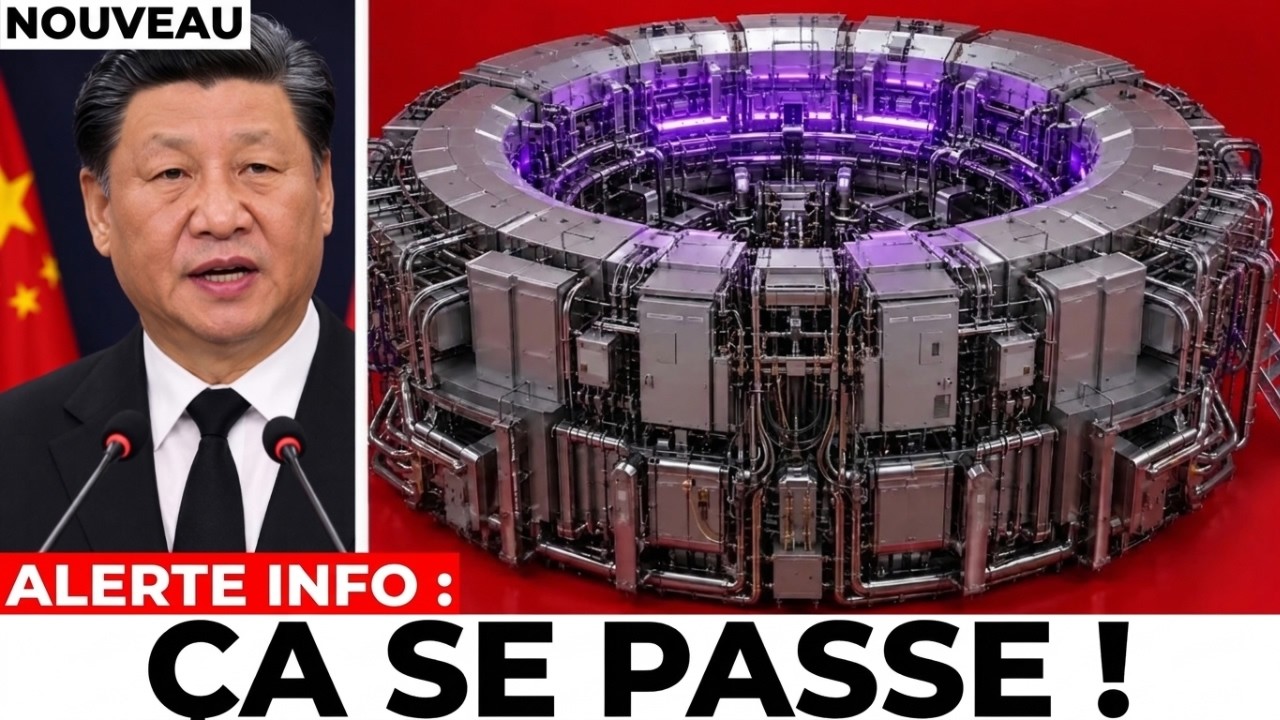
La Chine vient de construire ce qu'ASML redoutait le plus — Et avec des années d'avance
China just built what ASML feared most — And years ahead of schedule
Keywords
Summary
207 words
Critical Evaluation
Value of the Information & Strength of the Argument
The video provides substantial technical detail on both ASML’s EUV source and the SSMB concept, making it informative for a technical audience. It argues logically that the SSMB, as proven by the Berlin experiment, demonstrates a viable physical pathway that could eventually bypass ASML’s plasma-based monopoly. The argument is structured: it first establishes why ASML’s source is so hard to replicate, then explains how SSMB sidesteps the problem, and finally discusses the bottlenecks and remaining uncertainties. The reasoning is generally sound, although it tends to overstate the near-term impact of SSMB, which is still in early experimental stages. The video also benefits from including counterpoints, such as the ‘yield gap’ and the enormous infrastructure required, showing a balanced perspective.
Scientific Rigor, Source Quality, Title Accuracy
The video references a specific Nature publication (February 2021) and correctly attributes the initial SSMB idea to American physicist Alexander Chao and student Daniel Ratner, with Chinese contributions from Tinghua, and emphasizes that the decisive experiment was performed at Berlin’s Metrology Light Source. It does not provide direct URLs but the transcript mentions enough details to identify the work. The title is somewhat sensationalist (‘China just built what ASML feared most’) though the video makes clear the Chinese work is a prototype and the actual breakthrough came from Germany. This mismatch is minor and the content aligns with the title’s overall message about emerging alternatives. No third-party sources are cited beyond the Nature paper and general knowledge, but the video’s educational disclaimer and simplified presentation are appropriately flagged.
262 words
Title / Content Match
The title is catchy but accurate: it highlights China's progress on an EUV alternative (SSMB) and frames it as a threat to ASML, which matches the content.
Quality & Reliability
7/10
The video bases its core claims on a peer-reviewed Nature publication (2021) and describes the SSMB concept accurately, but it speculates on timelines and the impact on ASML's monopoly with a sensationalist tone. Simplifications are acknowledged.
Key Moments
Markers derived by PSI from the transcript: the creator did not define chapters.
- Introduction to ASML's monopoly and the machine size/cost.
- Description of ASML's tin droplet plasma source and its complexity.
- Introduction of the Tsinghua Nature paper and the SSMB concept.
- Explanation of the SSMB principle and the 'lithography cannon' idea.
- Discussion of the Berlin experiment, remaining challenges, and Xlite startup.
Cited Sources
- Nature paper on SSMB (February 2021) — Reported on experimental proof of steady-state microbunching at Berlin's Metrology Light Source.
- Tsinghua University research team led by Prof. Chuan Xiang Tang — Published a theoretical proposal for SSMB in Nature.
Concurring Sources
- Nature 2021 SSMB paper — Supports the claim that SSMB is physically feasible, as cited in the video.
Contribution & Novelties
The video adds value by clearly explaining the SSMB concept and its potential to disrupt ASML’s dominance, while also warning that it remains unproven at industrial scale. Its novelty lies in synthesizing technical and geopolitical aspects of the EUV race, making the topic accessible without oversimplifying the physics.
Pour aller plus loin :
- Extreme ultraviolet lithography — Overview of EUV lithography and ASML’s technology.
- ASML (company) — Background on ASML’s history and market position.
- Particle accelerator — Explanation of the physics behind SSMB.
- Steady-state microbunching (SSMB) — No reliable URL found; further reading via academic sources is recommended.
98 words
Radar Profile
The scores indicate a balanced profile with high technical depth and information density, but slightly lower reliability due to speculative elements and a sensationalist framing. The strong scores in 'quantite_information' and 'niveau_technique' reflect the in-depth explanation, while 'fiabilite_globale' is moderately high given the reliance on a peer-reviewed source.