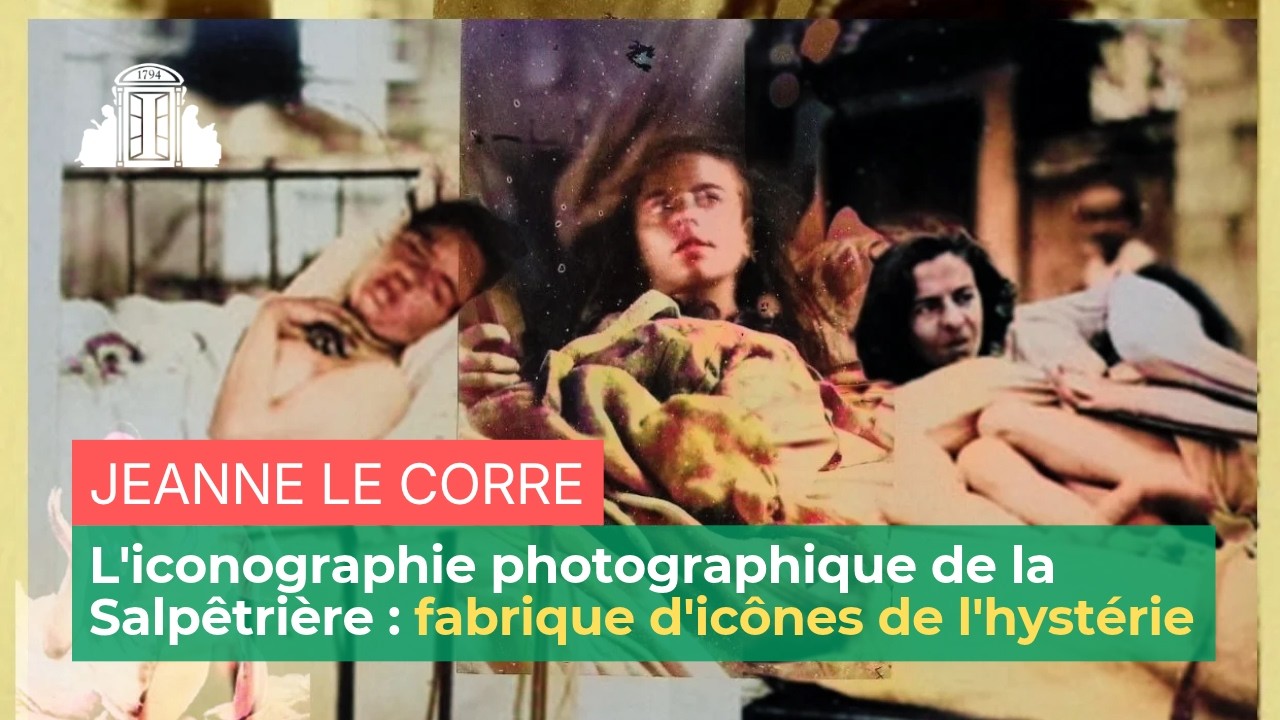
L'iconographie photographique de la Salpêtrière : fabrique d'icônes de l'hystérie | ENS-PSL
The Photographic Iconography of the Salpêtrière: Manufacturing Icons of Hysteria | ENS-PSL
Title history
- L'iconographie photographique de la Salpêtrière : fabrique d'icônes de l'hystérie | ENS-PSL — observed on 20261115-1639 UTC (YouTube)
Keywords
Summary
141 words
Critical Evaluation
Value of the Information & Strength of the Argument
The presentation offers a coherent and original argument, particularly in its reversal of the traditional view: rather than seeing the women as inherently hysterical, Le Corre suggests that the medical and photographic gaze constructs them as such. She supports this with references to Didi-Huberman and Legrand, though thèse arguments remain concise and would benefit from deeper development. The use of examples from the iconography helps illustrate her points, but the brevity of the talk limits the depth of the analysis.
Scientific Rigor, Source Quality, Title Accuracy
The talk cites key scholarly works, notably Didi-Huberman’s ‘L’invention de l’hystérie’ and Legrand’s research, but without precise page references or publication details. The sources mentioned in the description are institutional links (ENS, Savoirs) rather than specific academic references. The title aligns well with the content, which actually focuses on the construction of iconographic images of hysteria. However, the scientific rigor is moderate due to the lack of detailed citations and the informal tone of the presentation.
171 words
Title / Content Match
The title accurately describes the content, which focuses on how photographs from Salpêtrière contributed to constructing hysteria as a female pathological identity.
Quality & Reliability
6/10
The talk is based on a master's thesis that references established scholars (Didi-Huberman, Legrand), but the presentation is brief and the arguments are not deeply developed.
Key Moments
Markers derived by PSI from the transcript: the creator did not define chapters.
- Introduction and explanation of personal background
- Definition of the photographic iconography and its context
- Discussion of Charcot's goal and the gendered etymology of hysteria
- Didi-Huberman's theory on the image overshadowing the concept
- Mention of Julia Legrand's study on hysteria in modern psychiatry
- Conclusion and articulation of the original perspective
Cited Sources
- Savoirs - ENS — Institutional platform hosting the video and related academic content.
- ENS-PSL official site — Official school website mentioned in the description.
- ENS-PSL LinkedIn — Institutional LinkedIn page included in the description.
- ENS-PSL YouTube channel — Channel that hosts the video, referenced in the description.
- L'invention de l'hystérie (book) — Georges Didi-Huberman's book cited in the talk as a key reference.
Contribution & Novelties
Le Corre’s main contribution is to invert the traditional reading of the Salpêtrière iconography: instead of seeing these images as documents of a female pathology, she argues that the gaze itself is hysterical, effectively constructing the women as such. This feminist re-appropriation offers a fresh perspective on historical medical imagery.
Pour aller plus loin :
- Hysteria on Wikipedia — Provides background on the medical and cultural history of hysteria.
- Georges Didi-Huberman — The philosopher and art historian whose work on the Salpêtrière images is central to the talk.
- Pitié-Salpêtrière Hospital — Historical context of the hospital where the photographs were taken.
101 words
Radar Profile
The profile shows a balanced but moderate approach: scores for information quantity and quality are similar, while technical level is slightly lower, reflecting the accessible nature of the talk. Reliability is moderate, consistent with a student presentation that relies on established scholars but lacks detailed citations.